Roughly 15,000 Indonesian students study in China. Degrees from MOE-accredited Chinese universities pass Indonesia’s Penyetaraan Ijazah (degree equivalency) process, which takes 5 working days online and costs nothing. The real value of the degree depends on your field and what you do after: engineering grads who speak Mandarin walk into a job market where hundreds of Chinese companies in Indonesia are actively hiring. Medicine is viable but heavily regulated. A business degree from a university nobody has heard of adds less than one from Universitas Indonesia. The degree is recognized. Whether it pays off is a question you answer by choosing your major and your university carefully.
1. The official recognition story: Penyetaraan Ijazah
Indonesia recognizes foreign degrees through Penyetaraan Ijazah Luar Negeri (foreign degree equivalency), managed by the Ministry of Higher Education, Science, and Technology (Kemendiktisaintek). Without this certificate, your Chinese degree carries no formal weight for government jobs, civil service applications, or further study at Indonesian public universities.
The process runs entirely online through the PILN portal at piln.kemdiktisaintek.go.id. Processing time: 5 working days once your documents are complete. No fee.
Documents you will need:
- Scanned diploma from your Chinese university
- Scanned transcripts
- Passport biodata page and visa/stamp pages
- Birth certificate (Akta Kelahiran)
- Photo (4×6 cm, color)
- Verification letter from the Indonesian embassy in China or Chinese embassy in Indonesia confirming your study status
Real bottleneck: The embassy verification letter. The Indonesian embassy in Beijing and consulates in Guangzhou, Shanghai, and Hong Kong need to confirm your enrollment with your university. Budget 2–3 months for the full timeline, not just the 5 working days Kemendiktisaintek quotes for processing.
Before you pick a university: Kemendiktisaintek does not publish a master list of recognized foreign universities. Equivalency is evaluated case by case. Degrees from universities accredited by China’s Ministry of Education are almost always recognized. If your university sits in China’s top 100 nationally, recognition is routine. If it is a provincial college you have only seen in an agent’s brochure, verify before you enroll.
2. Medicine: the degree most Indonesians go to China for
Medicine is the single most popular field for Indonesian students in China. It is also the most regulated when you come back.
In addition to Penyetaraan Ijazah, medical graduates need registration with Konsil Kedokteran Indonesia (KKI) to practice. After equivalency, you must pass the Uji Kompetensi Mahasiswa Program Profesi Dokter (UKMPPD), Indonesia’s national medical competency exam, before registering as a doctor.
A development worth knowing: Indonesia’s KKI tightened its recognition process for foreign medical degrees in 2023–2024. Chinese medical programs were not singled out, but the direction is clear. Regulatory oversight of all foreign medical qualifications is getting stricter. By 2026, the situation has stabilized, but the message holds: check the latest KKI requirements for your specific university before you commit. Do not rely on agent promises.
There are currently 45 Chinese universities authorized by China’s Ministry of Education to offer MBBS in English, with a total enrollment quota of 2,740 seats for 2025/2026. For Indonesian students, English-medium programs are the most realistic path. Studying medicine in Mandarin adds a year or more of language prep and makes the UKMPPD harder since the exam is in Indonesian.
The clinical gap is real. Chinese teaching hospitals give international students less hands-on patient time than Indonesian medical faculties do. You will fill this gap during your internship (koas) back in Indonesia. Plan for it.
For engineering, architecture, and other regulated professions, the pattern is the same: Penyetaraan Ijazah first, then registration with the relevant Indonesian body: Persatuan Insinyur Indonesia (PII) for engineers, Ikatan Arsitek Indonesia (IAI) for architects, and so on.
3. The economic advantage: China is Indonesia’s biggest partner
This is where the story gets stronger than most Indonesian families realize.
China is Indonesia’s largest trading partner, accounting for 23.8% of Indonesian exports and 40% of imports. Chinese FDI into Indonesia reached USD 5.4 billion in the first three quarters of 2025 alone. Add Hong Kong and Taiwan, and Greater China investment approaches USD 12.7 billion, consistently among the top three FDI sources into Indonesia.
These are not abstract numbers. They are thousands of Chinese companies operating in Indonesia, hiring across every major sector:
| Sector | Chinese presence | Example |
|---|---|---|
| Nickel & battery | Controls ~75% of Indonesia’s refining capacity | CATL USD 6B Karawang plant, 35,000 jobs projected |
| Electric vehicles | Multiple manufacturing plants | BYD USD 1B Subang facility; Wuling, Chery, Neta |
| Infrastructure | Major contractor and investor | Jakarta-Bandung HSR, Nusantara (IDR 70T+ in Chinese commitments) |
| Green energy | Solar, hydro, geothermal | Trina Solar, LONGi Green Energy factories |
| Digital & tech | E-commerce, fintech, cloud | Huawei, ZTE, Alibaba Cloud, Tencent |
| Consumer goods | Manufacturing and retail | Xiaomi, Oppo, Vivo, Haier |
In April 2024, more than 30 Chinese companies gathered in Jakarta with over 80 Indonesian educational institutions to discuss connecting Indonesian graduates with Chinese employers. In May 2025, 24 Chinese companies held a job fair at Universitas Sumatera Utara in partnership with the China-Indonesia Cultural and Educational Exchange Association. Bank of China participated in the 2025 “Study Beijing” education fair in Jakarta specifically to talk to Indonesian students about careers.
What this means: a graduate with a Chinese degree who speaks Mandarin and understands how Chinese companies work walks into a job market where a large and growing category of employers actively wants exactly that profile. The degree is not about “studying in China.” It is about becoming hireable by hundreds of Chinese companies already operating in Indonesia.
4. By degree type: which ones travel best
Engineering and technology
Recognition: strong. Employment: very strong.
Chinese engineering degrees from C9 and Project 211 universities are competitive globally. The China-Indonesia infrastructure story. Jakarta-Bandung HSR, Nusantara development, nickel processing. This has created visible demand for engineers who understand Chinese technical standards and can operate across both languages. PII registration through Penyetaraan Ijazah is routine for graduates of recognized Chinese universities.
Cost and language: International tuition at public Chinese universities runs roughly USD 2,000-4,500 per year for bachelor’s and USD 3,500-8,500 for master’s, according to CUCAS. Many programs are English-taught, especially at the 279 universities designated to host CSC students. China’s Ministry of Education requires HSK 5 for Chinese-taught degrees and HSK 3-4 for English-taught degrees by graduation.
Medicine
Recognition: increasingly regulated. Employment: exam-dependent.
China remains the most affordable path to an MBBS for Indonesian students locked out of domestic public medical faculties. But the UKMPPD is the only gate that matters. Pass rates vary by university and individual preparation. Look for universities that have sent multiple cohorts of Indonesian graduates through the UKMPPD. A documented track record is your safest signal.
Business, economics, and management
Recognition: university-dependent. Employment: Mandarin is the multiplier.
A degree from Tsinghua, Peking, or Fudan carries weight in Indonesian corporate hiring. A degree from a mid-tier provincial university carries less than one from Universitas Indonesia or UGM. The value flips if you add Mandarin. A bilingual business graduate is hireable by Chinese companies in Indonesia in ways a monolingual graduate is not.
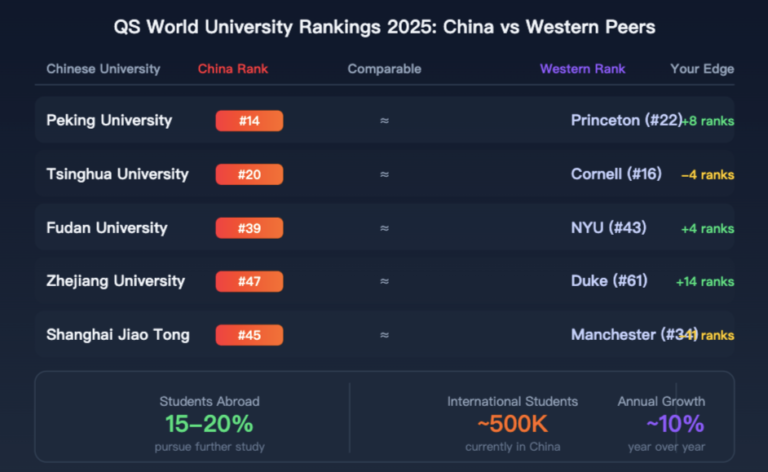
Why prestige shows up in the numbers: In the QS World University Rankings 2026, five mainland Chinese universities sit in the global top 50: Peking University (#14), Tsinghua (#17), Fudan (#30), Shanghai Jiao Tong (#47), and Zhejiang (#49). Thirty-three mainland universities appear in the QS top 500. Indonesian employers who know little about Chinese universities respond to these rankings, so lead with them when you present your degree.
Mandarin and Chinese studies
Recognition: not about the certificate. Employment: directly tied to fluency.
This degree is evaluated by whether you can actually read, write, and speak Chinese at a professional level. As Chinese investment deepens, companies need Indonesians who can negotiate contracts, translate technical documents, manage cross-cultural teams, and handle government liaison in both languages. The degree is secondary. The skill is what pays.
5. What employers actually think
Employer attitudes in Indonesia break into three categories.
Government and civil service (PNS/CPNS): Bureaucratic. Penyetaraan Ijazah is the only thing that matters. If your degree clears equivalency, it is treated the same as any accredited degree for CPNS eligibility. No bias, no special treatment, just a documentation requirement.
Chinese companies in Indonesia: Strongly positive. This category actively values a Chinese degree. They know the Chinese university system, they know which institutions produce strong graduates, and they want people who bridge both business cultures. For Indonesians working at Huawei Indonesia, BYD Indonesia, Bank of China Jakarta, China Construction, Sinohydro, and hundreds of other Chinese firms, the combination of a Chinese degree and Mandarin is a concrete hiring advantage.
Indonesian private sector: Mixed, mostly about university prestige. Top Indonesian conglomerates like Astra, Sinarmas, and Djarum evaluate Chinese degrees the same way they evaluate any foreign degree: by the reputation of the institution. A Tsinghua degree is respected. A degree from a university the HR manager has never heard of faces the same skepticism as an unknown university from anywhere. Many Indonesian HR professionals simply know less about Chinese universities than the US, UK, or Australian systems. Having your Penyetaraan Ijazah ready and presenting your degree with ranking data helps close that gap.
6. The scholarship pipeline
Indonesian students access Chinese education through three main channels.
Chinese Government Scholarship (CSC): The Chinese embassy in Jakarta administers a bilateral quota for Indonesia. According to the official embassy announcement for 2025/2026, the bilateral allocation is 20 full-scholarship seats across undergraduate, master’s, and doctoral levels, focused on marine science, medicine, health, tourism, and education. This is smaller than the article previously suggested.
What a full CSC scholarship covers: tuition, on-campus housing, and comprehensive medical insurance, plus a monthly living stipend of CNY 2,500 for undergraduates, CNY 3,000 for master’s students, and CNY 3,500 for PhD students, according to the official China Scholarship Council portal. The university-direct (Type B) route is typically far larger than the 20-seat embassy quota.
However, the university-direct CSC route (Type B) is typically much larger than the bilateral quota. Chinese universities with their own CSC allocations admit Indonesian students independently. If you want a CSC scholarship, the most reliable path is to secure a pre-admission letter from a professor first, then apply through the university channel rather than relying solely on the embassy quota.
LPDP: Indonesia’s national scholarship fund can fund study in China. LPDP requires overseas applicants to gain admission to universities ranked in relevant global rankings, and many Chinese universities (especially C9 and Project 211 institutions) meet this bar. In 2025, LPDP opened a specific scholarship track with Central South University (CSU) in China, signaling growing recognition of Chinese universities within Indonesia’s own scholarship framework.
LPDP’s 2025 approved overseas university list includes Peking University, Tsinghua, Fudan, Zhejiang, Shanghai Jiao Tong, Nanjing, and the University of Science and Technology of China, which confirms that top Chinese institutions clear Indonesia’s own scholarship bar (KOMPAS).
Private and foundation scholarships: This is where Indonesia differs from many countries. The Indonesia Tionghoa Culture Centre (ITCC) in Surabaya, founded by former minister Dahlan Iskan, has sent thousands of Indonesian students to China on scholarship since 2014. These programs are open to students from all backgrounds and cover medicine, technology, economics, and business. Several Chinese provincial governments (especially Guangdong, Fujian, and Zhejiang) also run scholarships for Indonesian students, thanks to the deep trade ties between those provinces and Indonesia.
Self-funded costs: Undergraduate tuition at Chinese universities runs RMB 15,000–35,000 per year (roughly IDR 32–75 million). Medicine is on the higher end. Living costs range from RMB 1,000/month in smaller cities to RMB 2,500+/month in Beijing or Shanghai. A full four-year degree, including living expenses, costs roughly IDR 350–600 million total. Less than a single year at an Australian or US university.
A pipeline you can point to: About 1,200 Indonesians graduate from Chinese universities each year and complete degree equivalency through the KBRI Beijing SIPONI system (KBRI Beijing). One concrete industry case: since 2019, the GEM-Central South University program has trained 266 Indonesian engineers, many now working at GEM’s nickel operations in the Morowali industrial park.
7. What nobody tells you
- The timeline gap is bigger than you think. Penyetaraan Ijazah processes in 5 working days on paper, but getting the embassy verification letter and having your university respond can stretch the real timeline to 2–3 months. For medical graduates, UKMPPD scheduling adds another 6–12 months. Budget your finances and your patience accordingly.
- Mandarin adds value unevenly. In engineering, trade, and roles at Chinese companies, Mandarin is a direct salary boost. In medicine, it adds nothing. Indonesian clinical practice is in Indonesian. In government, it adds nothing unless you work in diplomacy or trade relations. Decide whether Mandarin is part of your career strategy before choosing your degree. The language investment is large. The payoff varies by industry.
- The “top university” override is real. A degree from Tsinghua, Peking, Fudan, Zhejiang, or Shanghai Jiao Tong opens doors in Indonesia that degrees from lesser-known Chinese universities do not. The name on your diploma matters more than almost any other factor in Indonesian corporate hiring. Agents selling mid-tier Chinese university programs rarely mention this.
- The self-funded math has to add up. IDR 350–600 million is a substantial investment for an Indonesian family. Engineering and technology offer much clearer ROI than humanities or social sciences because the employment pipeline into Chinese and Indonesian companies is concrete. A Chinese literature degree, without professional Mandarin fluency, does not create the same return.
| Pros | Cons and watch-outs |
|---|---|
| Recognized via Penyetaraan Ijazah (free, about 5 working days) | Embassy verification letter stretches the real timeline to 2-3 months |
| Tuition far below US or UK (USD 2,000-8,500 per year) | Self-funded total of IDR 350-600 million is a real burden for a family |
| CSC, LPDP, and provincial scholarships are available | Embassy CSC quota is only 20 seats, so competition is real |
| Hundreds of Chinese companies in Indonesia are hiring | Value depends heavily on university prestige and your major |
| Mandarin fluency is a direct career multiplier | Mandarin is a large investment that pays off unevenly by field |
| QS top-50 names such as Peking and Tsinghua open doors | Lesser-known Chinese universities need explaining in every interview |
8. Should you do it?
If you want to work for a Chinese company in Indonesia: The strongest case possible. Chinese companies in Indonesia are growing, they are recruiting, and they prefer graduates who understand both cultures. Engineering, IT, supply chain, and trade are the best degree choices. Add Mandarin and you become genuinely hard to replace.
If you want to become a doctor in Indonesia: Viable, with conditions. Verify KKI recognition for your target university before enrolling. Budget for UKMPPD preparation and the clinical gap. Know that regulation is tightening, not loosening. If you can get into an Indonesian public medical faculty, the path is simpler. If you cannot (and the competition is brutal), China remains the most realistic alternative.
If you want a government job (PNS): Fine. Penyetaraan Ijazah is the only gate that matters. Clear equivalency, and your degree is treated identically to any other accredited degree for CPNS eligibility.
If you want to work for a top Indonesian company or multinational: Go to the best Chinese university you can get into. Prestige matters. A Tsinghua degree gets taken seriously. A degree from a provincial university nobody has heard of will need explaining in every interview.
If you are not sure you will return to Indonesia: A Chinese degree plus professional Mandarin opens doors across Southeast Asia’s Chinese business networks. Singapore, Malaysia, Thailand, and Vietnam all have large Chinese corporate presences that need bilingual professionals. This career geography barely existed a generation ago. It is expanding.
The 15,000 Indonesian students already in China are not there because an agent sold them a dream. They are there because China is Indonesia’s largest economic partner, because Chinese degrees cost a fraction of Western alternatives, and because Chinese companies in Indonesia are hiring. The degree is recognized. Whether it works for you depends on what you study, where you study it, and whether you build the Mandarin skill that turns a diploma into a career.
Frequently asked questions
Is a Chinese degree recognized in Indonesia?
Yes. Indonesian graduates complete Penyetaraan Ijazah (degree equivalency) through Kemendiktisaintek’s online PILN portal. Processing takes about 5 working days and is free. Roughly 1,200 Indonesians complete this for Chinese degrees each year.
How much does it cost to study in China without a scholarship?
International tuition at public universities runs about USD 2,000-4,500 per year for bachelor’s and USD 3,500-8,500 for master’s, according to CUCAS. Living costs are modest compared with the US or UK, so the total is a fraction of a Western degree.
Can Indonesian students get a scholarship to study in China?
Yes, through several routes. The Chinese Government Scholarship (CSC) covers tuition, housing, insurance, and a monthly stipend of CNY 2,500 to 3,500. Indonesia’s LPDP fund lists top Chinese universities including Peking, Tsinghua, and Fudan. The ITCC in Surabaya and several Chinese provincial governments also offer scholarships.
Do I need to speak Mandarin to study in China?
It depends on the program. Chinese-taught degrees require HSK 5. English-taught degrees require HSK 3-4 by graduation, plus IELTS 6.0-6.5 for admission. Many degrees at the 279 CSC-designated universities are English-taught, but daily life works better with practical Chinese.
Which majors are worth it?
Engineering and technology offer the clearest return because Chinese companies in Indonesia actively hire. Medicine is viable but regulated (UKMPPD). Business pays off with university prestige plus Mandarin. Mandarin and China studies convert directly into bilingual-career value.
Can I work in Indonesia after graduating from a Chinese university?
Yes, after completing Penyetaraan Ijazah. The strongest path is roles at Chinese companies in Indonesia, such as engineering, IT, supply chain, and trade, where a Chinese degree plus Mandarin is a concrete advantage. One working example is the GEM-Central South University program that has placed Indonesian engineers in Morowali’s nickel industry.
Sources
- Kemendiktisaintek — Penyetaraan Ijazah Luar Negeri (PILN) Portal
- MOE List of 45 Universities Authorized for MBBS in English, 2025/2026
- InvestinAsia — China Investment in Indonesia: Growth, Sectors, and Outlook (Oct 2025)
- Chinese Embassy in Indonesia — 2025/2026 CSC Scholarship Application (20 seats)
- Xinhua — 30+ Chinese Companies Meet 80+ Indonesian Institutions (Apr 2024)
- USU — 24 Chinese Companies Job Fair (May 2025)
- China Culture — 15,000+ Indonesian Students in China (2023, MOE data)