You keep hearing that China is full of jobs, and maybe your own campus already feels like proof. Then you sit down with a laptop and the panic shows up. Where do I even start? Which app do people here actually open, and is LinkedIn still a thing? Will anyone hire someone who is still on a student visa? I have been in that exact spot, and the honest answer is that the Chinese job market runs on a completely different stack of apps and rules than what you knew back home. Once you learn the map, the path gets clear fast.
This piece is for international students and fresh graduates who want to stay and work in mainland China. We skip the fluff and go straight to the platforms that work in 2026, the work permit you need before any contract gets signed, how to make your resume readable to local recruiters, and the scams that quietly target newcomers. I also tell you how people I know actually landed jobs here, because the official advice and the real road are not always the same thing.

The permit comes before the search
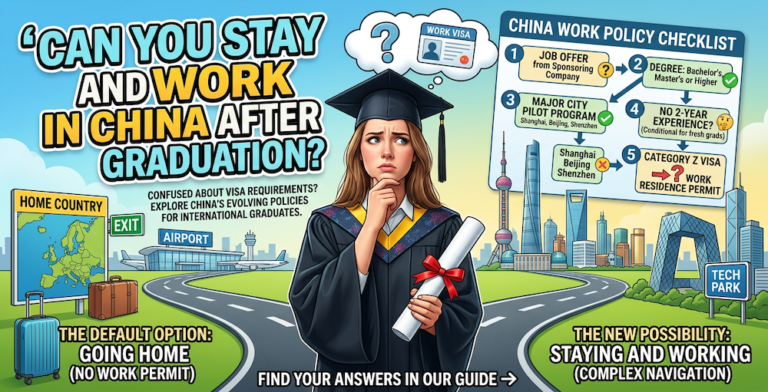
Before you open a single job app, get one fact straight. On a student visa you cannot take regular employment, and most serious employers will not even talk salary until a work authorization path is clear. The usual route is employer led. Your future company applies online through the Service System for Foreigners Working in China for a Notification Letter of Foreigner’s Work Permit. With that letter you apply for a Z visa at a Chinese embassy or consulate, enter the country, then collect the physical Foreigner’s Work Permit within 15 days and the work-type residence permit within 30 days. The Beijing government guide to foreign employment lays out the sequence step by step, and your city follows the same logic.
There is a real break for outstanding graduates of Chinese universities. A 2017 inter-ministerial notice lets a master’s graduate from a Chinese university apply for a work permit without the usual two years of prior experience, provided the job matches the field of study and the salary meets the local average urban wage. Bachelor’s graduates normally still need experience first. Your city’s exit entry bureau is the final word, so confirm the current threshold before you build a plan around it.
Where the jobs actually live now
Start with the elephant that left the room. LinkedIn’s localized Chinese app, InCareer, stopped service on 9 August 2023, and the company deleted all personal account data from it. The international linkedin.com site still loads and still helps with multinational and cross border roles, but it is no longer a primary channel for jobs based inside mainland China. If you relied on LinkedIn back home, you need a new habit, and the numbers tell you where to point it.
As of mid 2025, BOSS Zhipin had roughly 54 million monthly active users, the largest of any recruitment app in the country. Zhaopin sat around 26 million and 51job around 17 million, and those three alone accounted for the great majority of time spent on recruitment apps. Liepin targets mid-to-senior and executive roles. Maimai works like a Chinese LinkedIn for networking and referrals. All of them are mostly in Mandarin, which is the first reason a basic Chinese profile pays off.
| Platform | Primary language | Best for |
|---|---|---|
| BOSS Zhipin | Chinese | Direct chat with hiring managers, fastest replies |
| Zhaopin | Chinese | Broad white collar and graduate listings |
| 51job | Chinese and English | Established companies across industries |
| Liepin | Chinese | Mid to senior and executive roles |
| Maimai | Chinese | Networking and warm referrals |
| HiredChina | English | Foreign friendly, vetted listings |
Beyond the domestic giants, a smaller set of sites is built for expatriates and publishes English listings. HiredChina and eChinacities keep databases of foreign-friendly roles, and eChinacities is strong on teaching and ESL positions. City-specific boards such as The Beijinger for Beijing and SmartShanghai for Shanghai mix events and classifieds with jobs. The National Immigration Administration also runs an official app with job alerts and visa information in both Chinese and English. None of these replace the domestic apps for volume, but they are where many English-only roles live.
Then there is WeChat, and this is the part no guide mentions enough. The single most useful move you can make is to join WeChat groups in your field, follow company official accounts, and tell your network you are looking. Recruiters post roles in groups that never touch a job board. A friend of mine found a marketing job at a tech firm through a group he joined for a weekend football league. The hidden job market in China is larger than the advertised one, so treat your phone as a job tool, not just a chat app.
How people I know actually got hired
Let me give you three real patterns instead of theory. A Brazilian master’s graduate I know at a Shanghai university got hired through a campus recruitment drive run by her school’s international office. The employer already trusted the partnership, so the work permit paperwork moved in weeks rather than months. A Kenyan student used BOSS Zhipin daily for a month, treating it like a messaging app instead of a form, and landed interviews at three startups by chatting directly with founders. A British teaching assistant never opened a job board at all. He found his role through AmCham China events and a professor’s introduction.
The thread between them is simple. None of them waited for listings to come to them. They showed up, in person or in a group chat, and let a real relationship carry the application. If your entire strategy is refreshing a feed, you are competing with millions of strangers. If you walk into a room or a WeChat group, you are one of a few. That difference is why the same degree gets different results for different people.
Make your resume readable to Chinese recruiters
A direct translation of a Western CV reads as thin to a Chinese recruiter. Prepare both an English and a Chinese version, with a Chinese name line and a local phone number at the top. Keep it to one or two pages, lead with measurable achievements, and include any China experience even if it was short or unpaid. Recruiters on domestic platforms search with Chinese keywords, so add basic terms for your field and a line that says you speak English. Numbers beat adjectives every time. Write “grew sales 30 percent” rather than “strong commercial instinct.”
Get ready to talk total compensation, not just base pay. Packages often bundle housing stipends, bonuses, and insurance, and China’s individual income tax is progressive, reaching up to 45 percent at the top brackets. Research local salary benchmarks for your role and city before you negotiate, because the figure on the offer is rarely the figure in your pocket. A candidate who knows the local range negotiates from strength, and a candidate who guesses negotiates from fear.
Language is the quiet filter
People ask me whether they need Chinese to find work here. The fair answer is that English-only roles exist, mostly in teaching, some tech companies, and international desks at big firms, but Mandarin unlocks far more. Even a basic spoken level changes how recruiters respond, because it signals you plan to stay and you can handle the small daily frictions of an office here. If your Chinese is weak, lead with the English roles and the international companies, then keep studying. The students who struggle most are not the ones with weak Chinese. They are the ones who assume language does not matter and apply to roles that quietly require it.
The 2017 graduate route, in detail
The rule people cite without naming is 人社部发〔2017〕3号, a joint notice from the ministries of human resources and social security, foreign affairs and education (the full text is published by Beijing municipal government). It lets a foreign graduate with a master’s degree or above, earned at a Chinese university or a well-known overseas one within the past year, be hired without the two years of work experience the general route expects.
Six conditions decide it: at least 18 and in good health, no criminal record, an average grade of 80 out of 100 or B+/B or better with no misconduct record, degree and diploma in hand, a confirmed employer whose role matches your major, and a salary in principle no lower than the average wage of urban unit employees in your city, with the exact line set by the province.
The employer side is where files fail. The company must show it posted the role to domestic candidates for a full 30 days, and the route runs under a provincial quota, so a qualified candidate can still be waiting on a slot. The employment permit is issued for one year first and can be renewed up to a cumulative five years, and it is not extended if the tax you pay falls short of the salary you declared.
Read the whole thing as a schedule rather than a slogan. The one-year window, the annual quota and the 30-day posting proof all move at different speeds, and the file is strongest when the employer opens it in the month you graduate.

The traps worth naming out loud
The biggest risk for newcomers is the paid placement agency that promises a job or a visa for an upfront fee. Real recruiters are paid by the employer, never by you. Red flags include requests for cash before any interview, jobs that will not name the company, salaries far above the market, and any hint that you can work first and fix the visa later. Verify every listing on your own, and never hand over your passport or original documents to a stranger who insists it is routine.
Working without the proper permit is illegal employment under Chinese law, and the penalties are not theoretical. They can include fines, detention, and deportation, and they can cost you your residence permit. The National Immigration Administration publishes the governing regulations, and your city’s exit entry bureau decides what is allowed in your specific case. When a company says “don’t worry about the visa,” that is exactly the moment you should start worrying.
A five step start for this week
Here is the order I would follow if I were beginning today.
1. Talk to your university’s international office and career center before anything else. They know the local permit path and may already have partner employers who trust the school.
2. Build a one-page Chinese resume and get a local phone number, even a basic prepaid one, so recruiters can actually reach you.
3. Download BOSS Zhipin and one foreigner-friendly site, then join WeChat groups in your field and follow the official accounts of companies you like.
4. Confirm your work permit route with the exit entry bureau, especially if you are a master’s graduate hoping to use the experience waiver.
5. Interview, then let the employer drive the permit paperwork once you hold a real offer. Do not pay anyone to shortcut it.
Steps, not magic. The people who struggle most are those who spend months polishing a LinkedIn profile that no local recruiter opens, while the people getting hired are already chatting on BOSS Zhipin and showing up to events.
If you are on a government scholarship, the Campus China portal is your official home base for study-related services, and your international office is the first stop for any employment question tied to your residence permit. Start there, build the Chinese stack, and treat the permit as the real gate. The jobs are real. The path is just different from what you knew.

Frequently asked questions
What are the best job sites for foreigners in China?
China specific boards such as eChinacities, HiredChina, and LinkedIn China, plus university career fairs and WeChat groups, are where most international job seekers actually land roles.
Can I work on a student visa?
No. You need a proper work permit and Z visa sponsored by an employer. Some limited part time on campus work is allowed with university approval, but a full job requires switching status.
Is my degree recognised by Chinese employers?
Large employers and multinationals recognise major Chinese and foreign degrees. For regulated professions, check the relevant Chinese accreditor and whether your qualification needs verification.
Can I work in China straight after graduating?
Only inside the permit system. A master’s graduate within one year of graduation can use the 2017 graduate route without prior work experience if the grade, major-match and salary conditions are met. Everyone else needs the general route, which expects relevant experience.
This piece comes from the Degree in China editorial team. Claims that rest on a regulation or a statistical release carry a link to the source in the body, and anything we could not verify is written as a range rather than a promise. Check locally before you commit money or sign a contract.
More tools and guides from Degree in China
We build free, practical tools and guides for international students. These are the most useful alongside this article: