A note on the data before we start
If you’re looking for employment statistics that specifically track international graduates from Chinese universities, they don’t exist. China’s Ministry of Education publishes graduate employment data annually, but it lumps Chinese and international grads together in one pool. MyCOS (麦可思), the most cited employment research firm in China, does not break out international students either.
Here’s how this article handles that gap:
- Employment rates come from MyCOS’s 2025 China Undergraduate Employment Report, which tracks over 500,000 Chinese graduates. I use these as a baseline signal of which majors have genuine demand.
- Salary ranges draw from three sources: the MyCOS report (post-graduation tracking), Zhaopin (智联招聘, China’s largest job platform) public salary surveys, and Xinchou.com (中国薪酬网) university-level compensation rankings.
- Career path analysis for international students is based on publicly available LinkedIn profiles, Reddit discussions, and agency placement data, plus conversations with graduates I’ve interviewed for this series.
Bottom line: these numbers reflect the Chinese graduate market, not international graduates specifically. Where the international student path diverges meaningfully, I flag it. If you spot outdated numbers, email me and I’ll fix them.
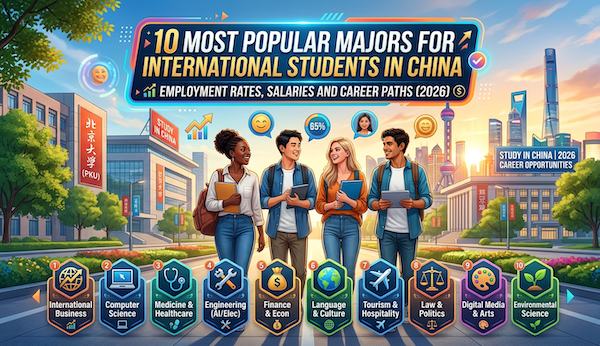
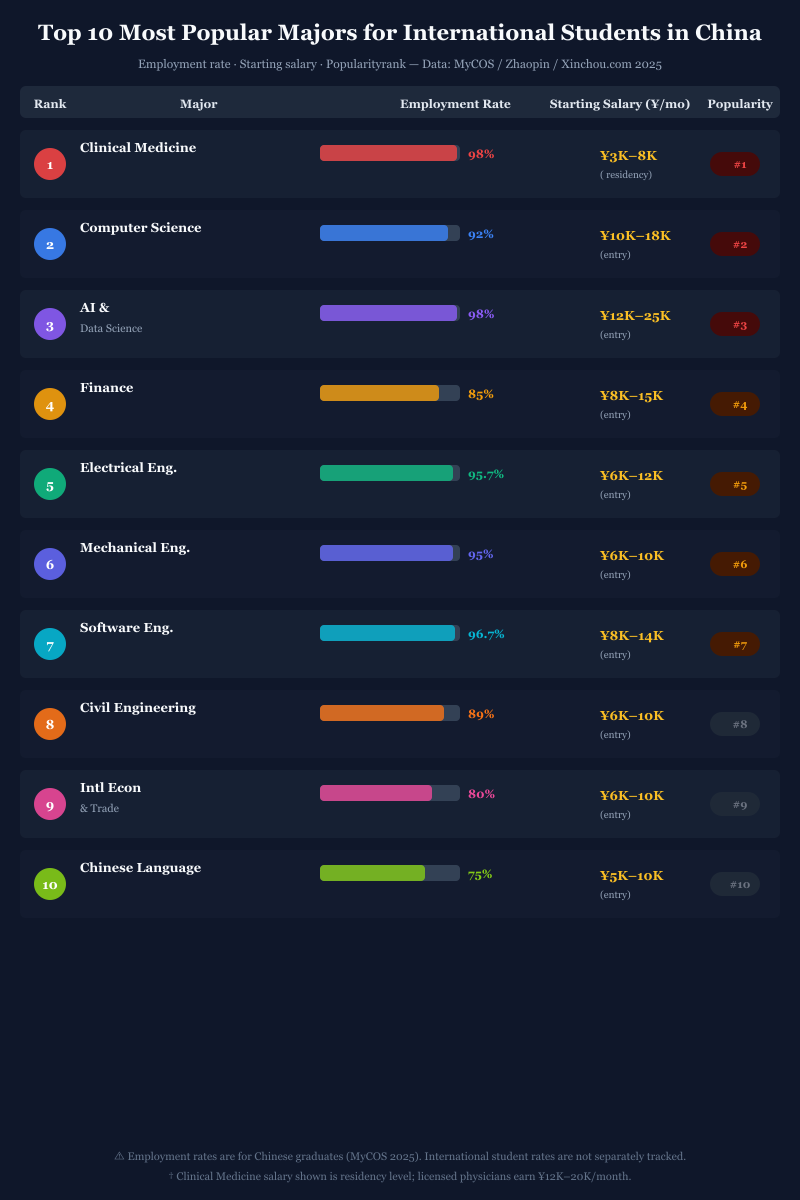
The 10 majors, ranked by international student popularity
This ranking is based on a composite of three data sources: the CrosslineEdu 2026 Discord analysis (100,000+ messages from prospective students), CUCAS application data, and English-language search volume for “[major] in China for international students.”
#10: Chinese Language & Literature (汉语言文学)
Why international students choose it: The most obvious path into China. Most students don’t actually plan to become language majors. They enroll in a 1-2 year language program as a bridge to a degree program or a China-based career. A smaller group pursues the full 4-year degree, often aiming for translation, journalism, or diplomatic work.
Employment rate (Chinese graduates): ~75%
Chinese Language graduates have one of the lowest direct-employment rates among all degree categories. The degree itself is rarely the hiring signal. It’s what you do with the language that matters.
Salary range:
| Level | Monthly (¥) | Annual (USD equiv.) |
|---|---|---|
| Entry (translation/content) | 5,000–10,000 | ~$8,400–16,800 |
| 3 years (localization manager/international BD) | 10,000–20,000 | ~$17,000–34,000 |
| 5+ years (diplomatic/NGO/business director) | 20,000–40,000+ | ~$34,000–67,000+ |
Career paths for international graduates:
- Strongest play: Pair Chinese fluency with another hard skill (engineering, finance, supply chain). Pure language grads face brutal competition from native speakers who also speak English.
- In demand: Localization managers for Chinese tech companies expanding overseas (TikTok, Temu, SHEIN). These roles pay 15,000–30,000 ¥/month and explicitly require non-native Chinese speakers.
- Declining: Translation-only roles. Machine translation has hollowed out the low end. Human translators who survive are niche specialists (legal, medical, literary).
Top universities: Beijing Language and Culture University, Peking University, Fudan University, Nanjing University
#9: International Economics & Trade (国际经济与贸易)
Why international students choose it: This major sits at the intersection of China’s most visible economic roles: import/export, supply chain, cross-border e-commerce. Students from Belt and Road countries are particularly drawn to it, as their home governments and companies actively seek China trade expertise.
Employment rate (Chinese graduates): ~80%
This is a classic “broad but shallow” degree. Graduates are employable across many industries, but the major itself doesn’t teach a single hard skill that commands a premium.
Salary range:
| Level | Monthly (¥) | Annual (USD equiv.) |
|---|---|---|
| Entry (trade assistant/sourcing) | 6,000–10,000 | ~$10,000–16,800 |
| 3 years (trade specialist/category manager) | 12,000–20,000 | ~$20,000–34,000 |
| 5+ years (trade director/head of sourcing) | 25,000–50,000+ | ~$42,000–84,000+ |
Career paths for international graduates:
- Strongest play: Procurement/sourcing roles connecting your home country to Chinese suppliers. Companies in Southeast Asia, Africa, and the Middle East aggressively hire Chinese-educated country nationals for exactly this.
- The Alibaba effect: Cross-border e-commerce on platforms like AliExpress, Temu, and SHEIN is the fastest-growing employer for this major. Roles span supplier verification in Yiwu/Guangzhou to market operations in your home country.
- Watch out: This degree without an internship = very hard to land first job. The students who succeed do a minimum of 2 internships during their degree.
Top universities: University of International Business and Economics (UIBE), Shanghai University of Finance and Economics, Xiamen University, Zhejiang University
#8: Civil Engineering (土木工程)
Why international students choose it: Chinese construction companies are building infrastructure across Africa, Southeast Asia, and Latin America as part of the Belt and Road Initiative. A civil engineering degree from a Chinese university plus native language skills from your home country equals a rare combination that Chinese state-owned enterprises (SOEs) pay for.
Employment rate (Chinese graduates): ~89%
Civil engineering employment has softened somewhat from its 2010s peak, as China’s domestic infrastructure boom cools. But the international angle remains strong.
Salary range:
| Level | Monthly (¥) | Annual (USD equiv.) |
|---|---|---|
| Entry (site engineer, domestic China) | 6,000–10,000 | ~$10,000–16,800 |
| Belt & Road deployment (overseas) | 12,000–25,000 | ~$20,000–42,000 |
| 5+ years (project manager, overseas) | 25,000–50,000+ | ~$42,000–84,000+ |
Career paths for international graduates:
- The BRI multiplier: Chinese SOEs (China Communications Construction, CREC, PowerChina) pay significant premiums for engineers who speak the local language of their project country. A Ghanaian civil engineering graduate from Tongji University working on a Chinese-built railway in Ghana is worth far more than either a Chinese-only engineer or a local-only engineer.
- Domestic path: Working as a civil engineer within China as a foreigner is extremely difficult. Design institutes and domestic firms overwhelmingly hire Chinese nationals. Don’t bet on this path.
Top universities: Tongji University, Southeast University, Tsinghua University, Harbin Institute of Technology
#7: Software Engineering (软件工程)
Why international students choose it: China’s software engineering programs are practical, code-heavy, and tightly connected to the industry. Unlike some countries where CS is heavily theoretical, Chinese software engineering departments emphasize projects, internships, and job placements.
Employment rate (Chinese graduates): ~97% (MyCOS 2025)
One of the highest employment rates of any major. Software engineers remain in demand despite the tech industry’s post-2022 correction.
Salary range:
| Level | Monthly (¥) | Annual (USD equiv.) |
|---|---|---|
| Entry (junior dev, tier-2 city) | 8,000–14,000 | ~$13,400–23,500 |
| Entry (junior dev, Beijing/Shanghai/Shenzhen) | 12,000–20,000 | ~$20,000–33,600 |
| 3 years (mid-level, tier-1 city) | 20,000–35,000 | ~$33,600–58,800 |
| Senior/architect | 35,000–60,000+ | ~$58,800–100,800+ |
Career paths for international graduates:
- Strongest play: Chinese tech companies expanding overseas (TikTok, Temu, SHEIN, Alibaba International). These roles explicitly value English fluency + cultural knowledge of target markets, creating a niche that Chinese grads can’t easily fill.
- Remote work arbitrage: Some international SE grads work remotely for Western companies while living in China on a lower cost of living. This is legally gray on a post-graduation work permit. Tread carefully.
- Reality check: Getting hired at a Chinese tech giant (Baidu, Tencent, Alibaba) as a non-Chinese national is extremely competitive. Most international SE grads end up at mid-tier firms or foreign-invested companies.
Top universities: Tsinghua University, Zhejiang University, USTC, Nanjing University, Beihang University
#6: Mechanical Engineering (机械工程)
Why international students choose it: It’s the classic “engineering degree that works everywhere.” Chinese mechanical engineering programs are among the most cost-effective in the world, with strong industry ties to automotive, aerospace, and manufacturing.
Employment rate (Chinese graduates): ~95%
MyCOS consistently ranks mechanical engineering among the most reliably employable degrees. It’s not the highest-paid, but it has one of the highest placement rates year after year.
Salary range:
| Level | Monthly (¥) | Annual (USD equiv.) |
|---|---|---|
| Entry | 6,000–10,000 | ~$10,000–16,800 |
| 3 years (specialized role) | 10,000–18,000 | ~$16,800–30,200 |
| Senior/management | 18,000–35,000 | ~$30,200–58,800 |
The numbers above are the baseline. One sub-field within mechanical engineering operates on a completely different pay scale: robotics. Robot algorithm engineers at companies like Unitree (宇树科技) and BYD start at 15,000–25,000 ¥/month and can reach 900,000+ ¥/year at the senior level (Zhaopin 2025 data).
Career paths for international graduates:
- Strongest play: Manufacturing firms with factories in both China and your home country. Foxconn, BYD, and CATL all have global operations and need engineers who can bridge Chinese management with local workforces.
- The EV boom: China now produces over 70% of the world’s electric vehicles (IEA 2025). Mechanical engineering grads who understand EV manufacturing are in a hot market that barely existed five years ago.
Top universities: Tsinghua University, Shanghai Jiao Tong University, Harbin Institute of Technology, Xi’an Jiaotong University
#5: Electrical Engineering & Automation (电气工程及其自动化)
Why international students choose it: Electrical engineering graduates in China have a unique advantage: the State Grid Corporation of China (国家电网) and China Southern Power Grid (南方电网) are among the world’s largest employers, and they’ve been expanding internationally into Brazil, Pakistan, the Philippines, and across Africa.
Employment rate (Chinese graduates): ~96% (MyCOS 2025)
Average starting salary: ~7,000 ¥/month. But this understates the value. The real draw is job security. Electrical engineering has one of the highest rates of “专业对口率” (job-major match rate) at 86%, meaning graduates almost always work in their field.
Salary range:
| Level | Monthly (¥) | Annual (USD equiv.) |
|---|---|---|
| Entry (State Grid / SOE) | 6,000–12,000 | ~$10,000–20,000 |
| Private sector (EV/renewables) | 10,000–18,000 | ~$16,800–30,200 |
| International deployment | 15,000–30,000 | ~$25,200–50,400 |
| Senior | 20,000–40,000+ | ~$33,600–67,200+ |
Career paths for international graduates:
- Strongest play: Chinese power companies’ international divisions. State Grid alone has operations in 10+ countries. They need engineers who speak Portuguese (Brazil), Urdu (Pakistan), or Tagalog (Philippines). These are languages few Chinese engineers know.
- Grid-adjacent: Solar and wind equipment manufacturers (LONGi, Goldwind, Trina Solar) are expanding globally and need field engineers for installation projects across Africa and Southeast Asia.
Top universities: Tsinghua University, Xi’an Jiaotong University, Huazhong University of Science and Technology, Zhejiang University
#4: Finance (金融学)
Why international students choose it: The prestige factor is real. For students from developing countries, a Chinese finance degree signals modernization, especially when combined with Mandarin proficiency. China is now the world’s second-largest financial market, and understanding how it works is a differentiated skill.
Employment rate (Chinese graduates): ~85%
Finance employment has become more bifurcated. Top university graduates (985/211) land high-paying roles; everyone else competes for bank teller and insurance sales positions that don’t require a degree.
Salary range:
| Level | Monthly (¥) | Annual (USD equiv.) |
|---|---|---|
| Entry (bank/corporate finance) | 8,000–15,000 | ~$13,400–25,200 |
| Investment banking/PE (top tier) | 20,000–50,000+ | ~$33,600–84,000+ |
| Mid-career (fund manager/analyst) | 25,000–80,000+ | ~$42,000–134,000+ |
Career paths for international graduates:
- Strongest play: Cross-border investment. Private equity and venture capital firms investing in your home country’s market often need analysts who speak the language and understand the local business environment. Chinese PE firms like Hillhouse and CDH invest heavily in Southeast Asia.
- The compliance niche: Anti-money laundering and sanctions compliance in cross-border trade finance. This is a growing field where a multilingual international grad has an edge over Chinese nationals.
- Reality check: Breaking into Chinese investment banking as a foreigner is nearly impossible unless you’re from a target school (Tsinghua/Peking/Fudan) and have family connections. Most international finance grads work at foreign banks’ China desks or return home.
Top universities: Peking University, Tsinghua University, Shanghai University of Finance and Economics, Central University of Finance and Economics
#3: Artificial Intelligence & Data Science (人工智能/数据科学)
Why international students choose it: This is the fastest-growing major category for international students in China, driven by two factors: China’s government has declared AI a national priority (pouring billions into university labs), and English-language AI education options outside the US and UK are thin. China has become the clear #3 destination for AI education globally.
Employment rate (Chinese graduates): ~98% (MyCOS 2025, highest of any major)
This is the single most employable degree in China right now. The talent gap is so large that companies recruit AI and big data students before graduation.
Salary range:
| Level | Monthly (¥) | Annual (USD equiv.) |
|---|---|---|
| Entry (AI engineer, tier-1 city) | 12,000–25,000 | ~$20,100–42,000 |
| 3 years | 25,000–50,000 | ~$42,000–84,000 |
| Senior (algorithm expert, top firm) | 40,000–100,000+ | ~$67,200–168,000+ |
AI算法工程师 average annual compensation exceeds 300,000 ¥ (中国薪酬网 2025). At top firms like ByteDance, senior AI researchers can earn 500,000–1,000,000+ ¥/year.
Career paths for international graduates:
- Strongest play: AI roles at Chinese companies expanding internationally. TikTok’s recommendation algorithm team, Temu’s pricing AI, and SHEIN’s supply chain AI all need global talent.
- Brain drain back home: A Chinese AI degree + return to your home country = rare expertise. Most developing countries have zero domestic AI graduates. You walk into a monopoly on “person who understands Chinese AI ecosystem.”
- The caveat: AI jobs cluster in Beijing, Shanghai, Shenzhen, and Hangzhou. If you’re not willing to live in a tier-1 city, about 80% of the job market disappears.
Top universities: Tsinghua University, Peking University, USTC, Zhejiang University, Shanghai Jiao Tong University
#2: Computer Science & Technology (计算机科学与技术)
Why international students choose it: The most consistently popular STEM major for international students in China, across every nationality and every year. It’s the closest thing China has to a “universal degree.” A CS degree from a Chinese university is widely recognized by employers in most countries.
Employment rate (Chinese graduates): ~92% (Zhaopin 2025)
This has declined from its 2018–2021 peak, but remains in the top tier. The “CS grads can’t find jobs” narrative in Chinese media is real, but it applies mostly to graduates from lower-tier universities without internship experience. Top university CS grads with 2+ internships are still heavily recruited.
Salary range:
| Level | Monthly (¥) | Annual (USD equiv.) |
|---|---|---|
| Entry (tier-1 city, decent company) | 10,000–18,000 | ~$16,800–30,200 |
| 3 years (mid-level) | 18,000–35,000 | ~$30,200–58,800 |
| Senior / tech lead | 35,000–60,000+ | ~$58,800–100,800+ |
Career paths for international graduates:
- Broadest applicability of any degree on this list. A CS degree from Tsinghua/Zhejiang/SJTU is recognized globally. You can work in China, return home, or aim for a third country. The degree travels.
- The startup path: Chinese tech incubators in Shenzhen and Hangzhou actively recruit international CS grads for their global-market-facing startups. The combination of “understands code + speaks English + knows Western user expectations” is genuinely rare in China.
- Competition reality: The market is crowded. CS is the single most popular major among Chinese students too, with several hundred thousand new CS grads entering the job market each year. You need internships and project portfolios to stand out.
Top universities: Tsinghua University, Peking University, Zhejiang University, USTC, Shanghai Jiao Tong University, Nanjing University
#1: Clinical Medicine / MBBS (临床医学/MBBS)
Why international students choose it: This has been the #1 most popular major for international students in China for over a decade, and the reasons haven’t changed: a 5-6 year English-taught medical degree costs a fraction of what it does in the US, UK, or Australia. For students from South Asia, Africa, and the Middle East, China’s MBBS program is often the only affordable path to becoming a doctor.
Employment rate (Chinese graduates): ~98% after residency completion
Medical graduates have near-total employment rates, but the path is long. The 5-year MBBS is just the beginning. Graduates must complete a residency (1-3 years depending on specialization) before they can practice independently.
Salary range:
| Level | Monthly (¥) | Annual (USD equiv.) |
|---|---|---|
| Residency (China) | 3,000–8,000 | ~$5,000–13,400 |
| Licensed physician (China) | 12,000–20,000 | ~$20,100–33,600 |
| Specialist / department head | 20,000–50,000+ | ~$33,600–84,000+ |
| Practicing in home country | Varies widely | Often $30,000–100,000+ depending on country |
Career paths for international graduates:
- Path A — Return home: The majority of international MBBS graduates return to their home countries. China’s MBBS programs are listed in the WHO World Directory of Medical Schools, and graduates are eligible to sit for licensing exams in most developing countries. Graduates must pass their home country’s licensing exam (e.g., NExT in India, PM&DC in Pakistan). This is the most common and most viable path.
- Path B — Stay in China: Extremely difficult. Practicing medicine in China requires passing the Chinese Medical Licensing Examination (in Mandarin), and hospitals overwhelmingly hire Chinese nationals. A tiny number of international graduates work at international hospitals in Shanghai/Beijing (Jiahui, United Family), but these positions are rare and competitive.
- Path C — Third country: Some graduates use China’s MBBS as a stepping stone to USMLE (US) or PLAB (UK) licensing. This requires significant additional exam preparation and is not a path the degree alone opens.
The critical warning no one tells you about: Not all Chinese MBBS programs are created equal. Before enrolling, verify that the specific program is listed in the WHO World Directory of Medical Schools and recognized by your home country’s medical council. Every year, graduates discover their degree isn’t accepted back home. By then, 5-6 years of tuition are gone.
Top universities: Peking University Health Science Center, Fudan University Shanghai Medical College, Shanghai Jiao Tong University School of Medicine, Zhejiang University School of Medicine, Sichuan University West China Medical Center
ROI matrix: which major pays back fastest?
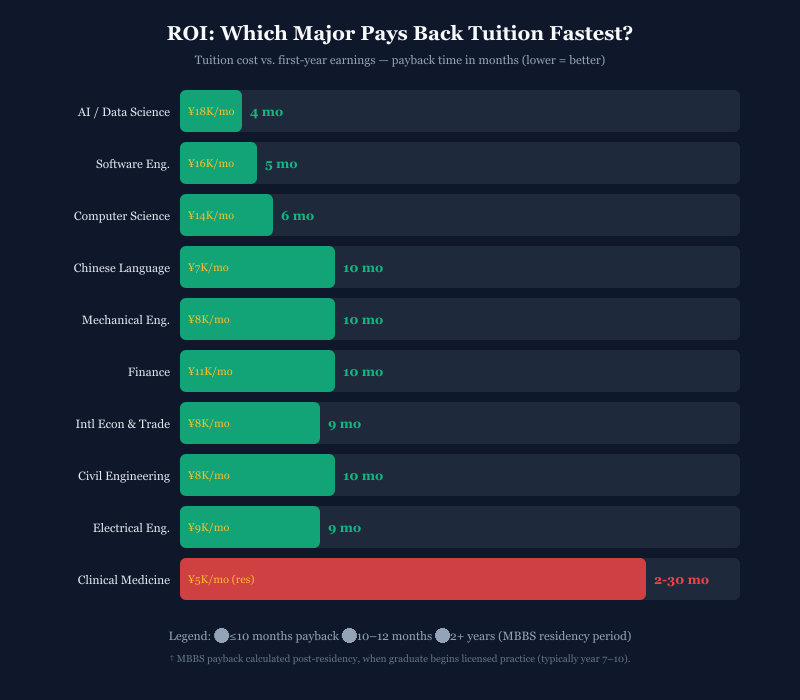
This table compares tuition cost against realistic first-year earnings. “Payback time” estimates how long it takes to earn back total tuition costs at the median entry salary.
| Major | 4-Year Tuition (¥) | Median Entry Salary (¥/month) | Annual (¥) | Payback Time |
|---|---|---|---|---|
| AI / Data Science | 60,000–120,000 | 18,000 | 216,000 | ~4 months |
| Software Engineering | 60,000–100,000 | 16,000 | 192,000 | ~5 months |
| Computer Science | 60,000–100,000 | 14,000 | 168,000 | ~6 months |
| Electrical Engineering | 60,000–100,000 | 9,000 | 108,000 | ~9 months |
| Finance | 60,000–120,000 | 11,000 | 132,000 | ~10 months |
| Mechanical Engineering | 60,000–100,000 | 8,000 | 96,000 | ~10 months |
| Int’l Economics & Trade | 50,000–80,000 | 8,000 | 96,000 | ~9 months |
| Civil Engineering | 60,000–100,000 | 8,000 | 96,000 | ~10 months |
| Clinical Medicine | 100,000–200,000 | Residency: 5,000 | 60,000 | 2–4 years† |
| Chinese Language | 40,000–80,000 | 7,000 | 84,000 | ~10 months |
† Clinical Medicine has the longest payback time but the highest lifetime earnings ceiling. Most MBBS graduates earn their return after returning home and completing licensing, a 7-10 year total timeline.
Tuition estimates are based on English-taught programs at mid-tier universities. Top universities and Chinese-taught programs are significantly cheaper (some as low as 15,000 ¥/year).
AI impact: which majors are safe?
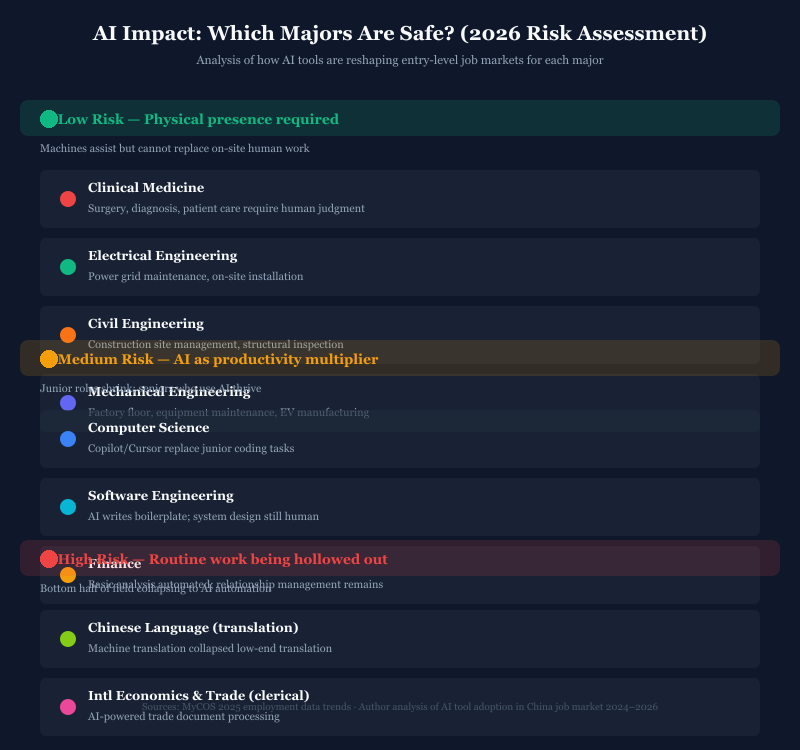
The 2025 employment data already shows a pattern: jobs that involve routine cognitive work are being hollowed out, while jobs that require physical presence or judgment in ambiguity are holding steady.
| Risk Level | Majors | Why |
|---|---|---|
| 🟢 Low risk | Clinical Medicine, Electrical Engineering, Civil Engineering, Mechanical Engineering | Physical presence required. Machines can assist diagnosis but can’t perform surgery. Power grids, bridges, and factories need human engineers on site. |
| 🟡 Medium risk | Computer Science, Software Engineering, Finance | AI tools (Copilot, Cursor) are already replacing junior coding and basic financial analysis roles. But senior engineers who use AI tools become more productive, not less. The net effect: fewer entry-level jobs, same or more senior jobs. |
| 🔴 High risk | Chinese Language (translation), Int’l Economics & Trade (clerical) | Machine translation and AI-powered trade document processing are collapsing the bottom half of these fields. Surviving means specializing in tasks AI can’t do: negotiation, relationship management, cultural interpretation. |
FAQ
Which major makes it easiest to stay in China after graduation?
Software Engineering or AI, by a wide margin. China’s tech companies are the most willing to sponsor work visas for international graduates, and these fields have the clearest “you have a skill Chinese applicants don’t” argument (English fluency + code ability). See our full article on staying in China after graduation for visa pathways.
Can I switch majors after enrolling?
Yes, but it’s not easy. Chinese universities allow internal major transfers, typically after the first year, based on first-year GPA and available spots. The most popular majors (CS, AI, Finance) are almost impossible to transfer into because they’re already full. Transfers into less competitive majors are more feasible.
Do Chinese employers care which university I attended?
Enormously. In China, university prestige (particularly 985/211/双一流 status) directly affects hiring decisions, far more than in Western countries. A CS degree from Tsinghua opens doors that the same degree from a provincial university does not. International students from non-target universities should compensate with internships and project portfolios.
What if I want to return home after graduation?
Computer Science, AI, and Electrical Engineering have the most globally portable credentials. Clinical Medicine travels well, but only if your home country recognizes the specific Chinese program. Verify this before enrolling. Chinese Language degrees have limited recognition value outside of China-specific roles.
Data sources: MyCOS 2025 China Undergraduate Employment Report, Zhaopin 2025 Graduate Employment Survey, Xinchou.com 2025 University Salary Rankings. All salary figures are before tax and in 2025 RMB. USD conversions use approximate exchange rate of 1 USD = 7.15 RMB.
Pros and cons at a glance
| Pros | Cons and things to weigh |
|---|---|
| STEM majors (AI, Software Engineering, Computer Science, Electrical Engineering) post 92 to 98 percent employment and pay back tuition in under a year | Published employment data lumps international and Chinese graduates together, so real international rates are unknown |
| Chinese degrees in CS, AI, and EE are globally portable and recognised in most countries | Language-heavy fields (Chinese Language, International Trade) face the highest AI displacement risk |
| Belt and Road demand gives civil and mechanical engineers a rare local-language edge | Clinical Medicine has the longest payback and strict home-country licensing before you can practise |
| Clear salary tables and an ROI matrix make the tradeoffs easy to compare | Finance and Computer Science are crowded, and non-target-school graduates struggle without internships |
Key authorities and official resources
- Campus China: official CSC admissions and scholarship portal for international students
- Ministry of Education of China: the governing body behind degree recognition and admission policy
- WHO World Directory of Medical Schools: verify that a specific MBBS program is listed before enrolling
- Zhaopin: China’s largest job platform, source of the salary surveys cited here