You submitted your application to a Chinese university. Weeks later, you get an email: “Admission Notice” attached. You’re excited, until you open it and see the words Pre-Admission Notice at the top.
You’re not alone in being confused. Every year, thousands of international students receive a pre-admission notice and assume it’s the final offer. Then they try to apply for a visa, or for the CSC scholarship, and realize the document they have isn’t the one they actually need.
This guide explains what a pre-admission notice is, how it differs from a final admission notice, why universities issue it, and exactly what you need to do after receiving one.
Part 1: What a pre-admission notice actually is
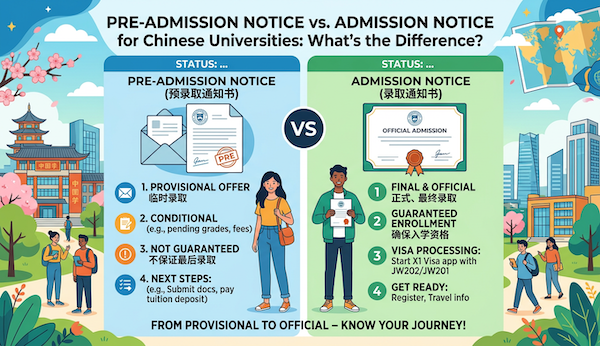
A pre-admission notice (sometimes called a “pre-admission letter”) is a provisional letter issued by a Chinese university indicating that you have been conditionally accepted, but the process isn’t finished yet.
It typically includes:
– Your name and passport number
– The program you applied for
– The intended start date
– A statement that you are “provisionally admitted” or “recommended for admission”
– A note that a final admission notice will be issued after certain conditions are met
Here’s the key point: a pre-admission notice cannot be used to apply for a student visa (X1/X2) to China. Only the final admission notice, together with the JW201 or JW202 form, is accepted by Chinese embassies and consulates for visa processing.
Part 2: Pre-admission vs. final admission — the key differences
| Pre-Admission Notice | Final Admission Notice | |
| Legal status | Provisional; not legally binding for visa purposes | Official; required for visa application |
| Visa eligibility | Cannot be used for visa application | Required for X1/X2 visa application |
| JW form included | No | Yes (JW201 for scholarship, JW202 for self-funded) |
| Conditions attached | Often (tuition confirmation, document submission) | No (or only minor administrative steps) |
| Who issues it | University admission office (often online system) | University + CSC (if scholarship) or university sole |
| When you receive it | After initial application review | After all conditions are met |
| Can you enroll with it? | No | Yes |
Part 3: Why Chinese universities issue pre-admission notices
Understanding why universities do this helps you know what to expect.
Reason 1: CSC Type A scholarship applicants need it
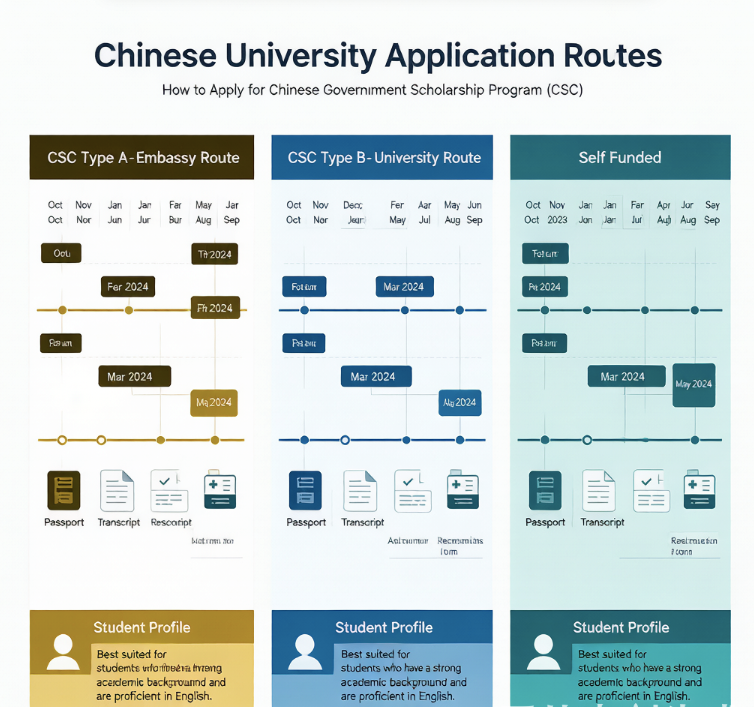
If you’re applying for a Chinese Government Scholarship through Type A (dispatching via your home country’s education ministry or embassy), you need a pre-admission notice from a Chinese university as part of your scholarship application package. The university issues the pre-admission notice to confirm they’re willing to accept you, but the final scholarship decision is made by CSC. Only after you’re awarded the scholarship does the university issue the final admission notice.
Reason 2: Tuition confirmation is required
Many universities issue a pre-admission notice first, and then require you to pay a tuition deposit (or confirm enrollment) before they release the final admission notice. This helps the university manage enrollment numbers and reduces no-shows.
Reason 3: Document verification takes time
Some universities issue a pre-admission notice after the initial review, but hold the final admission notice until they’ve verified your degree certificates, transcripts, and other documents. If your documents are from a non-English-speaking country and require notarization or authentication, this step can take several weeks.
Part 4: What to do after receiving a pre-admission notice
Receiving a pre-admission notice is good news, it means the university is interested in admitting you. But you’re not done yet. Here’s what to do next.
Step 1: Read the notice carefully
Check whether there are conditions listed on the notice. Common conditions include:
– Paying a tuition deposit by a specific date
– Submitting notarized degree certificates
– Submitting a physical examination form
– Confirming your enrollment via an online system
Step 2: Pay any required deposit (if applicable)
Some universities require a deposit (typically RMB 2,000–5,000) to confirm your enrollment. Check whether the deposit is refundable and whether it counts toward your first-year tuition.
Step 3: If you’re a CSC Type A applicant, submit the pre-admission notice to your dispatching authority
The pre-admission notice is one of the required documents for the CSC Type A application. Submit it together with your other application materials to your home country’s education ministry or the Chinese embassy.
Step 4: Wait for the final admission notice
After you’ve met all the conditions, the university will issue the final admission notice. This typically happens:
– For CSC Type A applicants: After the scholarship results are announced (usually July–August)
– For self-funded applicants: After tuition confirmation and document verification (typically 2–4 weeks after pre-admission)
Step 5: Use the final admission notice to apply for your visa
Once you have the final admission notice and the JW201/JW202 form, you can apply for your student visa at the Chinese embassy or consulate in your home country.
Part 5: Common mistakes (and how to avoid them)
Mistake 1: Trying to use a pre-admission notice for a visa application
The problem: Some students try to apply for a visa with just the pre-admission notice. Chinese consulates will reject this, the pre-admission notice is not an official admission document.
How to avoid it: Wait until you receive the final admission notice and the JW form before booking your visa appointment.
Mistake 2: Assuming the pre-admission notice automatically converts to final admission
The problem: Pre-admission is not a guarantee of final admission. If you don’t pay the deposit, don’t submit required documents, or don’t meet the conditions, the university can (and will) withdraw the offer.
How to avoid it: Respond to every email from the university promptly and complete all required steps by the stated deadlines.
Mistake 3: Not keeping a copy of the pre-admission notice
The problem: You may need the pre-admission notice later, for scholarship applications, for reference when communicating with the university, or for your own records.
How to avoid it: Save a PDF copy of the pre-admission notice as soon as you receive it, and keep it even after you receive the final admission notice.
Mistake 4: Confusing pre-admission with a pre-university program (Yuke)
The problem: “Pre-admission” sounds like “pre-university.” They’re completely different. A pre-university program (Yuke / 预科) is a one-year foundation program for students whose Chinese isn’t strong enough for direct entry. A pre-admission notice is just a provisional acceptance letter.
How to avoid it: Read the document carefully. If it’s a pre-admission notice, it will say “Pre-Admission Notice” or “Provisional Admission Notice” at the top. If it’s a pre-university program offer, it will mention “preparatory program,” “Yuke,” or “foundation program.”
Part 6: Real cases (composite scenarios based on commonly reported patterns)
Since there are very few published first-hand accounts in English of pre-admission issues, the following are composite scenarios based on commonly reported patterns from student forums and university admission office guidance. They represent realistic situations, not specific named individuals.
Case 1: The CSC Type A applicant who didn’t know he needed pre-admission
A student from Pakistan applied for the CSC Type A scholarship through the local education ministry. He didn’t realize he needed a pre-admission notice from a Chinese university as part of the application. By the time he found out, most universities had already closed their pre-admission application window. He ended up applying to three universities that had extended deadlines, got a pre-admission notice from one, and submitted it just before the deadline. Lesson: if you’re applying for CSC Type A, start the pre-admission application process in November or December, before the CSC deadlines.
Case 2: The self-funded student who tried to use pre-admission for a visa
A student from the United States received a pre-admission notice from a university in Shanghai in May. She assumed this was her final offer, booked a visa appointment at the Chinese consulate in San Francisco, and showed up with the pre-admission notice. The consulate rejected her application. She had to contact the university, complete the remaining steps, and wait for the final admission notice, which delayed her visa application by three weeks and nearly caused her to miss the start of the semester.
Case 3: The student who never paid the deposit
A student from Nigeria received a pre-admission notice from a university in Guangzhou. The notice said he needed to pay a RMB 3,000 deposit within two weeks to confirm his enrollment. He didn’t read the notice carefully and missed the deadline. When he finally checked his email a month later, the university had already given his spot to another applicant. He had to reapply the following year.
Part 7: FAQ
Q: How long does it take to get the final admission notice after receiving pre-admission?
A: It depends. For self-funded students who have already paid the deposit and submitted all documents, it typically takes 2–4 weeks. For CSC Type A applicants, it can take 3–5 months, because you have to wait for the scholarship results.
Q: Can I be rejected after receiving a pre-admission notice?
A: Yes. Pre-admission is conditional. If you don’t meet the stated conditions (e.g., you don’t pay the deposit, your documents are found to be fraudulent, or you fail the medical exam), the university can withdraw the offer.
Q: Do all Chinese universities issue pre-admission notices?
A: No. Some universities issue only one admission letter (the final one). Pre-admission notices are more common for CSC Type A applicants and for universities that require a tuition deposit confirmation before issuing the final notice.
Q: Is a pre-admission notice the same as a conditional offer in the UK or Australia?
A: They’re similar in concept, both are provisional acceptances with conditions attached. The main difference is that in China, the pre-admission notice can’t be used for visa purposes, whereas in some countries, a conditional offer can be used to start the visa process (with conditions to be met later).
Q: What if I receive pre-admission notices from multiple universities?
A: You can receive pre-admission notices from multiple universities, there’s no limit. But you can only accept one final admission offer, because each university issues its own JW form, and you can only use one JW form for your visa application.
Summary: The practical takeaways
1. A pre-admission notice is not your final offer. It’s a provisional letter that indicates the university is willing to admit you, pending certain conditions.
2. You cannot use a pre-admission notice to apply for a visa. You need the final admission notice and the JW201/JW202 form.
3. Read the notice carefully and complete all required steps (deposit payment, document submission) by the stated deadlines.
4. If you’re a CSC Type A applicant, start the pre-admission application process early, ideally in November or December.
5. Keep a copy of everything. Save the pre-admission notice, all email correspondence, and the final admission notice.
6. Don’t book your flight or visa appointment until you have the final admission notice and the JW form in hand.
*This guide draws on admission procedures from CSC Type A application process, and standard practices at major Chinese universities including University of Science and Technology Beijing and Zhejiang University. Individual university policies vary, always confirm the specific requirements with your university’s international student office.
Pros and cons at a glance
| Pros | Cons and things to weigh |
|---|---|
| A pre-admission notice confirms a university is willing to accept you and reserves a spot pending conditions | A pre-admission notice cannot be used for a visa; you must wait for the final notice and the JW201 or JW202 form |
| CSC Type A applicants must have one to complete the scholarship application package | It is conditional, the offer can be withdrawn if you miss a deposit or document deadline |
| It gives you time to arrange the deposit, documents, and visa steps in order | Timing varies widely: 2 to 4 weeks for self-funded, 3 to 5 months for CSC Type A |
| Issuing it helps the university manage enrollment and reduces no-shows | Pre-admission is often confused with a pre-university (Yuke) foundation program |
Key authorities and official resources
- Campus China: official CSC admissions and university application portal
- China Scholarship Council (CSC): official Chinese government scholarship body
- National Immigration Administration of China: rules for student visas (X1/X2) and the JW forms
- Study in China: official Chinese government portal for international students