Most international students spend months researching programs, preparing applications, and stressing over visa interviews. Then, two weeks before departure, they realize they need a medical exam and possibly vaccines that they haven’t scheduled.
This guide covers the entire health checkpoint: when to do what, where to go, what it costs, which vaccines actually matter, what happens if you have a pre-existing condition, and what to do if something goes wrong.
Part 1: The health checkpoint: what the process actually looks like
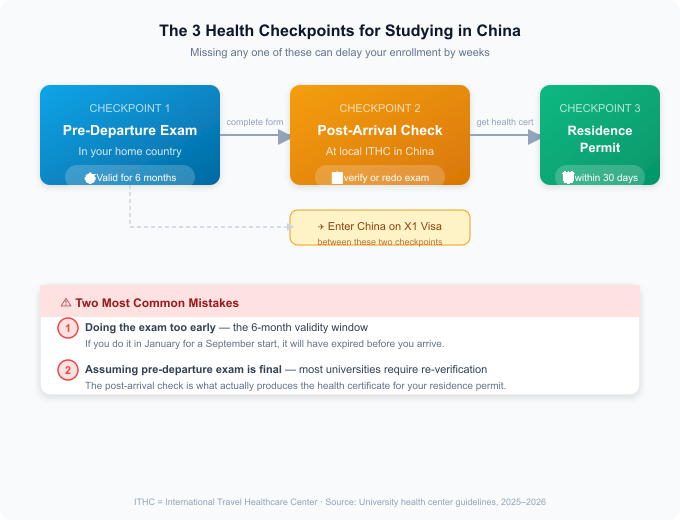
The health requirement for studying in China isn’t a single event. It’s a sequence of three checkpoints, and missing any one of them can delay your enrollment by weeks.
Here’s the full sequence:
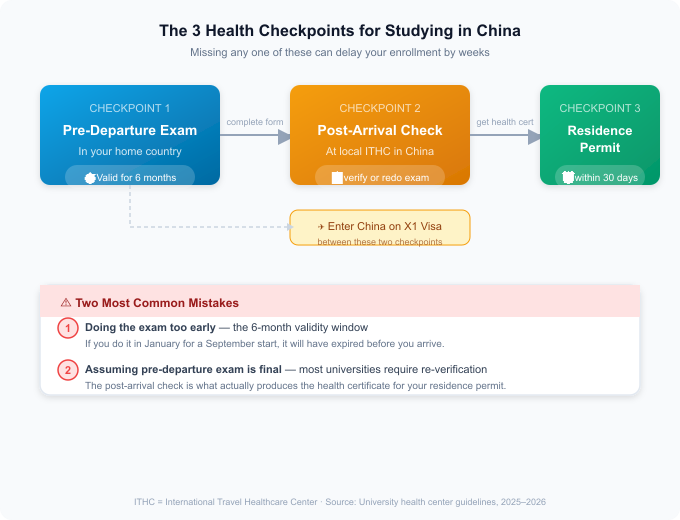
The most common mistake: completing the pre-departure exam too early. The Foreigner Physical Examination Form is valid for only 6 months from the date of issue. If you do it in January for a September start, it will have expired before you arrive.
The second most common mistake: assuming the pre-departure exam is the final step. It isn’t. Most universities require a second verification or re-examination after you arrive in China, and this step is what actually produces the health certificate needed for your residence permit.
Part 2: The foreigner physical examination form: what you need to know
What the form covers
The official form (issued by the Chinese customs authority) checks for:
– Infectious diseases: Tuberculosis (TB), syphilis, HIV/AIDS, hepatitis
– General health: vital signs, physical examination, mental health screening
– Laboratory tests: blood tests (HIV, syphilis, hepatitis B surface antigen), urinalysis, chest X-ray
The form must be completed and signed by a licensed physician, with the hospital’s official stamp. The original, not a photocopy or scanned PDF, must be brought to China.
Where to do it
You have two options:
Option A: At a designated International Travel Healthcare Center in your home country. Most major cities have one; search for “International Travel Healthcare Center” plus your city name. These centers are familiar with the Chinese form and know exactly what to fill in.
Option B: At a regular hospital or clinic. This works too, but make sure the doctor signs and stamps the form. Some universities are picky about whether the stamp is legible or whether the form was filled out in blue ink vs. black ink (policies vary by province).
Option C (after arrival): Skip the pre-departure exam entirely and do it all in China. This is allowed but risky. If you fail the exam after arriving, you have 30 days to resolve it before your residence permit application deadline.
How much it costs
Costs vary widely by country:
| Country | Estimated cost (USD) | Notes |
| United States | $200–$400 | Often not covered by insurance; Travel Health Centers charge a premium |
| United Kingdom | £150–£250 | Same-day results available at some private clinics |
|---|---|---|
| India | ₹2,000–₹5,000 ($25–$60) | Very affordable at government centers |
| Pakistan | PKR 3,000–8,000 ($10–$30) | International Travel Health Centers in major cities |
| Nigeria | ₦40,000–₦80,000 ($25–$50) | Lagos and Abuja have designated centers |
| Australia | AUD $250–$400 | Some GPs can complete the form |
Common reasons forms get rejected
Even if you’ve done the exam, your university or the local health center in China may reject the form:
1. The form is too old. More than 6 months have passed since the exam date.
2. The stamp is illegible. Photocopied stamps or faded ink are frequently rejected.
3. Missing blood test reports. The form alone isn’t enough; you must bring the original lab results.
4. The exam was done at a non-accredited facility. Some provinces cross-check the issuing hospital.
5. Incomplete fields. Even one blank box can trigger a rejection.
Part 3: Vaccination: the topic nobody explains clearly
Does China require vaccines for entry?
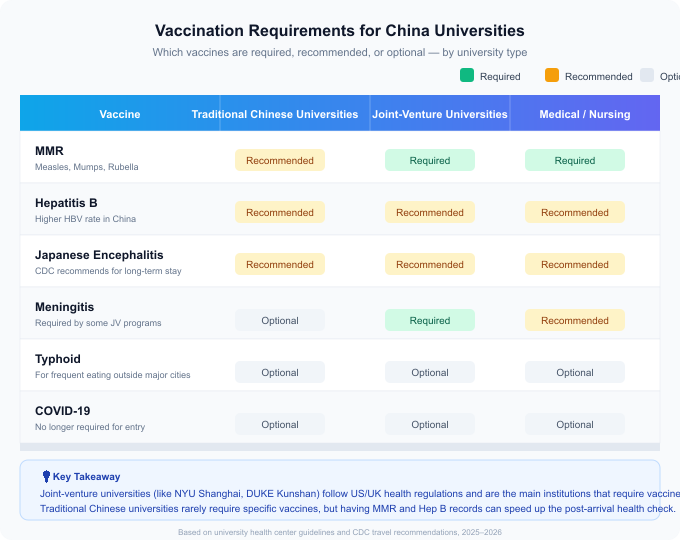
Here’s the short answer: For most international students, China does not require specific vaccines for entry. Unlike the United States, which requires MMR, varicella, and several other vaccines for most student visas, China’s entry requirements focus on the medical exam (checking for active infectious disease), not on proof of vaccination. The one exception: if you are traveling from a country with yellow fever risk, China requires proof of yellow fever vaccination under WHO International Health Regulations.
However, and this is where it gets complicated, individual universities can and do set their own requirements.
Which universities require vaccines?
Requirements vary by institution. Based on publicly available information:
– NYU Shanghai explicitly requires MMR (measles, mumps, rubella) and meningitis vaccines for all students taking 6 or more credits. This is a US-accredited program, so US health regulations apply.
– Joint-venture universities (Sino-foreign cooperative universities) often follow the health regulations of their foreign partner. If your program is accredited by a US or UK institution, expect US or UK vaccine requirements.
– Traditional Chinese universities generally do not require specific vaccines for enrollment. However, some universities’ on-campus health centers may recommend or gently encourage certain vaccines during the post-arrival health check.
– Medical and nursing programs may have additional requirements, since you’ll be in clinical settings.
The vaccines you should consider (even if not required)
Even when not mandatory, several vaccines are worth getting before you depart:
| Vaccine | Why it matters in China | Where to get it |
| MMR (measles, mumps, rubella) | Measles outbreaks still occur in China; most Chinese students are vaccinated, but the virus circulates | Home country GP or travel health center |
| Hepatitis B | China has a higher HBV carrier rate than North America or Europe; if you haven’t been vaccinated, the pre-departure blood test will show it | Home country; series takes 3–6 months |
|---|---|---|
| Japanese Encephalitis | Recommended by the US CDC for long-term travelers to China, especially in rural areas | Travel health center; takes ~1 month to complete series |
| Typhoid | Recommended for people eating outside major cities frequently | Travel health center; one injection or oral series |
| COVID-19 | No longer required for entry, but some universities may recommend staying up to date | Widely available |
| Meningitis | Required by some joint-venture programs; also relevant if you’ll be in dormitories | Home country |
Getting an English vaccination certificate
If a university asks for proof of vaccination, you’ll need an English-language certificate. Options:
1. From your home country’s health system. Most GPs can print an immunization record in English.
2. From a private travel health clinic. They can issue a stamped, signed certificate acceptable to Chinese universities.
3. Translating an existing record. If your vaccine record is only in your native language, get it translated by a certified translator and notarized.
Part 4: Pre-existing conditions: what disqualifies you vs. what doesn’t
Chinese health regulations for foreigners entering the country list specific conditions that can lead to visa denial or cancellation. According to the Administrative Measures for the Entry and Exit of Foreigners (issued by the Ministry of Public Security and the Ministry of Foreign Affairs), the following conditions can result in disqualification:
Conditions that can disqualify you
1. Active tuberculosis (TB), not past TB that has been treated, but active, untreated TB. You’ll need a chest X-ray showing no active lesions.
2. Psychiatric disorders, specifically conditions that pose a danger to public safety or that require institutionalization. Managed depression or anxiety does not disqualify you.
3. Infectious syphilis, the blood test checks for this; if positive and untreated, it’s a problem.
4. HIV/AIDS, China lifted the HIV entry ban in 2010, but individual universities may still have policies about supporting students with HIV. In practice, many international students with HIV study in China without issue, but you should consult your university’s international student office in advance.
5. Serious contagious diseases, as determined by the examining physician.
Conditions that do NOT disqualify you
– Asthma. As long as it’s managed and not actively severe.
– Diabetes. Manageable with medication; bring sufficient supplies.
– Hepatitis B carrier status. China removed HBV restrictions from school and work physicals in 2009; being a hepatitis B carrier does not disqualify you from studying in China.
– Past surgeries. As long as you’re fully recovered.
– Allergies. Bring your medication and a doctor’s note in English.
– ADHD / autism spectrum. These are not disqualifying conditions.
What to do if you have a pre-existing condition
1. Disclose it on the medical form. The form asks about past surgeries, chronic conditions, and current medications. Leaving it blank when you have a manageable condition is more risky than disclosing it.
2. Bring a doctor’s note in English explaining your condition, current treatment, and confirming that you’re fit to study abroad.
3. Contact your university’s international student office before departure if you’re unsure whether your condition will be an issue.
4. Bring extra medication. A 3–6 month supply if possible, since your specific medication may not be available in China or may require a local prescription.
Part 5: The post-arrival health check: why it exists and what happens
Even if you completed the medical exam in your home country, most universities will require a verification or a repeat exam after you arrive. Here’s why.
Two scenarios
Scenario A: You brought a completed Foreigner Physical Examination Form from home. You submit it to the local International Travel Healthcare Center (ITHC). They review it, checking the stamp, the blood test dates, and the completeness, and either (a) issue you a Chinese health certificate, or (b) ask you to redo some or all of the exam because something doesn’t meet their standards.
Scenario B: You didn’t do the exam before departure. You must complete the full exam at the local ITHC after arriving. The cost is typically lower than in Western countries (around ¥400–¥800 / $55–$110 in most cities), but you’re now on a timer: you must complete this and apply for your residence permit within 30 days of entering China.
What the post-arrival exam includes
The ITHC exam is essentially the same as the pre-departure exam:
– Physical examination
– Blood draw (HIV, syphilis, hepatitis B)
– Urinalysis
– Chest X-ray
– ECG (sometimes, depending on age and university requirement)
Results are typically available within 1–3 business days.
What if you fail?
“Failing” the health exam is rare for most international students, but it can happen. The most common reasons:
1. Active TB detected on chest X-ray, you’ll be referred for treatment; you cannot enroll until cleared
2. Positive syphilis test, if untreated, you’ll be required to undergo treatment before enrollment
3. High blood pressure or heart rhythm abnormality detected on ECG, usually not disqualifying, but may trigger a follow-up
4. Pregnancy, not disqualifying, but you’ll need to navigate prenatal care in China, which is a separate topic
If you fail the exam, the ITHC will not issue the health certificate. Without it, you cannot get a residence permit. Your university’s international student office is your first point of contact, they’ve seen this before and can guide you through next steps, which may include treatment, a deferred enrollment, or in rare cases, a return home.
Part 6: Real experiences: what can go wrong (and how students handled it)
Since there are very few published first-hand accounts in English of medical exam problems, the following are composite scenarios based on commonly reported patterns from student forums and university health center guidance. They represent realistic situations, not specific named individuals.
Case 1: The expired form
A student from Pakistan completed his medical exam in March for a September intake. He arrived in China in late August, only to discover that his medical form, dated March 12, had expired (6-month validity). He had to redo the entire exam at the Beijing International Travel Healthcare Center, paying out of pocket and delaying his residence permit application by 10 days. The lesson: time your pre-departure exam for no more than 3 months before your planned arrival.
Case 2: The missing blood test report
A student from the United States completed the medical form and brought it to China, but left the original blood test reports at home (only a photocopy was in the file). The ITHC in Shanghai rejected the form. She had to request that her parents scan and email the original reports, then courier the physical copies to China, a 5-day delay that nearly caused her to miss the residence permit application deadline.
Case 3: The unrecognized hospital stamp
A student from Nigeria had her medical exam done at a private clinic in Lagos. When she submitted the form in Beijing, the ITHC rejected it because the clinic wasn’t on their recognized list of facilities. She had to redo the exam at the Beijing ITHC, but since she was already in China, this was straightforward, just time-consuming.
Case 4: Hepatitis B carrier status
A student from Myanmar discovered during his pre-departure exam that he was a hepatitis B carrier (a very common situation in parts of Southeast Asia). He was worried this would disqualify him. It didn’t. His form was accepted, he enrolled, and he completed his degree. Being a hepatitis B carrier is not a disqualifying condition for studying in China.
Case 5: NYU Shanghai vaccine requirement
A student accepted to NYU Shanghai didn’t read the health requirements carefully. She arrived in Shanghai without MMR or meningitis vaccine records. NYU Shanghai required these before she could complete registration. She ended up getting the vaccines at a local international clinic in Shanghai (expensive, but possible) and was allowed to register after a one-week delay.
Part 7: Where to go: by country
If you’re looking for where to complete your medical exam, here are the main designated centers by region. These centers are familiar with the Chinese Foreigner Physical Examination Form and know exactly what to do.
China (for post-arrival exams)
Every major city has an International Travel Healthcare Center (中国国际旅行卫生保健中心). Key locations:
| City | Center | Approximate cost (RMB) |
| Beijing | Beijing ITHC (Haidian branch) | ¥500–¥800 |
| Shanghai | Shanghai ITHC | ¥400–¥700 |
| Guangzhou | Guangzhou ITHC | ¥400–¥600 |
| Chengdu | Sichuan ITHC | ¥350–¥600 |
| Wuhan | Hubei ITHC | ¥300–¥500 |
| Nanjing | Jiangsu ITHC | ¥300–¥500 |
United States
There is no single designated center; any licensed physician can complete the form. However, travel health clinics are your best bet because they’re familiar with the format:
– Passport Health (nationwide chain), specializes in travel health, can complete the form
– Local county health departments, many offer pre-travel health checks
– University health centers, if you’re a current student, your campus clinic may be able to complete the form
United Kingdom
– Fleet Street Clinic (London), experienced with Chinese medical forms
– Travel Health Clinics via the NHS or private providers
– Major hospital travel medicine departments
India
– International Travel Health Centers in Delhi, Mumbai, Bangalore, Chennai, government-run, affordable
– Apollo Hospitals and other major private hospital chains can complete the form
Pakistan
– Aga Khan University Hospital (Karachi), familiar with the form
– Shaukat Khanum Memorial Cancer Hospital (Lahore), can complete the exam
– Local International Travel Health Centers in major cities
Nigeria
– Lagos State University Teaching Hospital (LASUTH), can complete the form
– Private clinics in Victoria Island and Ikoyi (Lagos) familiar with international health forms
General tip
Call ahead. Ask: “Have you completed the Chinese Foreigner Physical Examination Form before?” If the answer is no, keep looking. A doctor who has never seen the form may fill it out incorrectly, and you don’t want to find that out after you’ve already flown to China.
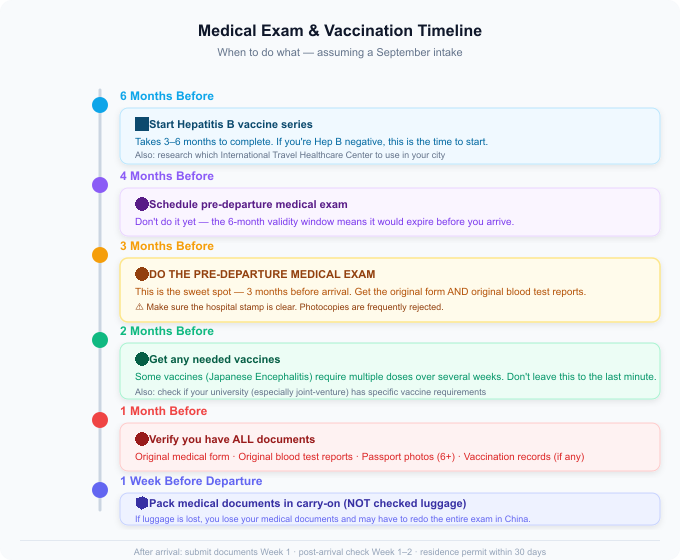
Part 8: Timeline: when to do what
Here’s a realistic calendar for the health checkpoint, assuming a September intake:
Summary: The Practical Takeaways
1. Do the pre-departure medical exam 2–3 months before you arrive, not earlier. The 6-month validity window is strict.
2. Bring the original form AND the original blood test reports to China. Photocopies are frequently rejected.
3. Vaccines are not nationally mandated, but joint-venture universities (like NYU Shanghai) may require them. Check your specific university’s health requirements page.
4. Being a hepatitis B carrier is not disqualifying. China removed this restriction years ago.
5. The post-arrival health check is mandatory at most universities. Budget ¥400–¥800 for it.
6. You have 30 days from arrival to get your residence permit, and the health certificate is required for that. Don’t delay.
7. If you have a pre-existing condition, disclose it on the form and bring a doctor’s note in English. Hiding it creates bigger problems than disclosing it.
This guide draws on official requirements from the Ministry of Education Order No. 42 (2017), Tsinghua University’s international student registration guidance, NYU Shanghai’s immunization requirements, and the standard procedures of International Travel Healthcare Centers in major Chinese cities. Individual university policies vary. Always confirm the specific requirements with your university’s international student office.
Pros and cons at a glance
| Pros | Cons and things to weigh |
|---|---|
| Most traditional Chinese universities do not require specific vaccines for enrollment | The exam form is valid for only 6 months, so mistiming delays enrollment |
| Hepatitis B carrier status is not disqualifying, China removed the restriction in 2009 | You must bring the original form and original lab reports, copies are often rejected |
| The post-arrival exam is cheap, about 400 to 800 RMB in most cities | Joint-venture universities like NYU Shanghai may impose their own vaccine rules |
| The process is well established at International Travel Healthcare Centers | You have only 30 days after arrival to finish the check and apply for the residence permit |
Key authorities and official resources
- Campus China: official CSC admissions and university application portal
- China Scholarship Council (CSC): official Chinese government scholarship body
- Study in China: official Chinese government portal for international students
- General Administration of Customs of China: issues the Foreigner Physical Examination Form
- National Immigration Administration of China: residence permit and 30-day arrival rule