What to pack for China (and what NOT to pack): a reality check for international students
You are staring at an empty suitcase, your bedroom floor covered in piles of clothes, toiletries, and electronics. Your mother wants you to bring six months of shampoo. Your friend says you need a rice cooker. A blog post from 2019 tells you to pack thermal underwear. None of these people have tried to buy shampoo on Taobao at 2 a.m. and received it before breakfast.
The reality is simple: China sells almost everything you need, often cheaper than your home country, with same-day or next-day delivery in most cities. The Shanghai government’s official packing guide for international students puts it plainly: “Shopping in China is simple and convenient. Once you arrive, you can easily meet your daily needs at campus supermarkets, convenience stores, or shopping centers nearby.” The China Daily study platform agrees: “Pack light but smart. You can buy almost everything in China, often at affordable prices.”
This article tells you what actually belongs in your suitcase, what to leave behind, and why most packing lists on the internet are wrong. It draws on official guidance from the Shanghai Municipal Government, the China Daily Study China platform, the OLACHina pre-departure checklist, and current Chinese customs regulations.

Category 1: Documents (carry-on only, never checked)
Documents are the one category where you cannot afford to make a mistake. Lose your passport in checked luggage and your first week in China becomes a bureaucratic nightmare. The OLACHina checklist is explicit: “Never pack these in a checked bag. Keep the originals on you, with photocopies and scans as backup.”
Here is what goes in your carry-on bag, in a single folder you can grab at customs:
- Passport with your X1 or X2 visa
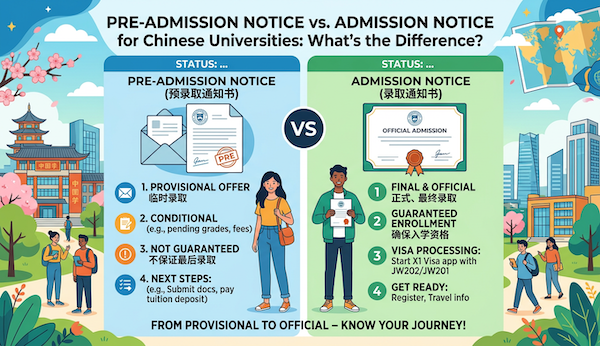
- Admission Notice and JW202/JW201 form (originals, not copies)
- Original diploma and transcripts, plus apostilled copies if required
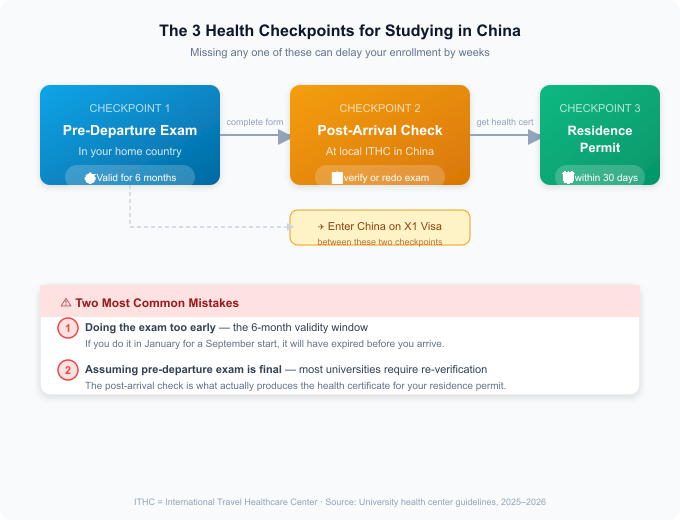
- Foreigner Physical Examination Form with results and doctor’s stamp
- Passport photos: bring at least 20 copies in 1-inch and 2-inch sizes. You will need them for registration, residence permit application, library card, campus card, and medical exam. The Shanghai government guide recommends bringing both sizes
- Scholarship award letter, if applicable
Category 2: Electronics (the adapter question)
This is where most students waste suitcase space and money. Here is what you actually need to know about electronics in China.

China operates on 220 volts at 50 Hz. The United States uses 110V at 60 Hz. If you plug a 110V-only device into a Chinese socket, it will fry. But here is the thing most packing lists do not mention: almost all modern laptop chargers and phone chargers are rated 100 to 240V, meaning they work in China without a voltage converter. Check the small print on your charger brick. If it says “100-240V, 50/60Hz,” you are safe. You only need a plug adapter, not a converter.
China uses three plug types: Type A (two flat pins, same as the US), Type C (two round pins, same as Europe), and Type I (three flat pins, same as Australia). The China Daily packing guide lists all three as common. A single universal adapter covers all three types.
| Electronic item | Bring from home? | Why |
|---|---|---|
| Laptop and charger | Yes | Essential for study; check charger is 100-240V |
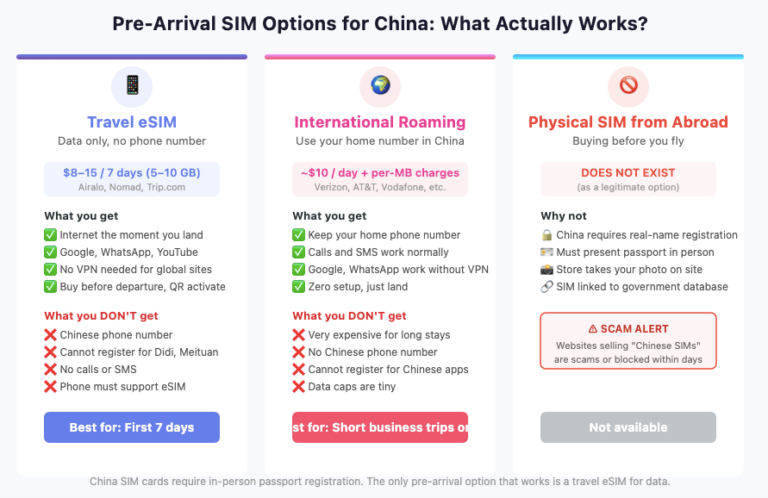
| Phone and charger | Yes | You will buy a Chinese SIM at the airport |
| Universal power adapter | Yes | One adapter covers all three Chinese plug types |
| Power bank | Yes, with conditions | Must have 3C certification for domestic flights |
| Headphones or earbuds | Yes | Personal preference, hard to replace exact model |
| Hair dryer | No | Buy locally; 110V dryers will burn out on 220V |
| Electric kettle or cooker | No | Dorm rules often prohibit; buy locally if allowed |
| Voltage converter | Usually no | Only needed for 110V-only appliances |
Category 3: Clothing (less than you think)
The Shanghai government guide recommends bringing “a few short-sleeved shirts and light jackets” for September arrival, plus “one or two thicker coats such as down jackets and trench coats for the coming winter.” Beyond that, the advice is to buy locally.
China’s climate varies enormously by region. A student arriving in Harbin in January faces temperatures of minus 25 degrees. A student arriving in Guangzhou in the same month enjoys 15 degrees. Pack for the first two weeks of your specific city, not for the entire year.
| City | September temp | January temp | What to pack for arrival |
|---|---|---|---|
| Beijing | 15 to 25 degrees | -5 to 5 degrees | Light jacket, buy winter coat locally |
| Shanghai | 20 to 28 degrees | 0 to 8 degrees | Light clothing, buy coat in November |
| Guangzhou | 25 to 33 degrees | 10 to 18 degrees | Summer clothes, light sweater |
| Harbin | 10 to 20 degrees | -20 to -10 degrees | Jacket for arrival, buy extreme cold gear locally |
| Chengdu | 18 to 26 degrees | 3 to 10 degrees | Light layers, humid climate |
Category 4: Medicine (strict rules apply)
China’s customs regulations on medicine are strict. The Shanghai government guide states that “opium, morphine, heroin, marijuana, and other addictive narcotics and psychotropic substances are strictly prohibited.” This is not a suggestion. Customs officers inspect medicine, and carrying prohibited substances can result in detention.
For prescription medication, the rules are clear: bring the medicine in its original packaging, carry the prescription, and bring a letter from your doctor explaining the medical condition and the medication. The OLACHina checklist recommends bringing “enough for several months” and noting the generic name of your medication, since brand names differ in China.
For over-the-counter medicine, bring only a small supply for the first few days. Pain relievers, cold medicine, and anti-diarrhea medication are all available at Chinese pharmacies for a fraction of Western prices. The China Daily guide notes that “medical treatment and purchasing medicines are very convenient” in China.
Category 5: What NOT to pack (the counter-intuitive list)
Here is where most packing lists fail. They tell you what to bring but never tell you what to leave behind. These items are commonly packed by international students and universally regretted:
| Item students pack | Why they pack it | Why they regret it |
|---|---|---|
| Bedding (sheets, pillows, blankets) | “Dorm beds are uncomfortable” | Chinese dorm beds use non-standard sizes. Buy locally to guarantee fit. Delivery is next-day. |
| Large bottles of toiletries | “I need my brand” | International brands (Unilever, P&G, L’Oreal) are sold everywhere. Generic equivalents cost ¥10 to ¥20. |
| Cooking appliances | “I want to cook my own food” | Most dorms prohibit cooking appliances due to fire risk. Buy a cheap rice cooker locally if your dorm allows it. |
| A year’s worth of clothing | “I won’t find my size” | Taobao and Pinduoduo sell every size and style. Prices are often 50 to 70 percent lower than Western retail. |
| Textbooks | “I need my reference books” | Too heavy, excess baggage fees exceed book value. Buy ebooks or use university library. |
| Large amounts of cash | “I need money for the first week” | Unsafe and unnecessary. Bring ¥1,000 to ¥2,000 as backup. Set up WeChat Pay and Alipay on day one. |
| Hair dryer or straightener | “My 110V one will work” | It will burn out on 220V. Buy a local one for ¥50 to ¥100. |
Category 6: Things you should pack but probably forgot
These are the items that do not appear on most packing lists but will save you stress during your first week:
- A small gift from your home country. Tea, sweets, or a small handicraft. You will give it to your fudaoyuan (student affairs officer), roommate, or class monitor as a gesture of goodwill. This matters more in Chinese culture than you might expect.
- Comfort food from home. A few packs of your favorite snacks. Not for nutrition, for homesickness. You will eat them on day three when everything feels overwhelming.
- Photos of family and friends. Print them. They go on your dorm desk or wall. Digital photos are not the same.
- Your university’s address written in Chinese. Printed on a card or saved as a phone wallpaper. Show it to the taxi driver at the airport. The OLACHina checklist specifically recommends this: “keep your dorm address written in Chinese.”
- VPN downloaded and tested before you fly. VPN websites are blocked inside China. Download and test your VPN on your home wifi before departure.
The 30-minute packing method
If you follow only one piece of advice from this article, follow this: pack in three layers. Layer one is your carry-on with all documents, electronics, and two days of clothing. Layer two is your checked bag with seasonal clothing, formal outfit, and medicine. Layer three is everything you think you need but probably do not. Put layer three in a pile on your bed. Now remove half of it. That is your final packing list.
The OLACHina checklist summarizes the philosophy: “Pack light. China sells clothing, bedding, and toiletries cheaply. Prioritise documents, prescription medicine, a power adapter, and climate-appropriate clothes for your specific city.”
Can I bring my gaming console to China?
Yes, but check the voltage. The PlayStation 5 and Xbox Series X have multi-voltage power supplies (100-240V), so they work in China with just a plug adapter. The Nintendo Switch charger is also multi-voltage. However, some older consoles are 110V-only and will burn out. Also note that certain games are region-locked or banned in China. Bring physical game discs rather than relying on digital storefronts.
Should I bring a laptop or buy one in China?
Bring your laptop from home. Laptops in China are similarly priced to Western markets, and buying one requires a Chinese payment method and sometimes a Chinese ID for warranty registration. Your existing laptop with a universal adapter will work fine. Just confirm the charger says 100-240V.
How much cash should I bring?
Bring ¥1,000 to ¥2,000 in cash for your first few days. This covers airport taxi, meals, and small purchases before your mobile payment is set up. Do not bring more than ¥5,000 in cash. China is highly cashless, and you will rarely use cash after the first week. Set up WeChat Pay and Alipay as soon as you have a phone number.
Can I bring food into China?
Sealed, commercially packaged snacks are generally fine. Fresh fruits, vegetables, meat, and dairy products are prohibited. Customs officers may inspect food items. Avoid bringing anything containing meat, including instant noodles with meat flavor packets from certain countries. When in doubt, declare it.
Do I need to bring passport photos or can I take them in China?
You can take passport photos in China at photo studios (xiangguan) for ¥20 to ¥50 per set. However, during registration week, you will need photos immediately for multiple forms. Bring at least 20 copies from home in both 1-inch (25mm x 35mm) and 2-inch (35mm x 49mm) sizes. Chinese universities use these specific sizes for ID cards, library cards, and residence permit applications.
What if my luggage is over the weight limit?
Remove bedding, toiletries, and excess clothing first. These are the heaviest items and the easiest to replace locally. Keep all documents and electronics in your carry-on. If you are still over weight, ship a box to your university address using an international courier (DHL, FedEx). Shipping costs are often lower than airline excess baggage fees.
Pros and cons at a glance
| Pros | Cons |
|---|---|
| Packing by category prevents forgotten essentials. | Adapter and voltage confusion breaks devices on arrival. |
| Carry-on-only for documents and electronics removes the biggest loss risk. | Medicine rules are strict and a wrong item means confiscation. |
| A what-not-to-pack list avoids customs trouble and wasted weight. | Over-packing clothing wastes the allowance you need for gifts and winter gear. |
Key authorities and official resources
- Campus China (CSC): Official China Scholarship Council portal for scholarships and the study-in-China system.
- CSC Application System: The official platform to submit CSC scholarship applications.
- National Immigration Administration: Rules on visas, residence permits, and temporary residence registration.
- Ministry of Education: National education regulations, degree recognition, and policy notices.
- Chinese Test (HSK): Official HSK Chinese proficiency test registration and score portal.
- China.org.cn: The official English gateway to Chinese government services and policy.
Frequently asked questions
Can I bring my gaming console to China?
Yes, but check the voltage. PS5 and Xbox Series X use multi-voltage power supplies, as does the Switch charger. Older 110V-only consoles need a transformer.
Should I bring a laptop or buy one in China?
Bring your laptop from home. Laptops cost about the same in China and buying one needs a local payment method. Your existing laptop with a universal adapter is simplest.
How much cash should I bring?
Bring RMB 1,000 to 2,000 for your first few days and do not carry more than RMB 5,000. China is highly cashless, so set up WeChat Pay and Alipay as soon as you land.
Can I bring food into China?
Sealed, commercially packaged snacks are generally fine. Fresh fruit, vegetables, meat, and dairy are prohibited, and anything with meat should be avoided.
Do I need passport photos or can I take them in China?
You can take photos in China for RMB 20 to 50, but bring at least 20 copies from home in 1-inch and 2-inch sizes because registration week needs them immediately.
What if my luggage is over the weight limit?
Remove bedding, toiletries, and excess clothing first. Keep all documents and electronics in your carry-on. You can ship a box to your university address with an international courier.