You finished your bachelor’s in China. Now you are looking at Bangkok.
Maybe it is a master’s at Chulalongkorn. Maybe it is a job at a Chinese EV factory in Rayong. Maybe you heard there is a Smart Visa that lets you stay four years without a work permit.
The question sitting in your head is simple: does this Chinese degree actually count in Thailand?
The short answer: yes, legally. And in some industries, it may count more than you think. The longer answer: it depends on which university you went to, which industry you are targeting, and whether you understand why 42% of Thailand’s foreign investment is now Chinese money.
This article breaks down the legal framework, the rankings, and where a Chinese degree genuinely opens doors in Thailand that other degrees do not.
1. The legal status: Chinese degrees are fully recognized in Thailand
China and Thailand signed a bilateral agreement on mutual recognition of academic degrees in May 2007. This means Thai government agencies are legally obligated to recognize Chinese university degrees at the bachelor’s, master’s, and doctoral levels.
In practice, recognition flows through two agencies:
- OHEC (Office of the Higher Education Commission, Thailand): evaluates foreign credentials for civil service positions, teaching licenses, and certain regulated professions.
- The Ministry of Foreign Affairs: handles visa and work permit documentation that requires degree verification.
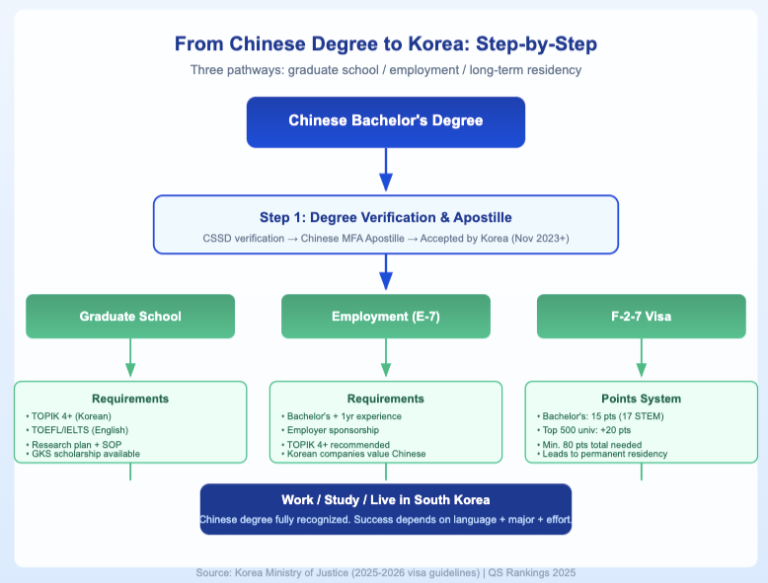
The Apostille system makes the process straightforward. Since China joined the Hague Apostille Convention in November 2023, and Thailand joined earlier, a single Apostille stamp from the Chinese Ministry of Foreign Affairs is sufficient for Thai authorities. No separate Thai consulate legalization needed.
The verification chain:
Your Chinese university → CSSD (China credential verification) →
Chinese Ministry of Foreign Affairs (Apostille) →
Accepted by Thai universities, employers, and immigration
One practical note: if you plan to work in a regulated profession in Thailand (medicine, law, engineering licensing, teaching at public schools), you may face additional credential evaluation by the relevant Thai professional council. This applies to any foreign degree, not just Chinese ones.
2. QS rankings: how Thai admissions officers and HR managers actually see Chinese universities
Legal recognition is one thing. How people actually perceive the value of your degree is another.
Thai graduate schools and Thai HR departments may not know every detail of Chinese higher education, but they do read QS rankings — and the comparison is stark.
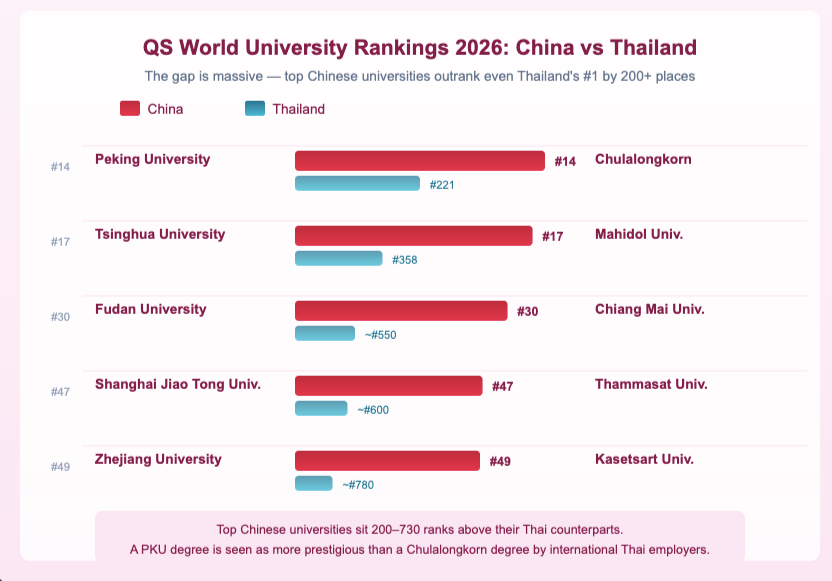
| Chinese University | QS 2026 | Thai Peer | QS 2026 |
|---|---|---|---|
| Peking University (PKU) | #14 | Chulalongkorn University | #221 |
| Tsinghua University | #17 | Mahidol University | #358 |
| Fudan University | #30 | Chiang Mai University | ~#550 |
| Shanghai Jiao Tong (SJTU) | #47 | Thammasat University | ~#600 |
| Zhejiang University (ZJU) | #49 | Kasetsart University | ~#780 |
What this table tells you:
The top Chinese universities sit in an entirely different tier from even Thailand’s best. Chulalongkorn is the undisputed #1 in Thailand (it has held that position for 17 consecutive years), and it is still over 200 places below Peking University in the global ranking.
This matters for two reasons:
First, for graduate admissions: a degree from a Chinese university ranked in the QS top 200 will be viewed favorably by admissions committees at Chulalongkorn, Mahidol, or Thammasat. The perception is that you have been educated in a more competitive academic environment.
Second, for corporate recruiting: large Thai companies and multinational corporations with operations in Thailand increasingly look at university brand recognition beyond just Thai universities. A PKU or Tsinghua degree will be recognized. Even Fudan, ZJU, and SJTU carry weight among Thai employers who operate internationally — especially those with Chinese business ties.
The practical threshold: if your Chinese university is in the QS top 500, your degree adds meaningful signal value in the Thai job market. Below top 500, recognition drops off sharply, because Thai HR managers may simply not have heard of it.
3. Using a Chinese degree for graduate school in Thailand
If your goal after studying in China is to pursue a master’s at a Thai university, your Chinese degree is treated no differently from any other foreign degree.
Thai graduate schools evaluate foreign applicants based on the same criteria: transcript quality, statement of purpose, letters of recommendation, and language proficiency (English or Thai, depending on the program). The country where you earned your bachelor’s degree is not a factor in the admission decision.
There is one card a Chinese degree holder can play that other foreign applicants generally cannot: Chinese language ability.
Many graduate programs at Chulalongkorn and Thammasat now offer courses on Chinese business, Chinese trade law, and Belt & Road economic policy. These programs value students who can read Chinese-language sources and communicate with mainland Chinese stakeholders. If you completed your undergraduate degree in China and became functional in Chinese, that is a differentiator in your application — especially for programs in international business, economics, and public policy.
Some specific programs where Chinese proficiency matters:
- Chulalongkorn’s ASEAN Studies and International Economics programs: courses on China-ASEAN trade are standard in the curriculum.
- Thammasat’s Pridi Banomyong International College: the China Global Affairs program directly values applicants with China experience.
- Mahidol’s International Business track: Chinese-speaking graduates have an advantage in internship placement with Chinese multinationals operating in Thailand.
4. Chinese companies in Thailand: the employment engine
This is where a Chinese degree becomes more than a credential — it becomes a direct career asset in a way that it simply is not in other countries.
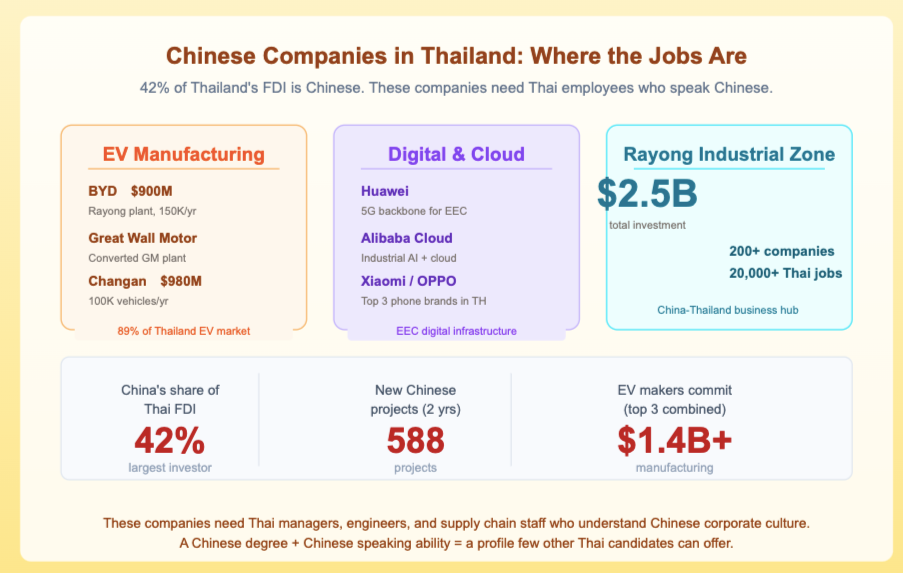
The numbers are hard to ignore:
| Metric | Data |
|---|---|
| China’s share of Thailand’s foreign investment (2024) | 42% |
| New Chinese-registered projects (2023-2024) | 588 projects |
| Total project value | ~$7 billion |
| Thai-Chinese Rayong Industrial Zone | $2.5 billion invested, 20,000+ Thai workers |
| Chinese EV market share in Thailand (early 2024) | 89% |
| China-Thailand trade deficit (Jan-Apr 2025) | $19.2 billion |
Who is hiring in Thailand right now:
| Company | Investment | What They Do in Thailand |
|---|---|---|
| BYD | $900 million | Rayong EV factory, 150,000 vehicles/year capacity |
| Great Wall Motor | Undisclosed | Converted former GM plant to EV production |
| Changan Auto | ¥98 billion ($980 million) | Dedicated EV plant, 100,000 vehicles/year |
| MG, NETA, GAC Aion | Individual investments | Sales, service, and assembly |
| Huawei | Undisclosed | 5G backbone for Eastern Economic Corridor (EEC) |
| Alibaba Cloud | Undisclosed | Cloud computing, industrial AI systems |
Three Chinese EV makers alone have committed over $1.4 billion to Thai manufacturing. These factories need Thai managers who understand Chinese corporate culture, Thai engineers who can read Chinese technical documents, and Thai supply chain professionals who can coordinate with headquarters in Shenzhen.
The specific edge of a Chinese degree holder:
A Thai national (or any Southeast Asian candidate) who graduated from a Chinese university and can speak Chinese walks into an interview at BYD Rayong or Huawei Bangkok with a profile that few other applicants can match. They have spent years inside the Chinese education system, they understand how Chinese organizations operate, and they can communicate with the Chinese side of the business without a translator.
This is not a theoretical niche. The Thai-Chinese business corridor is one of the fastest-growing employment pipelines in Southeast Asia. In 2024, Chinese-speaking job postings on Jobsdb Thailand in the manufacturing, logistics, and tech sectors grew at roughly 30% year over year. The demand is real, and it is concentrated in exactly the industries where Chinese universities have strong programs: engineering, computer science, business administration, and international trade.
5. Visa and work permit pathways
Thailand offers several visa categories that are relevant for foreign degree holders looking to work in the country.
Smart Visa (BOI)
The Board of Investment (BOI) Smart Visa is the most attractive option. It targets professionals in 18 priority industries including:
- Next-generation automotive (this is where the EV companies operate)
- Digital and software
- Medical and wellness
- Smart electronics
- Robotics and automation
Key benefits:
- 4-year visa, renewable
- No work permit required (the visa itself authorizes work)
- 90-day reporting instead of every 90 days at immigration
- Fast-track service at international airports
- Spouse and children can accompany
The Smart Visa has three categories:
- Smart T (Talent): for highly skilled professionals. Requires a master’s degree or higher and a job offer from a BOI-promoted company with a minimum salary of 100,000 THB/month.
- Smart I (Investor): requires a minimum investment of 20 million THB in a BOI-promoted industry.
- Smart E (Executive): for senior executives at BOI-promoted companies.
Most Chinese degree holders would target the Smart T category. Your Chinese degree is evaluated on its own merits — nationality and where you earned the degree do not disqualify you.
Non-Immigrant B Visa (Work)
The standard work visa route. You need:
- A job offer from a Thai company
- Employer files for a work permit on your behalf
- Registration with the Social Security Office
Companies that are BOI-promoted have an easier time sponsoring work permits. Since many Chinese-invested factories and tech operations in Thailand qualify for BOI promotion, this is a relevant factor.
LTR Visa (Long-Term Resident)
The LTR visa targets wealthy global citizens, wealthy pensioners, professionals working from Thailand, and highly skilled professionals. For the “highly skilled professional” category, you need a job offer or employment contract and three years of relevant experience. A degree from a recognized foreign university is part of the basic qualifications.
6. Practical step-by-step: from Chinese degree to Thai career
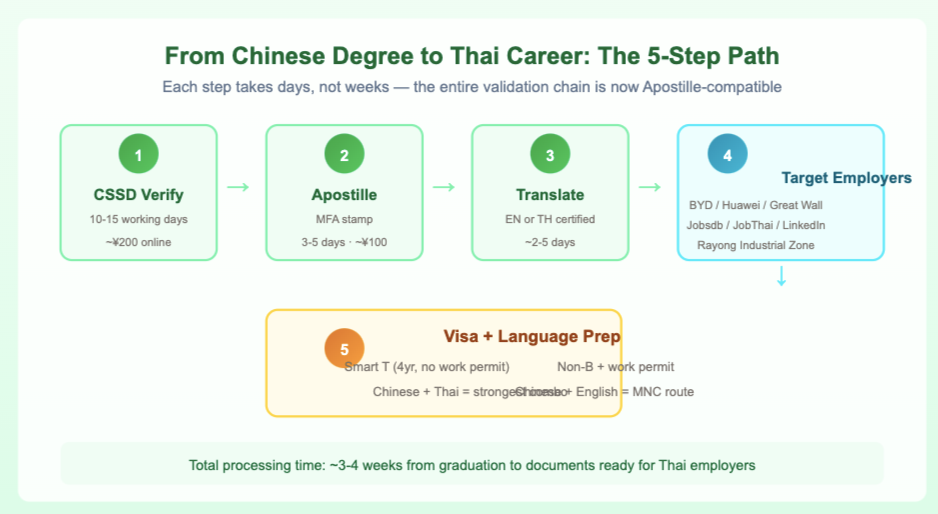
Step 1: Verify your degree through CSSD
The Chinese Service Center for Scholarly Exchange (CSSD) issues official verification reports. This is the first document any Thai employer or graduate school will ask for. The online application typically takes 10-15 working days.
Step 2: Get the Apostille
Take your CSSD-verified degree certificate to a designated office of the Chinese Ministry of Foreign Affairs. The Apostille costs about ¥100 and takes 3-5 working days. This single stamp replaces the old multi-step legalization process.
Step 3: Translate your documents
For most Thai employers and immigration offices, an English translation of your degree certificate and transcript is sufficient. For some Thai government agencies, a certified Thai translation may be required. Translation can be done through a Thai embassy-approved translator or a certified translation service in Bangkok.
Step 4: Identify your target employers
If you are pursuing the Chinese-company route, the most efficient approach is to apply directly to Chinese multinationals with Thai operations:
- BYD Thailand (Rayong): recruiting through their Bangkok office and at Thai university job fairs
- Huawei Thailand: posts openings on Jobsdb and LinkedIn
- Great Wall Motor: recruits through their Rayong HR department
- Thai-Chinese Rayong Industrial Zone: over 200 companies, many with Thai-language job listings
For non-Chinese employers, standard Thai job platforms apply: Jobsdb Thailand, JobThai, LinkedIn, and direct company career pages.
Step 5: Language preparation
If you plan to work for a Chinese company in Thailand, Chinese + Thai is the strongest combination. If your Chinese is strong but your Thai is limited, target positions where the working language is English or Chinese (these exist in multinational settings). If neither Chinese nor Thai is your strong suit, focus on English-language positions at larger international firms.
7. When a Chinese degree does NOT help in Thailand
Here are the scenarios where your Chinese degree adds little or no signal value:
| Scenario | Why It Does Not Help |
|---|---|
| Chinese university not in QS top 500 | Thai HR managers likely have not heard of it; the brand recognition is absent |
| No Chinese language ability | The core advantage of a Chinese degree — cultural and linguistic bridge to Chinese employers — is lost |
| Seeking a job with no China connection | If your target employer does no business with China and has no Chinese-speaking clientele, a Chinese degree is no more useful than any other foreign degree |
| Regulated professions | Medicine, law, and engineering licensing in Thailand require additional Thai exams and credentials regardless of where you studied |
| Targeting government roles | Thai civil service positions strongly preference Thai university graduates; a foreign degree offers no advantage |
8. Summary: the picture in one table
| Factor | Status |
|---|---|
| Legal recognition | Full — 2007 bilateral agreement + Hague Apostille (2023) |
| Graduate school admission | Standard foreign-degree treatment; Chinese language ability is a differentiator |
| QS ranking advantage | Chinese top 5 massively outrank Thai top 5 |
| Employment (Chinese companies) | Strong — 42% of Thai FDI is Chinese, EV sector alone carries 1.4 billion USD |
| Employment (non-Chinese companies) | Moderate — depends on QS rank of your university |
| Smart Visa eligibility | Yes — Smart T targets degree holders in target industries |
| Non-B work permit | Yes — standard route, no discrimination against Chinese degrees |
| Chinese-speaking job market | Growing at ~30% year over year |
| Key caveat | Value collapses if you cannot speak Chinese |
The bottom line: a Chinese degree in Thailand is a credential with a built-in employment pipeline. The 42% of Thai FDI coming from China, the $1.4 billion in EV manufacturing commitments, and the 30% year-over-year growth in Chinese-speaking job postings are not projections — they are the current market. If you graduate from a recognized Chinese university and can speak Chinese, you walk into a job market where your specific combination of skills is undersupplied. If you cannot speak Chinese, your degree is no different from any other foreign credential — still recognized, but without the multiplier effect.
Pros and cons at a glance
A balanced view, drawn from the sections above, helps you judge whether a Chinese degree is the right move for your Thailand plan.
| Pros | Cons and watch-outs |
|---|---|
| Legally recognized: the 2007 China-Thailand mutual-recognition agreement plus the Hague Apostille (China joined in 2023) make verification a single step | Recognition drops sharply for universities outside the QS top 500, because many Thai HR managers have not heard of them |
| Top Chinese universities (Peking #14, Tsinghua #17 in QS 2026) outrank even Chulalongkorn (#221), Thailand’s #1 school | Regulated professions (medicine, law, engineering) require extra Thai licensing regardless of where you studied |
| Direct pipeline to Chinese companies in Thailand: about 42% of Thai FDI is Chinese, and the EV sector alone has committed over USD 1.4 billion | Thai civil service roles strongly prefer Thai university graduates |
| The BOI Smart Visa (Smart T) evaluates your degree on its own merits, with no country penalty | Without Chinese language ability, the main advantage is lost |
| Chinese language skill becomes a hiring multiplier with Chinese employers and China-facing roles | For roles with no China connection, a Chinese degree counts like any other foreign credential |
Key authorities and official resources
The links below are the official bodies and reference sources behind the facts in this article. They are the pages you will actually use to verify or act on a Chinese degree in Thailand.
- Hague Apostille Convention (HCCH) – The official treaty text and member list for apostille recognition.
- Office of the Higher Education Commission (MHESI), Thailand – Thai authority that evaluates foreign credentials for civil service and licensed professions.
- Chinese Service Center for Scholarly Exchange (CSSD) – Issues the official verification report for Chinese degrees used abroad.
- China credential verification (CHESICC / chsi.com.cn) – China’s national education credential database used for degree verification.
- Chinese Ministry of Foreign Affairs – Issues the Apostille stamp on Chinese degree certificates.
- QS World University Rankings 2026 – The global ranking Thai admissions offices and employers read.
- Chulalongkorn University – Thailand’s top-ranked university; a common graduate-school target.
- Mahidol University – Leading Thai research university with international business tracks.
- Thammasat University – Home of the China Global Affairs and ASEAN studies programs.
- Thailand Board of Investment (BOI) / Smart Visa – Official Smart Visa rules and priority industries for skilled professionals.
- Jobsdb Thailand – Major Thai job board where Chinese-speaking postings are growing.
Frequently asked questions
Is a Chinese degree legally recognized in Thailand?
Yes. China and Thailand signed a bilateral agreement on mutual recognition of academic degrees in May 2007, and both countries are now part of the Hague Apostille Convention (China joined in November 2023). A single Apostille from China’s Ministry of Foreign Affairs is enough for Thai authorities. Recognition flows through Thailand’s Office of the Higher Education Commission for civil service and licensed professions, and through the Ministry of Foreign Affairs for visa and work-permit documents.
How do I get my Chinese degree accepted in Thailand?
First obtain a verification report from China’s credential service (CSSD / CHESICC). Then take your certificate to a designated office of China’s Ministry of Foreign Affairs for an Apostille (about CNY 100, 3 to 5 working days). An English translation of your certificate and transcript is usually enough for employers and immigration; some Thai agencies may ask for a certified Thai translation.
Do Thai employers and universities know Chinese universities?
They read QS rankings. In QS 2026, Peking University (#14) and Tsinghua (#17) sit far above Chulalongkorn (#221), Thailand’s top school. A degree from a Chinese university in the QS top 200 carries real signal value. Below the QS top 500, recognition drops because many Thai HR managers simply have not heard of the school.
Can I work in Thailand after a Chinese degree?
Yes, especially with Chinese companies. About 42% of Thailand’s foreign investment comes from China, and three Chinese EV makers alone have committed over USD 1.4 billion to Thai manufacturing. The BOI Smart Visa (Smart T) targets degree holders in priority industries and does not penalize a Chinese degree. Non-Chinese employers evaluate you mainly on university rank and skills.
Do I need to speak Chinese to benefit?
It helps a lot. The core advantage of a Chinese degree in Thailand is the cultural and linguistic bridge to Chinese employers and to China-facing roles. Without Chinese, your degree is recognized but loses its multiplier effect and competes as a neutral foreign credential.
Which jobs value a Chinese degree most in Thailand?
Roles at Chinese-invested manufacturers and tech firms (BYD, Great Wall, Changan, Huawei, Alibaba Cloud), supply-chain and trade positions tied to the Eastern Economic Corridor, and graduate programs in China-ASEAN business, trade law, and international economics at Chulalongkorn, Thammasat, and Mahidol.
Last updated: June 2026. Data sources: QS World University Rankings 2026, Thailand Board of Investment, Thailand Ministry of Foreign Affairs, Office of the Higher Education Commission, Chinese Ministry of Education, industry reports.