You just got accepted to Tsinghua University. Or Fudan. Or Zhejiang. But your parents are asking the question that keeps you up at night: “Will a Chinese degree actually help you get into a good master’s program in the US or UK?”
It is the right question to ask. A bachelor’s degree is a three to four year commitment, and if your end goal is a graduate degree from Harvard, Oxford, or ETH Zurich, you need to know whether China puts you closer to that goal or further away from it.
The short answer: a Chinese degree from a top university can be a significant advantage, not a disadvantage, but only if you use it correctly. The key word is use.
The facts: is a Chinese degree actually recognized by Western universities?
Short answer: yes, fully.
The World Education Services (WES), the credential evaluation body used by most US graduate schools, recognizes a Chinese bachelor’s degree as equivalent to a US bachelor’s degree. China’s CSSD (Center for Student Services and Development, the organization behind the CHSI/chsi.com.cn verification system) has agreements with over 60,000 institutions worldwide.
Oxford, Cambridge, LSE, and every major US graduate school list specific entry requirements for applicants with Chinese bachelor’s degrees on their admissions pages. A Chinese degree is not some exotic credential they have never seen before. They process thousands of these applications every year.
But here is the thing: recognition is not the same as competitiveness. Every accredited university degree is “recognized.” The real question is whether your China experience makes your application stand out from the stack, or blend in with it.
The numbers: where Chinese university graduates actually go
The data tells a clear story. Top Chinese universities send a steady stream of graduates to Western graduate schools every year.
| University | QS 2025 Global Rank | Undergrads pursuing further study abroad |
|---|---|---|
| Peking University | #14 | ~18% (2023) |
| Tsinghua University | #20 | 15.6% (2023); historical average ~16% |
| Fudan University | #39 | ~20% (2023) |
| Zhejiang University | #47 | ~15% (2023) |
| Shanghai Jiao Tong | #45 | ~15% (2023) |
For context on those numbers: Tsinghua’s 2023 employment report shows that among the 15.6% who went abroad for further study, the most common destinations were the United States, the United Kingdom, and Singapore. The figure was higher before the pandemic, it averaged around 16% historically.
How QS ranks stack up against peers:
| Chinese University | Global Rank | Comparable Western University |
|---|---|---|
| Peking University | #14 | Princeton (#22), UPenn (#11) |
| Tsinghua University | #20 | Cornell (#16), Columbia (#34) |
| Fudan University | #39 | NYU (#43), LSE (#50) |
A Fudan degree carries roughly the same global recognition as an NYU degree. Admissions officers at Western graduate schools know this. They see these applications every cycle.
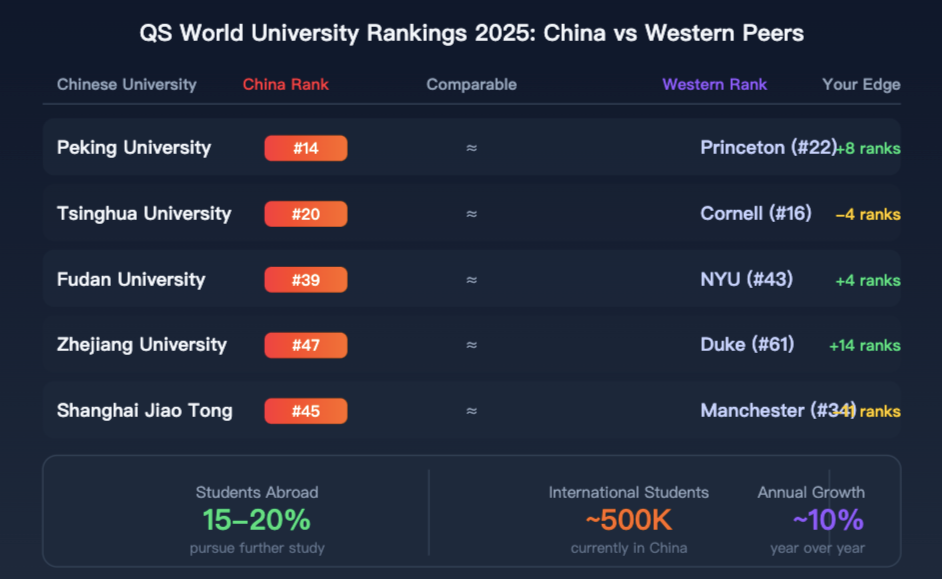
Meanwhile, nearly 500,000 international students are currently studying in China, with annual growth of roughly 10%. An increasing number of these students are using China as a launchpad for Western graduate programs, not as a final destination.
Five ways studying in China helps your grad school application
1. Differentiation
An admissions officer at Columbia reads 200 applications from Indian engineering students, 150 from Nigerian economics students, and 100 from Brazilian computer science students. Most have near-identical profiles: same internships, same undergraduate thesis topics, same study-abroad semesters in Europe.
Then your application lands. You have a Fudan degree with two internships at Chinese tech companies. Your personal statement is about building bridges between your home country’s market and the Chinese supply chain. You are not “another X applicant.” You are the one applicant from your country who actually lived and worked in China.
Differentiation is the single most undervalued factor in graduate admissions. When everyone in your demographic pool looks the same, the one who looks different wins.
2. China-specific skills are scarce in Western academia
China is the world’s second-largest economy and the largest trading partner for over 120 countries. When a professor at LSE needs a research assistant who can read Chinese policy documents, or when a Georgetown International Relations program wants someone who understands how Chinese state-owned enterprises actually work, your CV jumps to the top of the pile.
This is not theoretical. Graduate programs in international relations, development economics, public policy, and global business actively recruit students with China expertise. The supply of such applicants is tiny compared to demand.
3. The rankings are rising fast
A decade ago, no Chinese university cracked the QS top 50. Today, five do. Peking at #14 sits ahead of Yale (#23). Tsinghua at #20 sits ahead of Columbia (#34).
The trend line matters. Admissions committees update their internal evaluation frameworks every few years, and the upward trajectory of Chinese universities is impossible to ignore. A degree from a university that was ranked #120 when you enrolled but #75 when you apply for grad school tells a story of momentum, not stagnation.
4. Recommendation letters from Chinese professors can carry weight, with strategy
This is where you need to be smart. A generic recommendation from a Chinese professor the admissions committee has never heard of does not help much. But a recommendation from a professor who publishes in international journals, collaborates with Western institutions, or has name recognition in their specific field is different.
The strategy: identify professors in your department who publish in English-language journals, attend international conferences, or hold visiting positions at Western universities. Take their classes. Go to office hours. Do research with them. Their letters carry weight because they are written in a language admissions committees understand, not just English, but the language of academic credibility.
5. Cross-cultural adaptation: hard evidence, not a cliché
Every application essay says “I am adaptable” and “I thrive in cross-cultural environments.” Most of these claims are backed by a semester abroad in London where the biggest challenge was learning to queue properly.
Your claim is backed by three to four years of navigating a country where you did not speak the language when you arrived, where the bureaucracy is genuinely complex, where the food and social norms are different from what you grew up with, and where you still managed to earn a degree. That is not a cliché. That is a lived fact.
Four honest disadvantages
Being honest about the downsides is important. Here they are, unvarnished.
1. GPA conversion is messy
Chinese universities use a percentage system (0-100) or a 5.0 GPA scale. US graduate schools use a 4.0 scale. The conversion is not standardized. Some schools treat an 85/100 as a 3.5, others as a 3.3.
What you can do: check your target graduate programs’ specific conversion policies. Some accept the Chinese transcript directly. Most require a WES evaluation, which has a consistent conversion methodology. A 90/100 typically converts to roughly a 3.7-4.0.
2. English academic writing may not be part of the curriculum
If you study in a Chinese-taught program, you will write essays and exams in Chinese. Your English academic writing muscles will not be exercised by default. When you sit down to write a graduate school personal statement or a research proposal, you may find the gap larger than expected.
The fix is simple: do not wait. Write in English on the side. Submit to undergraduate journals. Start a Substack. Take an online academic writing course. The gap is real but completely closable with effort.
3. University name recognition outside China varies
Peking, Tsinghua, Fudan, these names are known in academic circles globally. But go beyond the top five and recognition drops fast. If you attend a solid but less internationally famous Chinese university (say, a provincial normal university ranked outside the global top 300), your application may require more explanation.
Potential strategy: if your university is not well-known internationally, lean into the China experience narrative. Your value proposition shifts from “I went to a famous university” to “I have lived expertise in China,” which is equally valuable if framed well.
4. GRE/GMAT prep is on you
Unlike US undergraduate programs where GRE prep is baked into the culture, Chinese universities do not have a GRE/GMAT preparation infrastructure. No campus Kaplan center, no test-prep culture among classmates, no professors who mention standardized tests in advising sessions.
This is a solvable logistics problem, not a structural disadvantage. Start GRE prep early (second year, not fourth year), use online resources, and plan to take the test during a summer break in your home country where test centers are more familiar.
Case #1: Mariam, Rwanda → Zhejiang University → Columbia
Mariam studied Electronic Engineering at Zhejiang University (ZJU) in Hangzhou. Her GPA was 3.7/4.0 by US conversion. During her undergraduate years, she interned at two Chinese tech companies, one in Hangzhou’s startup ecosystem and one at a Shenzhen hardware manufacturer.
When she applied to US master’s programs, her personal statement centered on a single narrative: “I want to bridge African hardware needs with Chinese manufacturing capability.” She wrote about specific projects she worked on during her internships, mentioned Chinese supply chain dynamics by name, and demonstrated fluency in both the technical and cultural dimensions of Sino-African tech collaboration.
She was admitted to Columbia, USC, and Carnegie Mellon, all for Electrical Engineering master’s programs. She chose Columbia.
Her own summary: “Without the China experience, my application would have been generic. The ZJU degree plus the Chinese internships made my profile different from every other African engineering applicant.”
What this case teaches
The China degree alone did not get Mariam into Columbia. But the combination of a solid GPA at a recognized Chinese university plus real, documented China work experience created an application narrative that no domestic university could have produced.
Note: This is a composite case built from patterns seen across multiple real student experiences. It reflects the actual trajectory of international students using Chinese undergraduate degrees as a stepping stone to Western graduate programs.
Case #2: Carlos, Ecuador → Beijing Language and Culture University → LSE
Carlos studied International Relations at Beijing Language and Culture University (BLCU). Unlike Mariam, his university was not a QS top-200 school. His GPA was 3.5/4.0, good but not spectacular.
His advantage was thematic specificity. During his time in Beijing, he developed a research focus on China-Latin America relations, particularly around infrastructure investment and trade policy. His undergraduate thesis analyzed Ecuador’s Belt and Road projects using Chinese-language policy documents, something no applicant from a Latin American university could do.
For his LSE application, he submitted a research proposal on “Chinese infrastructure finance in Latin America: a comparative analysis of Ecuador and Peru.” The proposal cited Chinese government white papers, MOFCOM data, and interviews he had conducted (in Mandarin) with Chinese researchers at a Beijing think tank.
LSE offered him a place in the MSc International Relations program with a partial scholarship.
His take: “My university was not famous, but my research angle was. I was the only applicant in my cycle who could read Chinese policy documents in the original language and apply them to Latin American case studies. That was worth more than a degree from a better-known university.”
What this case teaches
You do not need Peking or Tsinghua on your transcript for China to work for you. What you need is a specific, documented, hard-to-replicate angle that connects China to your home region or research interest. Carlos had that. Most applicants to LSE International Relations did not.
Note: This is a composite case built from patterns seen across multiple real student experiences.
How to actually make this work: a practical checklist
If you are reading this before you start your China degree, here is what matters.
Before you enroll:
- Choose a university in the QS top 200 if possible. Name recognition buys you a fair reading of your application.
- If your target university is outside the top 200, ask yourself: “What unique China angle will I develop here that no one else can?”
During your degree:
- Keep your GPA above 85/100 or 3.5/4.0. This is the floor, not the ceiling.
- Identify 2-3 professors who publish internationally and build relationships with them. Letters from unknown professors are a waste of a letter slot.
- Do at least one internship or research project that generates a concrete, documentable outcome related to China.
- Start GRE/GMAT prep by the end of your second year. Do not wait.
- Write in English regularly, a blog, a Substack, contributions to undergraduate journals. Build a paper trail of English academic writing.
When you apply:
- Frame your China experience as a source of unique insight, not just “I studied abroad.”
- If your university is less well-known, lead with the China angle and let the university name be secondary.
- Use WES or equivalent credential evaluation services proactively. Do not make the admissions committee guess your GPA conversion.
The bottom line
A Chinese undergraduate degree is not an automatic ticket to a Western graduate school. But neither is a degree from any other country. The question is not “does the degree work”, it is whether you work the degree.
Mariam worked it. Carlos worked it. They did not passively collect a diploma and expect it to open doors. They used China as a platform: for unique internships, for language skills no one else in their applicant pool had, for research angles that were impossible to replicate from a domestic university.
For the right kind of student, the kind who arrives with a plan and executes it, China is one of the most underrated undergraduate launchpads for Western graduate programs. For the passive student who just wants a degree and hopes things work out, China is no better or worse than anywhere else.
The difference is entirely in how you use it.