You land at your university in China. You walk into your assigned dorm room. It is smaller than you imagined. There is already someone else’s suitcase on the other bed. You look at the bathroom and realize it is a squat toilet. You sit on the bed and think: Did I make the wrong choice?
This moment happens to most international students in their first 24 hours in China. Not because the dorms are terrible. Because nobody told them what to actually expect.
This guide fixes that. I will walk you through the three main housing options, what they cost, what you really get, and how to decide before you pay for something you will regret.
1. The one-minute decision framework
If you remember nothing else, start here.
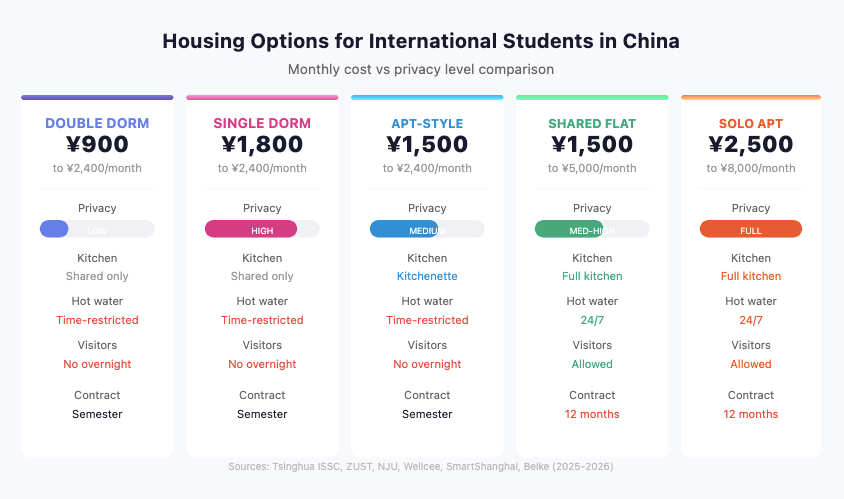
| Housing option | Monthly cost (RMB) | Privacy | Flexibility | Best for |
|---|---|---|---|---|
| Single dorm room | ¥1,800-2,400 | High | Low | Students who need quiet and privacy to study |
| Double dorm room | ¥900-1,200 per bed | Low | Low | Budget-conscious students who want campus convenience |
| Apartment-style dorm | ¥1,500-2,400 | Medium (own bedroom) | Low | Students who want privacy + some campus life |
| Off-campus shared flat | ¥1,500-5,000 | Medium-High | High | Students staying 2+ years who want independence |
| Off-campus solo apartment | ¥2,500-8,000 | Highest | Highest | Students who can afford it and want full control |
The short version: if you care about money, pick a double dorm. If you care about privacy, pick a single dorm or off-campus. If you want to cook your own food, you need off-campus housing.
Now let me explain why.
2. What Chinese university dorms actually look like
Before we talk about prices, let us talk about reality. Chinese university dorms are not what most Western students picture when they hear the word “dorm.”
The good parts
Most international student dorms in China are separate from Chinese student housing. This matters. Chinese student dorms are famously spartan: six to eight people in a room, communal squat toilets, no air conditioning in older buildings. International student dorms sit somewhere between Chinese dorms and a mid-range hotel.
Standard equipment in an international dorm room: a bed with mattress, a desk with chair, a wardrobe, air conditioning, and Wi-Fi. Most universities provide bedding (mattress, pillow, blanket, sheets), though the quality ranges from “fine” to “bring your own.”
International student buildings tend to be the newer ones on campus. Tsinghua University puts its international students in the Zijing Apartments complex. Zhejiang University has purpose-built international dormitories. Many universities have invested heavily in international accommodation over the last decade.
The parts that surprise people
Bathrooms are not what you expect. Some international dorms have private ensuite bathrooms with Western toilets. Others have shared bathrooms with squat toilets. The split is roughly 50/50 depending on the specific building and room type, and there is no reliable way to know which you will get until you arrive. The general rule: newly built campuses (often on city outskirts) lean Western toilet and private bathroom. Older campuses in city centers are a gamble.
Hot water has hours. This is the thing that shocks almost every international student. Hot water is not available 24/7 in many dorms. At Tsinghua, hot water runs from 7:00-14:00 and 17:00-00:00. At other universities the windows are similar. You cannot take a shower at 3:00 PM or 2:00 AM. This is not a malfunction. It is by design. Water heating in Chinese universities is centralized, and running it 24/7 would be prohibitively expensive.
You cannot cook in your room. With the exception of a few apartment-style units (like Tsinghua Building 20’s AB rooms, which have small kitchenettes), dorm rooms do not have kitchens. Most buildings have a shared kitchen on each floor or in a common area. You need to bring your own pots, pans, and utensils. Cooking appliances in your room (rice cookers, induction stoves, anything with a heating element) are banned and will be confiscated if found.
Air conditioning and heating are seasonal. At Tsinghua, the air conditioning system operates from June 1 to September 30. Heating runs from November 15 to March 15. In between those dates, you are at the mercy of the weather. This is common across most Chinese universities. Spring and autumn can be uncomfortable if a heat wave or cold snap hits outside the official window.
You will not live with Chinese students. International and Chinese students are housed separately at almost every university. The stated reason is “different living habits.” If you hoped to practice Mandarin with your roommate, that will not happen through housing. Some universities allow you to request a roommate from Hong Kong, Macao, or Taiwan as a middle ground. Otherwise, your roommate will be another international student.
3. Room type breakdown: what you pay and what you get
Double room (most common, cheapest)
A double room means two people share one room. Two beds, two desks, two wardrobes. Bathrooms may be ensuite or shared on the floor.
Real prices from real universities:
| University | Double room (per bed) | Period | Source |
|---|---|---|---|
| Tsinghua University (Beijing) | ¥40/day (¥1,200/month) | Year-round | Tsinghua ISA |
| Zhejiang University (Hangzhou) | ¥35-60/day | Semester | ZJU CUCAS |
| Peking University (Beijing) | ¥90-110/day (shared room) | Per day | PKU ISD |
| Fudan University (Shanghai) | ¥160-180/day (single only) | Per day | Fudan CUCAS |
| Nanjing University | ¥52/day | Semester | NU web |
| Beijing Language & Culture University | ¥80-150/day (varies by building) | Semester | BLCU |
| China University of Political Science & Law (Beijing) | ~¥450/semester total | Semester | CUPL |
Notes on the official data above:
- PKU: the official PKU International Student Division lists accommodation at ¥180-220/person/day depending on room type. A shared double room typically falls in the ¥90-110/day range.
- Fudan: on-campus dorms are extremely limited. CUAS lists only Unijia (private apartment near campus) at ¥160-180/day for single rooms. Fudan does not guarantee on-campus housing for all international students.
- ZJU: the CUCAS page lists ¥35-280/person/day depending on building and room type. Budget dorms start at ¥35/day; premium dormitories (international standard) run ¥60-80/day.
The range is enormous. CUPL at ¥450 per semester is less than ¥100/month: essentially free. BLCU at ¥150/day works out to ¥4,500/month, which is approaching off-campus rent territory. The price depends entirely on the university, the specific building, and whether the room has an ensuite bathroom.
Who should pick this: You are on a tight budget, you do not mind sharing space, you want maximum campus convenience, and you are only staying 1-2 semesters.
Single room (more privacy, harder to get)
A single room means you get the whole room to yourself. These are in high demand and short supply at most universities.
Real prices:
| University | Single room | Period | Source |
|---|---|---|---|
| Tsinghua University | ¥80/day (¥2,400/month) | Year-round | Tsinghua ISA |
| Peking University (PKU) | ¥180-220/day | Per day | PKU ISD official |
| Zhejiang University (ZJU) | ¥60-100/day | Per day | ZJU CUCAS |
| ZUST (Hangzhou) | ¥60-80/day | Semester | ZUST web |
| Nanjing University | ¥67/day | Semester | NU web |
PKU’s official range (¥180-220/day) translates to ¥5,400-6,600/month: more expensive than most off-campus shared flats in Beijing. If you get a PKU single room at the lower end (¥180/day = ¥5,400/month), you are paying a premium for campus proximity and security.
At ¥2,400/month, a Tsinghua single room costs more than a shared off-campus flat in Beijing’s university districts. You are paying for campus proximity and not having a roommate.
Who should pick this: You need quiet to study, you value privacy highly, and you can afford it. Or you got one of the few available single rooms and are not letting it go.
AB room / apartment-style (the middle ground)
Some universities offer an arrangement where you get your own bedroom but share a bathroom and sometimes a kitchenette with one other person. Tsinghua calls these “AB rooms” (¥80/day). The ApplyForChina site describes similar setups at other universities: private bedroom, shared living room, bathroom, and kitchen among 2-4 students.
Who should pick this: The best of both worlds. Privacy in your bedroom plus some social interaction. Usually costs the same as a single room but harder to find.
4. Off-campus renting: freedom, cost, and paperwork
Most international students eventually move off campus. Some do it immediately. Some do it after a semester. Very few stay in dorms for a full four-year degree.
What it costs, city by city
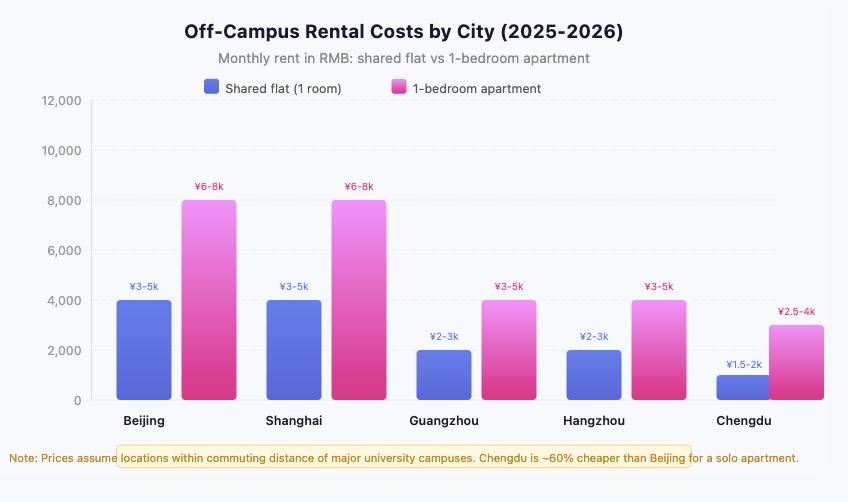
These are real market rates for international students in 2025-2026, based on listings from Wellcee, SmartShanghai, Beike, and Ziroom:
| City | Shared flat (1 room) | 1-bedroom apartment |
|---|---|---|
| Beijing | ¥3,000-5,000 | ¥6,000-8,000 |
| Shanghai | ¥3,000-5,000 | ¥6,000-8,000 |
| Guangzhou | ¥2,000-3,000 | ¥3,000-5,000 |
| Hangzhou | ¥2,000-3,000 | ¥3,000-5,000 |
| Chengdu | ¥1,500-2,000 | ¥2,500-4,000 |
Prices assume a location within reasonable commuting distance of major university campuses. If you want to live in Beijing’s Wudaokou (the university district) or Shanghai’s Yangpu, expect the higher end.
The payment system: 押一付三 (yā yī fù sān)
This is the most important Chinese real estate phrase you will learn. It means: one month deposit plus three months rent upfront. When you sign a lease, you pay four months of rent immediately. You get the deposit back when you move out (minus any deductions for damage).
A Beijing shared flat at ¥3,500/month means you need ¥14,000 on day one.
The agent fee
Real estate agents in China charge 35-50% of one month’s rent as their fee. On a ¥3,500/month flat, that is ¥1,225-1,750. Some landlords pay this. Some split it with you. Some make you pay the whole thing. Negotiate this before signing anything.
If you can find a graduating international student who is moving out and wants to transfer their lease, you skip the agent fee entirely. University WeChat groups are the best place to find these.
The 24-hour police registration
This is not optional. Within 24 hours of moving into any off-campus accommodation, you must register at the local police station (派出所, pàichūsuǒ). You need: your passport, your visa, your rental contract, the landlord’s ID, and the property ownership certificate. The police will issue a Temporary Residence Registration Form (临时住宿登记表). Without this form, you cannot renew your visa.
If you move, you do it again. If your visa changes, you do it again. If you leave China and come back, you do it again. This is the administrative price of off-campus freedom.
How to verify the landlord’s property ownership certificate (房产证)
Before signing any lease in China, you must verify that the person renting you the apartment actually owns it. Here is the step-by-step process:
Step 1: Ask to see the original certificate (房产证原件)
- Do not accept a photocopy or a photo on a phone. Ask for the physical original.
- The certificate is a red-covered booklet (for older properties) or a blue-covered booklet (newer properties after 2008).
- If the landlord says they “lost it” or “left it at home,” walk away. This is the single most common rental scam in China.
Step 2: Check the name on the certificate against the landlord’s ID
- The “权利人” (owner’s name) on the certificate must match the name on the ID card the landlord showed you.
- If there are multiple owners (共有人), all of them must sign the lease, or one owner must show a notarized authorization letter (授权委托书) from the others.
Step 3: Verify the property details
- Check that the address on the certificate matches the actual apartment you are viewing.
- Check the “房屋性质” (property type): it must say “住宅” (residential). If it says “商业” (commercial) or “办公” (office), you cannot register there for visa purposes.
- Check the “建筑面积” (floor area): make sure it matches the size you are being shown.
Step 4: Check for mortgages or liens (他项权利)
- Look at the last page of the certificate. If there is a stamp from a bank, the property is mortgaged.
- A mortgaged property can still be rented, but if the landlord defaults, the bank can evict you. Ask the landlord to provide a “抵押情况说明” (mortgage explanation) or consider finding a different place.
Step 5 (optional but recommended): Verify at the local housing bureau (房管局)
- Take the certificate number (房产证编号) to the local housing bureau and ask them to verify it.
- This costs about ¥50 and takes 30 minutes. It is worth it if you are signing a 12-month lease.
Red flags that mean walk away:
- Landlord refuses to show the original certificate
- Name on certificate does not match ID
- Property type is not “住宅”
- Landlord is evasive about mortgages or liens
- Rent is far below market rate for the area (common scam tactic)
If you cannot do this process yourself in Chinese, bring a Chinese-speaking friend. Do not sign anything until the certificate is verified.
5. The hidden costs of each option
The sticker price is not the real price. Here is what else you pay.
Hidden costs of dorms
| Item | Approximate monthly cost | Notes |
|---|---|---|
| Electricity | ¥50-150 | Higher in summer (AC) and winter (space heaters); some dorms give a free quota |
| Water | Usually included | But hot water may be metered separately |
| Laundry | ¥20-40 | Coin-operated machines, ¥3-5 per wash |
| Eating out more | ¥500-1,000 extra | No kitchen means you buy every meal |
| Wi-Fi | Usually included | But may need a VPN fee if not provided |
The biggest hidden cost of dorm living: you eat out for every meal. Even with cheap campus canteens (¥6-15 per meal), that adds up to ¥540-1,350/month just on food. In an off-campus apartment with a kitchen, you can cut that by 40-50%.
Hidden costs of off-campus
| Item | Approximate monthly cost | Notes |
|---|---|---|
| Utilities (water + electricity + gas) | ¥250-400 | Higher in summer/winter |
| Internet | ¥100 | Separate broadband contract |
| Property management fee | ¥0-200 | Sometimes included in rent |
| Commuting | ¥200-400 | Metro, bus, or bike share |
| Deposit lock-up | ¥3,000-5,000 (one-time) | Money you cannot touch until you move out |
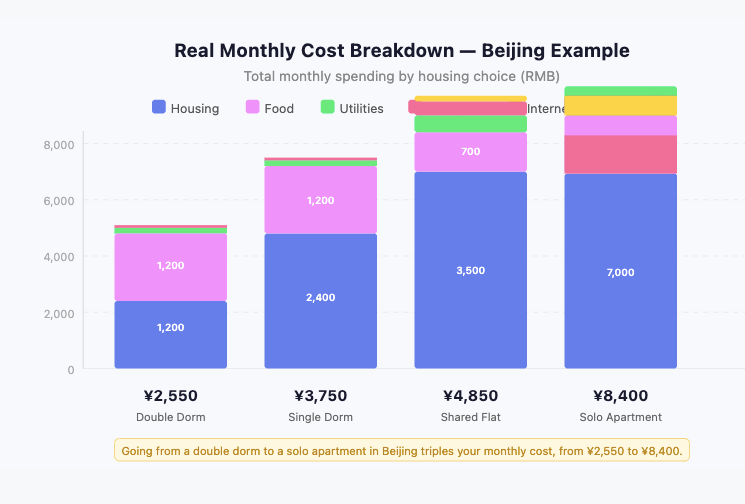
Real monthly total comparison: Beijing example
| Category | Double dorm | Single dorm | Shared flat | Solo apartment |
|---|---|---|---|---|
| Housing | ¥1,200 | ¥2,400 | ¥3,500 | ¥7,000 |
| Food | ¥1,200 | ¥1,200 | ¥700 | ¥700 |
| Utilities | ¥100 | ¥100 | ¥300 | ¥350 |
| Transport | ¥50 | ¥50 | ¥250 | ¥250 |
| Internet | ¥0 | ¥0 | ¥100 | ¥100 |
| Total | ¥2,550 | ¥3,750 | ¥4,850 | ¥8,400 |
The jump from double dorm to shared flat is ¥2,300/month. Over a two-year master’s program, that is ¥55,200. The jump from double dorm to solo apartment is ¥5,850/month: ¥140,400 over two years.
These are not small numbers. A double dorm student in Beijing spends about the same per month as a solo apartment student in Chengdu just pays in rent.
6. Rules, curfews, and things nobody tells you
Curfews: mostly gone, check your university
Most international student dorms do not have a strict curfew. You can come and go at any hour. But some undergraduate dormitories (especially at less internationally-oriented universities) still have a 23:00 door lock. If you are studying in a smaller city or a university with few international students, ask this question before you sign up.
Visitors: not what you think
Visitors must register at the front desk with ID. Visiting hours are typically 8:00-23:00. Overnight visitors are banned, and this is taken seriously. At Tsinghua, allowing an overnight guest is one of the violations that triggers “cancellation of accommodation eligibility.” You will lose your dorm room. This applies across most Chinese universities.
If having your partner stay over is important to you, you need off-campus housing.
The “electricity quota” system
Many dorms give you a free electricity allowance per month (typically ¥30-50 worth). Once you exceed it, you pay. If you run an air conditioner in summer or a space heater in winter, you will exceed it, often dramatically. The first electricity bill shock usually arrives in July.
At ZUST, if you fail to pay your housing fees for two weeks, they cut your electricity. You then have to move out. This is an extreme example but the underlying principle holds: in Chinese dorms, you follow the rules or you leave.
What you cannot have in your room
The banned item list is long and consistent across universities: electric heaters, electric blankets, immersion heaters (the coil that boils water in a cup), rice cookers, induction stoves, candles, and e-bike batteries. The e-bike battery ban is a fire safety issue: lithium battery fires in Chinese apartment buildings have killed people, and universities are not taking chances.
Moving out early
If you want to leave your dorm mid-semester, you typically need to give 1-4 weeks notice (ZUST requires 1 month). You may forfeit part of your housing fee. Dorms are semester or year contracts. Off-campus leases are almost always 12 months, and breaking them early means losing your deposit.
7. Universities that cannot guarantee housing
Not every university has enough dorm rooms for all international students. These are the ones where housing is tight:
- Peking University (PKU): frequently cannot guarantee rooms for all international students
- University of International Business and Economics (UIBE): limited international dorm capacity
- Beijing Language and Culture University (BLCU): despite having six dormitory options, demand exceeds supply
At these universities, dorm rooms are often allocated on a first-come-first-served basis at registration. If you arrive late in the registration period, you may find yourself needing to find off-campus housing with zero preparation. If you are going to one of these universities, have an off-campus backup plan ready before you fly.
At universities like Tsinghua, international student housing is guaranteed for full-time degree students who apply through the booking system. Scholarship students (CSC full scholarship) often get automatic room assignments and do not need to book.
8. How to actually book a dorm room (CRS and university systems)
The process varies by university, but the universal rule is: do not wait until you arrive.
The booking systems you will encounter
Different universities use different online systems. Here are the main ones:
1. University-specific systems (most common)
- Tsinghua University: uses the “Tsinghua University International Student Dormitory Room Booking Application System” (instructions are included in your admission package). Log in with your admission number. The system opens 1-2 months before the semester starts.
- Zhejiang University (ZJU): uses the “International Student Management System” at
isinfosys.zju.edu.cn. First-time login: use your student ID as username, default password is the last 6 digits of your passport number (pad with zeros if your passport number has fewer than 6 digits). - Peking University (PKU): international student accommodation is booked through the PKU International Student Division system. CSC full-scholarship students get automatic room assignments and do not need to book.
2. CUCAS (China University and College Admission System) Many universities now use CUCAS as a unified platform. If your university uses CUCAS, you will receive login credentials after admission. The accommodation booking section is usually under “Campus Life” or “Accommodation.”
3. What the booking interface looks like (typical flow) Although each system is different, the typical flow is:
- Log in with your admission number or student ID
- Select your preferred room type (single/double/AB room)
- Review the price and confirm
- Pay a deposit (usually ¥200-500) or pay the full semester upfront
- Receive a confirmation email with your building name and room number
Popular room types (singles) sell out within days, sometimes hours. Set a calendar reminder for the day the system opens.
What to do if you cannot book a dorm
Some universities simply run out of rooms. If this happens, you have three options: book a hotel near campus for the first week and apartment-hunt in person (recommended), try to arrange an off-campus rental before you fly through platforms like Wellcee or Ziroom (risky without seeing the place), or contact your university’s international student office and ask for assistance (they sometimes have emergency allocations or partner landlords). The first option is what most students end up doing.
After booking, you receive a confirmation. On arrival day, you go to the international student dormitory reception, show your passport and admission letter, pay the remaining housing fee, sign the dormitory agreement, and get your key.
9. Two real stories (composite cases)
Because real named cases are hard to find: most students post about their experiences in WeChat groups, not public blogs: these are built from patterns I have seen across dozens of student accounts. The details are real. The names are not.
Kwame (Ghana, computer science bachelor’s, Hangzhou)
Kwame arrived at his university in Hangzhou in September 2025. He had booked a double room through the online system. His roommate was a student from Pakistan studying mechanical engineering.
The room was about 18 square meters. Two single beds, two desks with shelves, a wardrobe each. Shared bathroom on the floor: Western toilet, but the shower only had hot water from 7:00-9:00 and 18:00-23:00. His first month, he missed the evening window twice and had to shower in cold water. He set phone alarms after that.
His electricity quota ran out in August when he ran the air conditioner every night. He paid an extra ¥180 that month on top of his ¥40/day rent.
He stayed in the dorm for the full academic year. Total housing cost for two semesters (about 9 months): ¥10,800 for the room plus roughly ¥1,500 in extra electricity and laundry. His food bill, eating exclusively in campus canteens and cheap restaurants, was about ¥1,200/month.
Total first-year housing + food: ¥22,500.
For his second year, Kwame decided to move off campus. He found a shared flat through a graduating student’s WeChat post: ¥2,200/month for a bedroom in a three-bedroom apartment, 15 minutes by shared bike from campus. With a kitchen, his food costs dropped to ¥800/month. His total second-year housing + food: ¥27,000. More expensive than the dorm, but he had a private bedroom, a kitchen, and no hot water schedule.
Fatima (Morocco, international trade master’s, Beijing)
Fatima got into a university in Beijing and was assigned a single room at ¥80/day. She was relieved: she is a light sleeper and knew a roommate would not work.
The room was fine. About 12 square meters, a bed, a desk, a wardrobe. Private bathroom with a Western toilet. The air conditioning worked. The hot water had the standard time windows. She studied well in the room.
The problem was the isolation. She was in a single room on a floor where most neighbors kept to themselves. The building had a common kitchen but it was always occupied by groups who already knew each other. She went to class, came back, sat alone. Three months in, she realized she had made exactly two friends in the entire city, both from her program.
At the end of the first semester, she gave up her single room and moved into a shared flat in Wudaokou with two other international students she had met through a housing WeChat group. Her share: ¥3,800/month. More expensive than her single room. But she had a kitchen she could use anytime, no hot water schedule, and most importantly, people to talk to.
She told me later: “I thought privacy was the most important thing. Then I got privacy and realized it was just loneliness with a nicer bathroom.”
10. How to decide: a practical guide
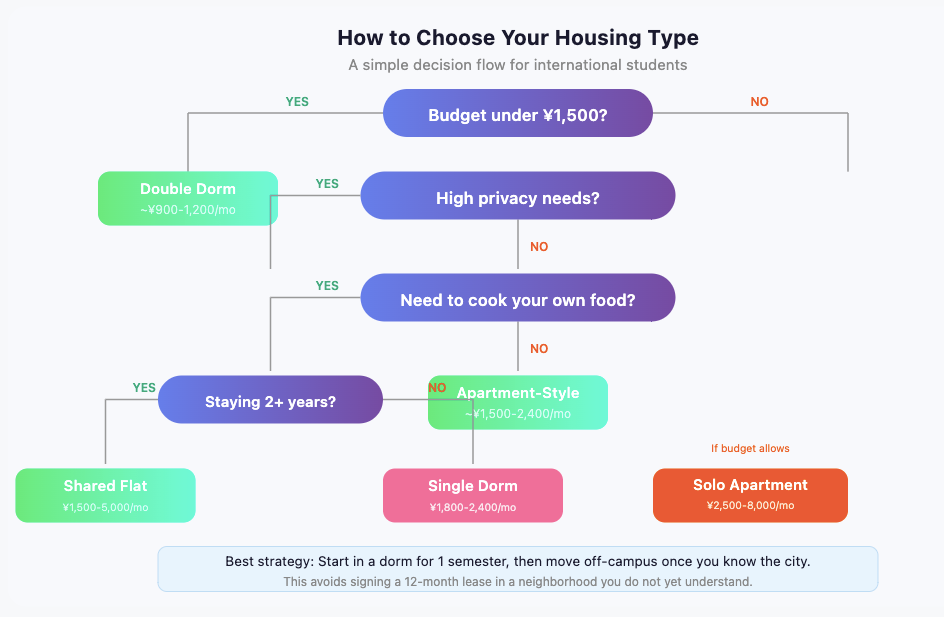
Ask yourself these five questions, in this order:
1. How long are you staying?
- One semester: take the dorm. It is not worth the lease hassle.
- One year: dorm for the first semester, then decide.
- Two or more years: start in the dorm for one semester, then move off campus once you know the city.
2. What is your actual monthly budget for housing?
- Under ¥1,500: double dorm only.
- ¥1,500-2,500: single dorm or apartment-style dorm.
- ¥2,500-4,000: off-campus shared flat in most cities, single dorm in expensive cities.
- Over ¥4,000: off-campus solo apartment or premium location shared flat.
3. How important is cooking to you?
- If you cook your own meals regularly: you need off-campus. Even apartment-style dorms with kitchenettes are not designed for serious cooking.
- If you are fine eating in canteens and restaurants: dorms work.
4. How much do you value privacy?
- High: single dorm or off-campus.
- Medium: apartment-style dorm or off-campus shared flat.
- Low: double dorm.
5. How good are you at paperwork?
- If filling out forms in Chinese, visiting the police station, and negotiating with landlords sounds exhausting: stay in the dorm.
- If you can handle it (or have a Chinese-speaking friend who can help you): off-campus is manageable.
My recommendation for most students
Year 1, Semester 1: double or single dorm. Learn how China works. Figure out where you actually spend your time on campus. Make friends. Do not sign a 12-month lease in a city you do not yet understand.
Year 1, Semester 2 or Year 2: move off campus. By now you know your budget reality, your social circle, which neighborhoods you like, and whether you actually need a kitchen. You have WeChat groups with graduating students posting lease transfers. You have Chinese-speaking friends who can help you read the contract.
The dorm-to-apartment migration is the path most long-term international students follow. It is not the only path. But it is the safest one.
Summary table: everything in one place
| Double dorm | Single dorm | Shared flat | Solo apartment | |
|---|---|---|---|---|
| Monthly cost | ¥900-2,400 | ¥1,800-2,400 | ¥1,500-5,000 | ¥2,500-8,000 |
| Privacy | Minimal | High | Medium | Full |
| Kitchen | Shared only | Shared only | Full kitchen | Full kitchen |
| Hot water | Time-restricted | Time-restricted | 24/7 | 24/7 |
| Overnight visitors | No | No | Yes | Yes |
| Contract length | Semester/year | Semester/year | Usually 12 months | Usually 12 months |
| Police registration | Handled by school | Handled by school | You do it yourself | You do it yourself |
| Upfront payment | 1 semester | 1 semester | 4 months (押一付三) | 4 months (押一付三) |
| Agent fee | None | None | ¥1,000-2,000 | ¥1,000-4,000 |
| Deposit risk | Low | Low | Medium | Medium |
| Best for | Budget, short stay, social | Study-focused, privacy | Long-term, independent | Financially comfortable |
Practice the Chinese you just read
Paste any sentence from this guide into the tool below to see pinyin above each character and an English meaning for every word. Useful when you are facing real forms, notices, or WeChat messages.