You finished your bachelor’s in China. Now you are looking at Seoul.
Maybe it is a master’s at SNU. Maybe it is a job at Samsung or LG. Maybe it is the F-2-7 points-based visa that could lead to permanent residency.
The question sitting in your head is simple: does this Chinese degree actually count in Korea?
The short answer: yes, legally. The longer answer: it depends on what you are trying to do, which university you went to, and how well you speak Korean or English.
This article breaks down the actual data, the visa rules, and what Korean employers and graduate schools actually think of a degree from a Chinese university.
1. The legal status: Chinese degrees are fully recognized in Korea
South Korea and China both joined the Hague Apostille Convention (China joined in November 2023; Korea joined earlier). This matters more than it sounds.
Before 2023, if you wanted to use a Chinese degree in Korea (for a visa, a job, or graduate school), you needed multiple layers of authentication: notarization, foreign ministry verification, and Korean consulate legalization. It took weeks and cost several hundred yuan.
After China’s accession to the Hague Convention, the process collapsed into one step: Apostille. You take your degree certificate to the Chinese Ministry of Foreign Affairs (or a designated office), pay about ¥100, and receive an Apostille certificate that is automatically recognized by Korean authorities. No further legalization needed.
The legal chain looks like this:
Your Chinese university → CSSD (China's education credential verification center) →
Chinese Ministry of Foreign Affairs (Apostille) → Accepted by Korean universities/employers/immigration
Korea’s Ministry of Justice (which handles visas) and the Ministry of Education (which oversees degree recognition) do not distinguish between a Chinese degree, an American degree, or a European degree. A bachelor’s degree is a bachelor’s degree.
The Korean Research Foundation (NRF) maintains a list of recognized overseas institutions. All degree-granting universities in China that are authorized by the Chinese Ministry of Education are on that list. In practice, this means every legitimate Chinese university degree is legally recognized in Korea.
2. QS rankings: how Korean admissions officers and HR managers actually see Chinese universities
Legal recognition is one thing. How people actually perceive the value of your degree is another.
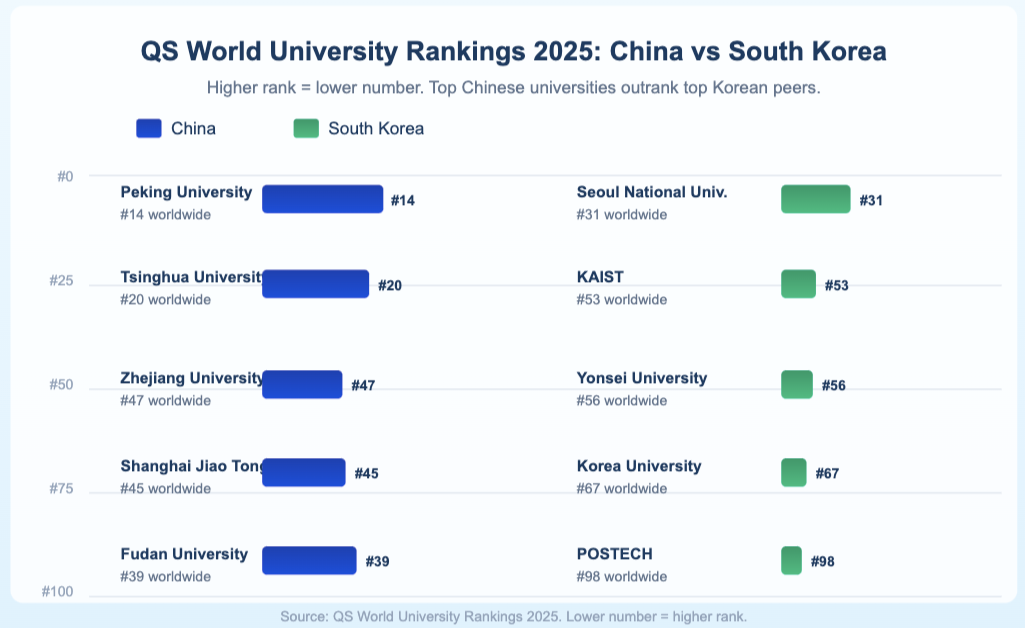
Korean graduate schools and Korean HR departments may not know the details of every Chinese university, but they do read QS rankings. Here is how the top Chinese universities compare with the top Korean universities in the QS World University Rankings 2025:
| Chinese University | QS 2025 | Korean Peer | QS 2025 |
|---|---|---|---|
| Peking University (PKU) | #14 | Seoul National University (SNU) | #31 |
| Tsinghua University | #20 | KAIST | #53 |
| Zhejiang University (ZJU) | #47 | Yonsei University | #56 |
| Shanghai Jiao Tong University (SJTU) | #45 | Korea University | #67 |
| Fudan University | #39 | POSTECH | #98 |
What this table tells you:
Peking University and Tsinghua outrank SNU and KAIST. Fudan, ZJU, and SJTU outrank Yonsei, Korea University, and POSTECH.
This matters because Korean graduate admissions committees and Korean corporate recruiters who are familiar with international rankings will recognize a PKU or Tsinghua degree as being at least as prestigious as a SNU degree. For the next tier (Fudan, ZJU, SJTU), the recognition is roughly equivalent to Yonsei or Korea University.
Below that tier, things get more variable. A degree from a Chinese university ranked outside QS top 500 may not add much signal value in the Korean job market, simply because Korean HR managers may not have heard of it.
The practical takeaway: if your Chinese university is in the QS top 200, you have a credential that Korean graduate schools and major Korean employers will recognize and respect.
3. Using a Chinese degree for Korean graduate school admission
Korean graduate schools (especially at the major universities) actively recruit international students. The admission requirements are standardized across degree origins.
3.1 Academic requirements
For most Korean graduate programs, the requirements are:
- A bachelor’s degree (from any country, as long as it is accredited)
- Academic transcripts
- Proof of language proficiency (TOPIK 4+ for Korean-taught programs; TOEFL/IELTS for English-taught programs)
- Statement of purpose and research plan
- Recommendation letters
There is no Korea-specific disadvantage for holding a Chinese degree. The admissions office evaluates your academic record, your research potential, and your language ability. Where you got your bachelor’s degree matters less than what you did there.
3.2 GKS (Global Korea Scholarship)
GKS is the Korean government’s flagship scholarship for international students, administered through the official Study in Korea portal (NIIED). It covers full tuition plus a monthly stipend (approximately 1,000,000 KRW for graduate students as of 2026).
GKS does not discriminate by degree origin. In fact, having a Chinese degree can be an advantage if your research topic relates to China-Korea relations, Chinese economy, or China-related engineering collaboration, because Korean professors increasingly value China expertise.
The 2026 GKS application data shows continued strong competition, but there is no quota or preference that disadvantages Chinese-degree holders.
3.3 Graduate school employment outcomes
One indirect signal of degree value: where do graduates of Korean graduate schools end up?
Korean universities publish employment reports. For international students who graduated from top Korean graduate programs (SNU, KAIST, Yonsei, Korea University), employment rates in Korea range from 65 percent to 85 percent within six months of graduation, depending on major and Korean language proficiency.
A Chinese bachelor’s degree does not disqualify you from these outcomes. If anything, the combination of a Chinese degree plus a Korean master’s degree signals bicultural competence, which is valuable for Korea-China trade, technology collaboration, and regional business roles.
4. The visa points system: how many points is your Chinese degree worth?
This is where things get specific. If your goal is to work in Korea after graduation (or directly after your Chinese degree), the F-2-7 points-based residency visa is the main pathway.
4.1 F-2-7 points table (education section)
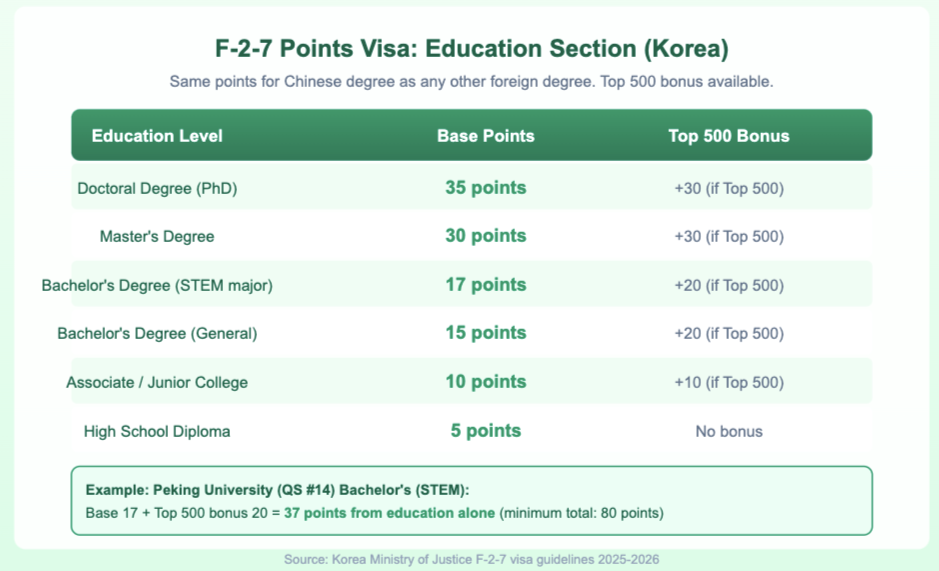
| Education Level | Points |
|---|---|
| Doctoral degree | 35 points |
| Master’s degree | 30 points |
| Bachelor’s degree (general) | 15 points |
| Bachelor’s degree (STEM major) | 17 points |
| Associate degree | 10 points |
| High school diploma | 5 points |
Key observation: The points table does not distinguish between countries. A bachelor’s degree from China gives you the same 15 points as a bachelor’s degree from the United States, the United Kingdom, or India. There is no country penalty and no country bonus at the baseline level.
4.2 Top 500 university bonus
There is an additional bonus in the F-2-7 system: if your university is in the top 500 of QS or THE rankings, you receive an additional 15 to 30 points depending on exact rank.
Given the QS 2025 data above, PKU (#14), Tsinghua (#20), Fudan (#39), ZJU (#47), and SJTU (#45) all qualify for this bonus. This means a PKU bachelor’s degree holder gets 15 (base) + 30 (top-tier bonus) = 45 points from education alone.
The minimum for F-2-7 approval is typically 80 points total (combining education, age, income/korean language ability, and other factors). A Chinese degree from a top-tier university gets you more than halfway there on education points alone.
4.3 E-7 work visa
The E-7 visa (for professionals with a bachelor’s degree and at least one year of relevant work experience) also does not distinguish by degree origin. A Chinese bachelor’s degree satisfies the same requirement as any other foreign bachelor’s degree.
5. The Korean job market: where a Chinese degree actually helps
Legal recognition and visa points are one thing. Whether a Korean employer wants to hire you is another.
5.1 Which industries value China expertise?
Korea’s major conglomerates (Samsung, LG, Hyundai, SK, Lotte) all have significant China operations or China-facing business units. For these companies, a candidate who holds a Chinese degree and speaks Chinese and understands Chinese business culture is genuinely valuable.
The Korea Trade-Investment Promotion Agency (KOTRA) regularly organizes job fairs specifically targeting international talent with regional expertise. At the May 2026 KOTRA job fair, more than 60 Korean companies conducted over 300 one-on-one interviews with international job seekers, with semiconductor, machinery, and automotive sectors showing the strongest demand.
5.2 The Korean language barrier
The single biggest factor in Korean job market success is Korean language proficiency, not degree origin.
Multiple employment surveys of international graduates in Korea show that TOPIK 5 or higher is the single strongest predictor of job offer success. A Chinese degree from PKU will not help you much if you cannot conduct a job interview in Korean.
That said, for roles in China-related business development, trade, or China-based operations, Chinese language ability plus a Chinese degree is a powerful combination. Some Korean companies specifically recruit for their China desks, and for these roles, a Chinese degree is an asset rather than a neutral factor.
5.3 Salary expectations
Korean starting salaries for international graduates vary widely by industry. For reference:
- Major conglomerates (Samsung, LG, Hyundai): approximately 45-60 million KRW per year for new graduates (both Korean and international)
- Mid-size companies: approximately 30-45 million KRW per year
- Startups and smaller firms: 25-35 million KRW per year
A Chinese degree does not automatically put you at a salary disadvantage. Your negotiation position depends on your major, your language skills, and the specific value you bring to the role.
6. Practical step-by-step: from a Chinese degree to working or studying in Korea
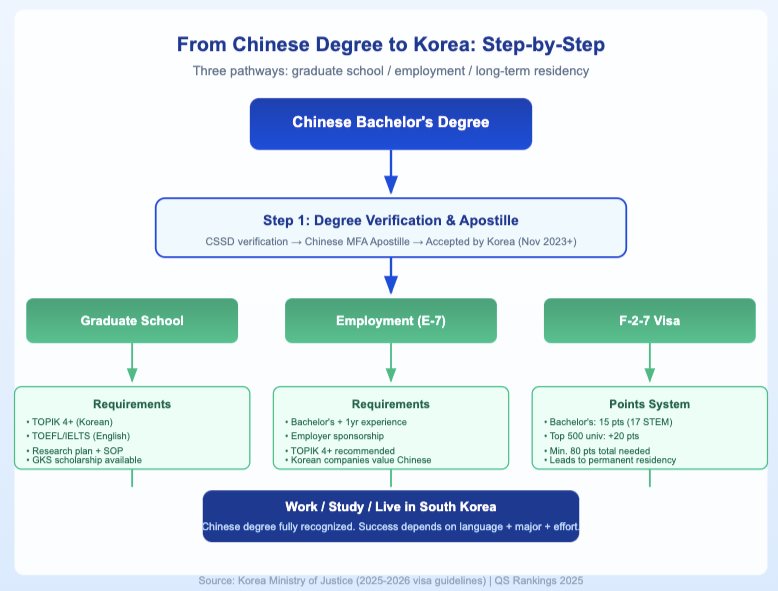
Step 1: Verify your degree through CSSD
Before you can use your Chinese degree in Korea, you need a verification report from CSSD (China’s Center for Student Development and Services). This is the standard credential verification body in China.
- Website: chsi.com.cn (English version available)
- Cost: approximately ¥100-200
- Processing time: 3-5 business days for online verification
Step 2: Obtain an Apostille
Since November 2023, China issues Apostilles through the Ministry of Foreign Affairs.
- Where: Foreign Affairs Office in your university’s city, or the national Ministry of Foreign Affairs in Beijing
- Cost: approximately ¥100
- Processing time: 3-7 business days
- Result: a certificate attached to your degree that is automatically recognized by Korean authorities
Step 3: Prepare for Korean language requirements (if targeting Korean-taught programs or Korean companies)
- TOPIK 4 is the minimum for most graduate programs
- TOPIK 5 or 6 significantly improves job prospects
- If you are targeting English-taught graduate programs (several exist at SNU, KAIST, and other major universities), TOEFL 90+ or IELT 6.5+ is the requirement
Step 4: Apply
- For graduate school: Apply through the university’s international admissions portal. Deadlines are typically in March (for fall admission) and September (for spring admission).
- For jobs: Use platforms like Saramin, JobKorea, or attend KOTRA job fairs. Also check company websites directly for international recruitment tracks.
7. When does a Chinese degree NOT help you in Korea?
Being honest about the limits is important.
Situation 1: Your university is not well-known in Korea. If your Chinese university is not in the QS top 500 and is not a household name, Korean HR managers may not recognize it. This is not discrimination against Chinese degrees; it is simply that Korean HR managers are not familiar with the full range of Chinese universities, just as Chinese HR managers are not familiar with every regional Korean university.
Situation 2: You cannot communicate in Korean. Most Korean workplaces operate primarily in Korean. Even at internationalized companies, day-to-day work often requires Korean. A Chinese degree without Korean language ability will limit you to a narrow set of roles.
Situation 3: Your major has no Korea-China relevance. If you studied a field with no connection to Korea-China economic or technological cooperation, a Chinese degree does not give you a particular edge in the Korean job market. In that case, you are competing on general merit like any other international applicant.
8. Summary: the realistic bottom line
| Summary: the realistic bottom line | |:—|:—| | Is a Chinese degree legally recognized in Korea? | Yes. Fully, through Apostille. | | Does it help with Korean graduate school admission? | Yes, if the university is reputable and you meet language requirements. | | Does it help with getting a job in Korea? | It depends. Korea-China business roles: yes. General roles: neutral. | | Does it help with visa points? | Yes. Same points as any other foreign bachelor’s degree, plus Top 500 bonus if applicable. | | Is Korean language ability required? | For most paths, yes. TOPIK 4+ for graduate school; TOPIK 5+ for better job prospects. |
The combination of a degree from a reputable Chinese university, Korean language ability, and a clear narrative about why Korea-China expertise matters for your target role is a genuinely strong positioning in the Korean job market.
The degree itself will not do the work for you. But it will not hold you back either.
Pros and cons at a glance
A balanced view, drawn from the sections above, helps you judge whether a Chinese degree is the right move for your Korea plan.
| Pros | Cons and watch-outs |
|---|---|
| Legally recognized via Apostille (China joined the Hague Convention in November 2023); no country penalty in law | Korean language ability (TOPIK 4 to 5) is usually the real gate, not degree origin |
| Top Chinese universities (Peking #14, Tsinghua #20 in QS 2025) outrank SNU (#31) and KAIST (#53) | Universities outside the QS top 500 may be unknown to Korean HR managers |
| The F-2-7 visa gives equal education points; QS or THE top 500 graduates get a 15 to 30 point bonus | If your major has no Korea-China relevance, the edge is limited |
| The GKS scholarship does not discriminate by degree origin; China expertise can be an advantage | For general roles, a Chinese degree is treated as a neutral foreign credential |
| A Chinese bachelor’s plus a Korean master’s signals bicultural competence valued in Korea-China trade | Without Korean or China-facing skills, you compete on general merit like any other applicant |
Key authorities and official resources
The links below are the official bodies and reference sources behind the facts in this article. They are the pages you will actually use to verify or act on a Chinese degree in Korea.
- Hague Apostille Convention (HCCH) – The official treaty text and member list for apostille recognition.
- Korean Council for University Education (KCUE) – Korea’s body that evaluates and recognizes foreign degrees.
- National Research Foundation of Korea (NRF) – Maintains the list of recognized overseas institutions.
- Korea Ministry of Education – Oversees degree recognition policy in Korea.
- Korea Immigration Service – Issues visas (F-2-7, E-7) and accepts the Chinese Apostille.
- Study in Korea / GKS (NIIED) – Official portal for the Global Korea Scholarship and international admission.
- China credential verification (CHESICC / chsi.com.cn) – China’s national education credential database used for degree verification.
- Chinese Ministry of Foreign Affairs – Issues the Apostille stamp on Chinese degree certificates.
- QS World University Rankings 2025 – The global ranking Korean admissions offices and employers read.
- Seoul National University – Korea’s top-ranked university; a common graduate-school target.
- KAIST – Korea’s leading science and technology university.
- KOTRA – Runs international job fairs for Korea-facing talent.
- TOPIK (Korean proficiency test) – The official Korean language test required by most programs and employers.
- Saramin – Major Korean job board used by international applicants.
Frequently asked questions
Is a Chinese degree legally recognized in Korea?
Yes. China joined the Hague Apostille Convention in November 2023, which collapsed the old multi-step legalization into a single Apostille recognized by Korean authorities. Korea’s Ministry of Justice (visas) and Ministry of Education (degree recognition) do not distinguish between a Chinese, American, or European degree. Every legitimate Chinese university authorized by China’s Ministry of Education is on Korea’s recognized list.
How do I use my Chinese degree in Korea?
Request a verification report from China’s credential service (CHESICC / CSSD, chsi.com.cn). Then obtain an Apostille from China’s Ministry of Foreign Affairs (about CNY 100). For graduate school, apply through the university’s international admissions portal; for jobs, use Korean platforms such as Saramin and JobKorea or attend KOTRA job fairs.
Do Korean universities and employers know Chinese universities?
They follow QS rankings. In QS 2025, Peking University (#14) and Tsinghua (#20) outrank Seoul National University (#31) and KAIST (#53). A degree from a Chinese university in the QS top 200 is respected by Korean admissions committees and major employers. Outside the QS top 500, recognition weakens because Korean HR may not recognize the school.
Does a Chinese degree help with a Korean visa?
Yes. The F-2-7 points-based residency visa awards the same education points to any foreign bachelor’s degree (15 points, or 17 for STEM). If your university is in the QS or THE top 500, you get an extra 15 to 30 points. A Peking University bachelor’s can reach 45 education points, more than halfway to the typical 80-point approval threshold. The E-7 work visa treats a Chinese degree the same as any other foreign degree.
Do I need Korean language ability?
Usually, yes. TOPIK 4 is the minimum for most Korean-taught graduate programs, and TOPIK 5 or higher is the strongest predictor of job-offer success. A Chinese degree from a top school will not help much if you cannot interview in Korean. For China-desk and trade roles, however, Chinese plus a Chinese degree is a genuine asset.
Is the GKS scholarship open to Chinese-degree holders?
Yes. The Global Korea Scholarship (GKS), run through the official Study in Korea portal (NIIED), does not discriminate by degree origin. A Chinese degree can even be an advantage if your research concerns China-Korea relations, the Chinese economy, or China-related engineering collaboration, because Korean professors increasingly value China expertise.
Last updated: June 2026. Data sources: QS World University Rankings 2025, Korea Ministry of Justice visa guidelines, KOTRA international recruitment reports, and university admissions websites.