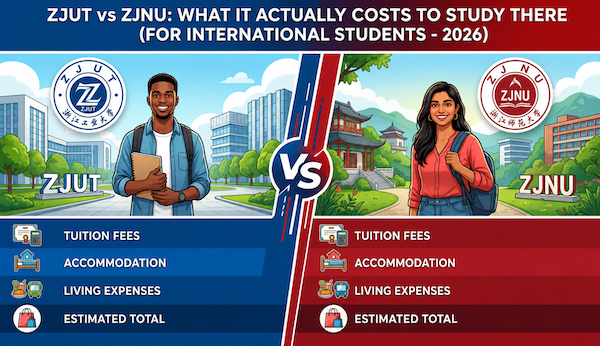
When you’re comparing universities in Zhejiang, scholarships get all the attention. But the sticker price matters too, especially if you don’t land a full ride or your scholarship only covers tuition. I went through the official fee pages for both Zhejiang University of Technology (ZJUT, in Hangzhou) and Zhejiang Normal University (ZJNU, in Jinhua) to figure out what you’d actually pay.
The numbers surprised me a bit. The school with lower tuition isn’t necessarily the cheaper option once you add everything up.
Tuition: the headline numbers
Let’s start with what most people look at first.
| Program | ZJUT (Hangzhou) | ZJNU (Jinhua) | Difference |
|---|---|---|---|
| Chinese Language (per semester) | ~7,000 RMB | 7,000 RMB | Roughly the same |
| UG (Chinese-taught) | 16,200 / year | 18,000 / year | ZJUT cheaper by 1,800 |
| UG (English-taught) | 18,800 / year | — | Only ZJUT clearly lists this |
| Master’s (Chinese) | 22,600 / year | 22,000 / year | ZJNU cheaper by 600 |
| Master’s (English) | 24,800 / year | 24,000 / year | ZJNU cheaper by 800 |
| MBA (IMBA) | — | 26,000 / year | Only at ZJNU |
| PhD (Chinese) | 25,000 / year | 25,000 / year | Identical |
| PhD (English) | 27,800 / year | 27,000 / year | ZJNU cheaper by 800 |
At first glance, ZJUT looks slightly cheaper for undergrad and ZJNU edges ahead for graduate programs. But tuition is maybe half the story.
A couple of things the official tables don’t make obvious.
One: ZJNU has an IMBA program at 26,000/year that ZJUT doesn’t offer. If you’re doing a business degree, that’s a whole extra option.
Two: ZJUT’s English-taught undergrad at 18,800/year is only 2,600 more than the Chinese track. That’s a pretty small premium for switching to English. At the graduate level it gets even smaller: 2,200 at ZJUT, 2,000 at ZJNU. If your Chinese isn’t strong enough for academic work, the upgrade won’t break you.
The fees nobody talks about
Tuition gets the headlines. Everything else adds up quietly. Here’s where the two schools diverge.
| Fee Category | ZJUT (Hangzhou) | ZJNU (Jinhua) |
|---|---|---|
| Application Fee | 400 RMB (non-refundable) | 400 RMB (non-refundable) |
| Insurance | 800 RMB / year | 1,000 RMB / year |
| Accommodation (double room) | ~600 / month (7,200 / year) | 450–600 / month (5,400–7,200 / year) |
| Accommodation (single room) | ~1,200 / month | Not listed |
| Room Deposit | 1,000 RMB (refundable) | Not mentioned |
| Books & Materials | Not listed by school | ~800 / year |
| Visa Costs | Not listed by school | ~800 / year |
| Physical Exam | Not listed by school | ~800 (one-time) |
| Living Expenses | ~2,180–2,780 / month | ~10,000 / year (833 / month) |
Two things stand out.
ZJNU’s fee page is much more transparent. They list book fees, visa costs, even the physical exam fee. ZJUT’s official page is sparse on non-tuition costs. That doesn’t mean ZJUT doesn’t charge these things, it just means their page doesn’t spell them out. You’d need to ask.
The living expense numbers tell the real story. ZJNU estimates about 10,000 RMB per year for living costs, or roughly 833 RMB per month. ZJUT’s estimates, from third-party data, range from 2,180 to 2,780 per month. That’s roughly 2.5 to 3 times higher, and most of it comes down to one thing: Hangzhou costs more than Jinhua. A lot more.
Some context on the accommodation: ZJUT lists a room deposit of 1,000 RMB and requires new students to live on campus. Both schools offer double rooms around 600/month. ZJUT also has single rooms at 1,200/month if you want privacy. ZJNU didn’t list singles, so don’t count on one.
Total cost: what one year actually looks like
Here’s what a year would cost for an undergraduate studying in Chinese, assuming a double room and average living expenses.
| Cost Item | ZJUT (Hangzhou) | ZJNU (Jinhua) |
|---|---|---|
| Tuition (Chinese UG) | 16,200 | 18,000 |
| Accommodation (double, 12 months) | 7,200 | 6,000 (avg) |
| Insurance | 800 | 1,000 |
| Books | ~800 (estimated) | 800 |
| Visa | ~800 (estimated) | 800 |
| Physical Exam | ~800 (estimated) | 800 |
| Living (food, transport, misc) | 30,000 (2,500/mo × 12) | 12,000 (1,000/mo × 12) |
| One-time fees (application, deposit) | 1,400 | 400 |
| Year 1 Total | ~58,000 RMB | ~39,800 RMB |
| Subsequent Years | ~56,600 RMB | ~39,400 RMB |
ZJUT is about 18,000 RMB more expensive per year. Over a four-year degree, that’s roughly 72,000 RMB, or a bit over 10,000 USD at current exchange rates. That’s not pocket change.
Wait, you might say. ZJNU’s living expense estimate of ~10,000/year from their official page sounds absurdly low. And honestly, it probably is. Even in Jinhua, 833 RMB a month barely covers food if you eat three meals a day. I used 1,000/month above as a more realistic floor. If you eat out occasionally or travel on weekends, budget closer to 1,500. At that rate, ZJNU’s annual total would be around 45,800 RMB, and the gap with ZJUT shrinks to about 10,000 per year. Still meaningful, but less dramatic than the raw numbers suggest.
Hangzhou vs Jinhua: the cost-of-living gap
This is where most of the difference lives. Tuition is close. Housing is close. But daily life in Hangzhou costs more, period.
Hangzhou is a tier-1.5 city (depending on who you ask) with a tech industry, Alibaba’s headquarters, and a population pushing 12 million. Rent off campus, eating out, Didi rides, weekend activities: all priced accordingly. Jinhua is a mid-sized city of about 7 million people, with a lower cost base across the board. A bowl of noodles costs less. A taxi ride costs less. A night out costs less.
The upside of Hangzhou isn’t subtle: it’s bigger, has a real tech scene (Alibaba alone employs tens of thousands of people), and the internship pool is an order of magnitude larger than Jinhua’s. If you’re planning to job-hunt in China after graduation, being physically in Hangzhou matters. Jinhua is quieter, cheaper, and honestly a better place to just study without distractions. The math changes depending on which one you value more.
This trade-off doesn’t have a right answer. It depends on what you’re optimizing for.
Refund policies: when things go wrong
Both schools charge a non-refundable 400 RMB application fee, which is standard. But ZJUT’s refund policy is worth reading, because it has some teeth.
Here’s what ZJUT’s policy says:
- RMB 1,000 of your tuition is non-refundable (though it can be carried to the next semester).
- If the school has already renewed your visa and you want to leave, you need to go to immigration and shorten it yourself before they’ll process a refund.
- Drop out, get expelled, or leave without a valid reason: no refund. Period.
- Take a leave of absence for personal reasons: no refund during the leave, but your tuition balance stays valid if you come back.
- Overpaid due to exchange rate differences: the excess rolls to next year’s tuition. No cash refund until graduation.
- Language program students: no refund after the first month, regardless of reason.
- Approved withdrawal or transfer: tuition is calculated by the month (30 days = 1 month, 10 months = 1 academic year), and you get back the unused portion.
The exchange rate policy is the one I’d flag. If you pay in USD or another foreign currency and the RMB weakens between your bank sending the money and ZJUT receiving it, you could end up short. If the RMB strengthens, you overpay and that money is locked up until you graduate. Either way, you’re eating the exchange rate risk.
ZJNU’s page doesn’t list a detailed refund policy. That doesn’t mean there isn’t one, but you should ask before committing, especially if you’re paying from abroad.
Which one costs less?
Short answer: ZJNU, by a comfortable margin. Even with slightly higher tuition at the undergrad level, the lower cost of living in Jinhua more than makes up for it.
But cheaper isn’t always better. Here’s how I’d think about it.
If you’re on a tight budget, go with ZJNU. The annual difference is real, and Jinhua is honestly a more pleasant place to be broke than Hangzhou.
If you want to work in China after graduating, ZJUT makes more sense. Being in Hangzhou gives you access to companies and internships that Jinhua simply doesn’t have. The extra 15,000 or so per year is an investment in your network.
If you’re a graduate student, the tuition difference is negligible (a couple hundred RMB). Your supervisor and research fit should drive the decision, not cost.
If you’re doing a language year first, both charge about the same for language programs. Pick based on where you want to live. You’ll spend a lot more on daily life in Hangzhou either way.
If you got a partial scholarship, run the numbers with your specific package. ZJUT’s higher living costs mean a tuition-only scholarship leaves a bigger gap you’ll need to cover yourself.
A practical tip: both schools’ fee pages are built for Chinese readers first. The English versions have less detail, and some numbers only appear in the Chinese PDFs. If you’re serious about either school, find the Chinese-language admission brochures and run them through a translator. You’ll catch things the English page leaves out.
Data sources: ZJUT fee page (gjxy.zjut.edu.cn), ZJNU fee page (iso.zjnu.edu.cn), ZJUT 2026 graduate admission brochure (official PDF), zjut.admissions.cn expense page, CUCAS/sicas supplementary data. All amounts in RMB unless noted. Exchange rate context is mid-2026.
Pros and cons at a glance
| Pros | Cons and things to weigh |
|---|---|
| ZJNU total cost is about 18,000 RMB per year lower, mainly because Jinhua living costs less than Hangzhou | ZJUT’s living costs run roughly 2.5 to 3 times Jinhua’s |
| ZJUT sits in Hangzhou’s tech hub, with an internship and job pool far larger than Jinhua’s | ZJNU is a smaller city with fewer company networks and internships |
| ZJNU publishes a more transparent fee breakdown, listing books, visa, and medical exam costs | ZJNU does not publish a detailed refund policy, so confirm in writing before paying |
| ZJUT publishes a detailed, predictable refund policy | Both schools’ English fee pages are less detailed than the Chinese-language PDFs |
Key authorities and official resources
- Zhejiang University of Technology (ZJUT): official university site and admission information
- Zhejiang Normal University (ZJNU): official university site and admission information
- ZJNU International College: international student office and fee pages
- Hangzhou Municipal Government: cost-of-living and city practical information
- Study in China: official Chinese government portal for international students
- Campus China: official CSC admissions and university application portal
- China Scholarship Council (CSC): official Chinese government scholarship body