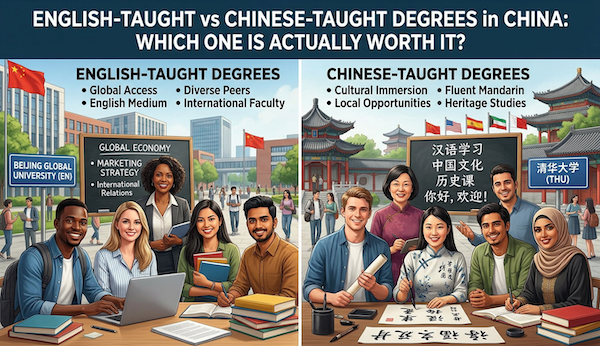
Every international student heading to China faces the same fork in the road. Take the English-taught program, skip the language barrier, and focus on your degree. Or take the Chinese-taught path, spend a year or two learning the language first, and hope the extra time pays off.
It sounds like a simple trade-off. Convenience now versus potential payoff later. But the reality is messier than that, and most of what you’ll read about this choice comes from university brochures that have every incentive to make both options sound great.
I’ve spent too much time digging into this question. Here’s what the data actually says, and more importantly, what three students who’ve been through it can tell you.
The Numbers: What “English-Taught” Actually Looks Like in China
In 2023, China had close to 2,900 English-taught degree programs across its universities, according to Studyportals data. That makes China the largest provider of English-taught programs outside of native English-speaking countries. Between 2021 and 2023, the number grew 12%.
But context matters. Here’s the breakdown from CSCA’s 2026 admission data covering 296 universities:
| English-Taught | Chinese-Taught | |
|---|---|---|
| Number of programs | 483 | 2,110 |
| Share of total | 18.3% | 79.9% |
| Average annual tuition | ¥32,500 | ¥26,400 |
| Tuition premium | — | English is 23% more expensive |
| Applicants per program (est.) | ~14.5 | ~1.4 |
| Scholarship coverage rate | 17.2% | 1.8% |
| Universities offering it | 165 | 240 |
A few things jump out.
English-taught programs are way more competitive. If 70% of applicants target English-taught programs (which is roughly what the data suggests), you’re competing against about 14 people per program slot versus roughly 1.4 for Chinese-taught. That’s not a small difference. It’s ten times the competition.
But they also come with better scholarship odds. The scholarship coverage rate for English-taught programs is 17.2%, versus 1.8% for Chinese-taught. The government and universities put scholarship money where the international demand is.
The subjects are concentrated. The top five English-taught fields are economics (24.6%), business administration (20.3%), clinical medicine/MBBS (10.4%), civil engineering (7.9%), and mechanical engineering (6%). If you want to study Chinese literature, traditional Chinese medicine, or law in English, your options narrow fast.
And the price tag is real. ¥32,500 per year for English-taught versus ¥26,400 for Chinese-taught. Add the 1-2 year Chinese language prep for Chinese-taught programs, and the financial math gets complicated. But we’ll come back to that.
Five Things the Brochures Won’t Tell You
1. “English-taught” doesn’t always mean “well taught in English”
The quality gap between programs is huge. At Tsinghua, PKU, and Fudan, English-taught programs have international faculty, rigorous standards, and cohorts that look like a mini-UN. But down the ranking ladder, you’ll find programs where the textbook was translated from Chinese, the professor’s English is rough, and the international cohort is 90% from one or two countries.
This isn’t unique to China. It happens everywhere English-medium instruction is expanding. But China’s scale makes the variance wider than most students expect.
2. Chinese-taught programs come with a hidden return
A Chinese-taught degree means you can read Chinese contracts, follow Chinese research, and sit through a Chinese job interview without a translator. That sounds obvious, but the implications aren’t.
Chinese companies, especially the ones that pay well, don’t interview in English. They don’t write internal memos in English. They don’t promote people who need a colleague to translate the Monday morning meeting.
One study I came across looked at international graduates in China and found something consistent: the language gap is the single biggest predictor of whether someone stays employed in China past the two-year mark. More than school ranking. More than major.
3. But the time cost is real
Chinese-taught programs typically require 1-2 years of language preparation before you even start your degree. That means a 4-year bachelor’s becomes 5-6 years. A 2-year master’s becomes 3-4.
HSK 4, the minimum for most Chinese-taught programs, takes 6-12 months of study at 2-3 hours per day, starting from zero. HSK 5, required by top universities, adds another 3-6 months. And HSK 5 is still “can read a newspaper” level, not “can debate economic policy in a seminar.”
That extra time isn’t free. It’s rent, food, and 1-2 years of your life. Whether that’s worth it depends entirely on your next question.
4. Your field changes the math
If you’re studying clinical medicine (MBBS), the question almost answers itself. Chinese-taught medical programs for international students barely exist, and clinical training is conducted in English at most major teaching hospitals. Take the English track.
If you’re in finance, the Chinese-taught path probably pays for itself. Chinese securities firms, banks, and funds operate almost entirely in Chinese. The CFA might be in English, but the team meeting about which stock to buy won’t be.
If you’re in engineering or CS, it’s closer to a tie. Your code is in English. Your documentation is in English. But your team stand-up is in Chinese. The students I’ve seen succeed in this space usually do English-taught degrees supplemented with aggressive Chinese study on the side.
5. Where you want to work changes everything
This is the question that should drive your decision, and it’s weird how rarely it gets asked.
If you plan to go back to your home country after graduation, the English-taught degree is almost certainly the right call. Your employer back home cares about the degree itself, not whether you can read a Chinese lease agreement. Save the time and money.
If you plan to stay in China, the Chinese-taught degree’s value compounds. Year one, it might not matter much. You can get by with English at an MNC. Year three, when your Chinese-taught peers are handling client meetings solo and you’re still asking a colleague to double-check your WeChat messages, the gap starts to widen.
If you plan to go to a third country, the English degree is more portable. A degree from Tsinghua or PKU carries weight, but a degree from a mid-tier Chinese university in a field the hiring manager has never heard of — you want it in English.
Three Students Who Actually Made This Choice
Numbers and trade-offs are useful. But what this actually feels like is a different thing altogether. Here are three people who’ve been through it.
DAO HANH TRANG, Vietnam — English-taught, and the hospital that changed everything
Dao Hanh Trang studied at Shanghai International Studies University in an English-taught program. She knew she’d need some Chinese for daily life — ordering food, asking for directions, the basics. What she didn’t expect was the hospital.
In November 2022, shortly after arriving in China, she got sick and was admitted to a Shanghai hospital. The nurses spoke almost no English. The other patients in her ward spoke none at all. She was alone, sick, in a room full of people she couldn’t communicate with.
“I was lucky I knew a little bit of Chinese,” she wrote later. “Everyone was incredibly kind and helpful, but without that basic Chinese, I don’t know how I would have managed.”
She recovered and was discharged after a week. But the experience changed how she thought about language. She had come to China assuming that an English-taught degree meant English would be enough. The hospital convinced her otherwise.
Her advice to future students: learning Chinese isn’t optional, even if your degree is in English. “You will certainly require a basic level of Chinese knowledge throughout your stay in China.”
Lola, France — English-taught, bilingual career, and why Shanghai worked
Lola arrived in Shanghai not speaking a word of Chinese. She enrolled in a master’s program in International Marketing and Communications, English-taught, and figured she’d pick up enough Chinese along the way to get by.
She did more than get by. She learned to order food, navigate the metro, negotiate prices at markets. She once confused “napkin” with “toilet paper” in a restaurant. She got on the wrong bus because she couldn’t read the signs and rode it for an hour before realizing. It was messy, and it was how she learned.
Today, Lola works as a Brand and Content Specialist at a renewable energy tech company in Shanghai. Her job is bilingual: she writes marketing materials in both English and Chinese, manages global social media accounts, and helps shape the company’s brand voice across different countries.
Here’s what’s worth noticing about her path. She took an English-taught degree. She learned Chinese on the ground, not in a classroom. And she ended up in a job that explicitly uses both languages.
She also benefited from a policy detail not every student knows: master’s degree graduates in China can apply for a work permit directly, without the two years of work experience required for bachelor’s graduates. That rule made her transition from student to professional possible.
Her take: “Learning Chinese helps, but it’s not always necessary” for getting a job. What mattered more was having a clear professional identity and knowing how to position herself as someone who bridged two markets, not someone who was just “the foreigner who speaks some Chinese.”
Cheah Cheng Kyat, Singapore — English-taught at PKU, now at a Chinese state-owned enterprise
Cheah Cheng Kyat chose the path with the strongest brand name: a Master’s of International Relations at Peking University, English-taught. He wanted to understand Chinese politics and foreign policy from the inside, and PKU’s School of International Studies is about as inside as it gets.
His time at PKU wasn’t easy. He came from a different academic background and struggled in the early semesters. COVID hit during his program, limiting his time on campus and in China. He got sick, recovered, and kept going.
He also traveled — extensively. Over 60 cities and regions across China, including inland places like Altay in Xinjiang and Ganze in Sichuan. He joined the PKU Cat Society, made friends, ate his way through Beijing.
Now he works at a major Chinese state-owned enterprise. The article doesn’t name which one, but the point stands: an English-taught degree from a top Chinese university opened a door most international students don’t reach.
His story complicates the simple narrative. An English-taught degree can lead to a career in China. But note the context. PKU. A field where understanding China is the entire point. And a graduate who made extraordinary effort to immerse himself in Chinese life beyond the classroom.
So Which One Should You Pick?
If you’ve read this far, you’ve probably noticed there’s no clean answer. But here’s a decision framework that might help:
| Your primary goal | Better choice | Why |
|---|---|---|
| Return to home country after graduation | English-taught | Degree recognition matters; language doesn’t |
| Stay in China long-term, work at a Chinese company | Chinese-taught | 2-3 years in, the language gap is your career ceiling |
| Stay in China, work at an MNC | English-taught + aggressive Chinese study | MNCs hire in English; promotions require Chinese |
| Medicine (MBBS) | English-taught | Chinese-taught medical programs barely exist for internationals |
| Finance, law, public policy in China | Chinese-taught | These fields are language-dependent; shortcuts don’t work |
| Engineering / CS / tech | English-taught + Chinese on the side | Technical skills > language, but communication matters |
| Budget is tight, want to minimize time | English-taught (with scholarship) | Higher scholarship rate offsets higher tuition; saves 1-2 years |
| Budget is tight, willing to invest time | Chinese-taught | Lower tuition, lower living costs during language prep year in cheaper city |
One thing this table doesn’t capture: the Chinese-taught students whose stories I couldn’t find.
I searched extensively for named, verifiable stories of international students who completed Chinese-taught degrees and are now working in China. I found almost nothing in English-language media. The students I found, Dao Hanh Trang, Lola, and Cheah Cheng Kyat, all studied in English-taught programs.
This isn’t an accident. Chinese-taught graduates tend to work in Chinese-language environments. They tell their stories on Xiaohongshu and WeChat, not on English-language blogs. They are, by definition, harder for an English-speaking researcher to find.
In a way, that’s the strongest argument for the Chinese-taught path. If your goal is to disappear into the Chinese professional world, to be hired and promoted as someone who belongs there, not as “the international hire,” then the degree that makes you invisible to English-language search results might be exactly the one you want.
The Short Version
If you’re going home after graduation, take the English-taught degree. It’s faster, easier, and your employer back home won’t care which language you studied in.
If you’re staying in China, the Chinese-taught degree is almost certainly the better long-term investment. The 1-2 years of language prep look expensive now, but they pay for themselves within 2-3 years of your career through higher salaries, better jobs, and a promotion path that doesn’t dead-end at “foreigner who needs a translator.”
The harder case is the middle ground: you might stay, you might go, you’re not sure. In that scenario, do what Lola did. Take the English-taught degree. Learn Chinese aggressively on the side. Not just in a classroom, but by living in it. Confuse napkins with toilet paper. Get on the wrong bus. End up in the hospital and realize how much you still don’t know.
Because the real question isn’t which program you enroll in. It’s whether, two years from now, you can have a 15-minute conversation in Chinese without reaching for a translation app.
If the answer is yes, the label on your degree won’t matter nearly as much as you think.