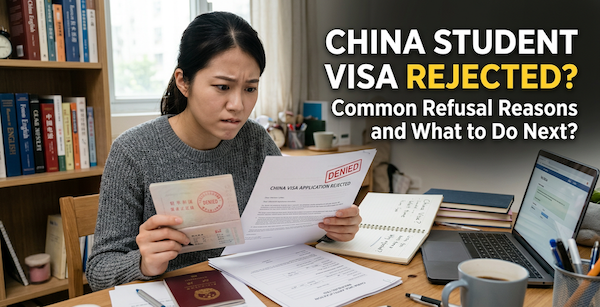
You have the acceptance letter. The scholarship confirmation. The flight alerts set up on your phone. Then the email arrives: your visa application has been refused.
It feels like the floor drops out. Every international student who has been through this knows the moment: sitting there staring at a two-sentence rejection notice that does not actually tell you what went wrong.
Here is the thing most people do not realize until it happens to them: a Chinese student visa rejection is rarely about you as a person. It is almost always about a fixable paperwork error. And the process for fixing it is simpler than the rejections you would face applying to the US, UK, or Canada.
This guide covers every common reason X1 and X2 visas get rejected, exactly how to fix each one, what the numbers actually look like compared to other countries, and two real experiences from students who went through this and came out the other side.
X1 vs X2: the visa you need matters before you apply
Before diving into rejections, you need to understand which visa you are applying for. Applying for the wrong one is itself a rejection trigger.
| X1 visa (long-term) | X2 visa (short-term) | |
|---|---|---|
| Who it is for | Programs longer than 180 days | Programs 180 days or fewer |
| Entry validity | 30 days from issuance, you must enter China within 30 days | Typically 90 days from issuance |
| After entry | Must convert to residence permit within 30 days at local PSB | No residence permit needed; visa covers entire stay |
| Key document | JW201 (scholarship) or JW202 (self-funded) | Usually does not require JW form |
| Medical check | Required, must be from an approved clinic | Not required |
| Processing time | 4-7 working days (standard) | 4-7 working days |
| Fee (varies by nationality) | $150-250 USD | $150-250 USD |
The most dangerous mistake is applying for X2 when your program is actually longer than 180 days. If you enter China on X2 for a degree program that runs 4 years, the Public Security Bureau will flag the mismatch when you try to get a residence permit, and you will not get one. You would have to leave China, apply for X1 from a consulate abroad, and re-enter.
Conversely, some students panic and apply for X1 when they are doing a 4-month language course. That usually gets processed fine, but it adds the unnecessary burden of the medical exam and the 30-day residence permit rush after arrival.
What actually gets you rejected: 7 common reasons
Based on data from Chinese visa application centers and consular feedback, here is what causes student visa rejections, ranked by how often they happen and how fixable they are.
| Rejection reason | How common | How serious | Can you fix it? | Typical fix time |
|---|---|---|---|---|
| Application form errors or inconsistencies | Very common (~35% of rejections) | Low | Yes, refill and resubmit | 1-2 days |
| Insufficient or problematic financial proof | Common (~25%) | Medium | Yes, provide stronger documents | 1-4 weeks |
| JW201/JW202 form issues | Common for first-timers | High | Yes, contact university to reissue | 2-4 weeks |
| Passport validity or page issues | Occasional | Low | Yes, renew passport first | Varies by country |
| Photo does not meet specifications | Occasional | Low | Yes, retake immediately | Same day |
| Undisclosed prior visa rejection | Occasional | Medium | Yes, disclose honestly with explanation | 1-2 days |
| Sensitive nationality or background flag | Rare (~8%) | Very high | Depends, case by case | Months or not possible |
Reason 1: the COVA form is wrong and you did not notice
This is the single biggest rejection cause, accounting for roughly 35 percent of all denials according to visa application center data. The COVA online form seems simple, but consular officers cross-check every field against your supporting documents.
The most common COVA mistakes that get students rejected:
- Name does not match passport exactly. If your passport says “MOHAMMED ALI HASSAN” but you typed “Mohammed A. Hassan,” that is a mismatch.
- Past China travel history is incomplete. You visited China 3 years ago for a 2-week summer program. You did not list it because it felt irrelevant. The officer sees it in the database and flags the omission.
- Employer or education fields are blank. Even if you have never worked, writing “N/A” is better than leaving it empty. A blank field reads as incomplete.
- Dates do not match. Your admission letter says the program starts September 1, but you listed your intended arrival as August 15. That is a 2-week gap with no explanation.
- Family information is missing. The form asks for parents’ full names and birth dates. Skipping this because you do not have the information handy is a common trigger.
How to fix it: Fill out a completely new COVA form. Do not copy-paste from the old one, start fresh and cross-check every field against your passport bio page, admission letter, and JW form. Most consulates will let you resubmit immediately with the corrected form.
Reason 2: your bank statement does not convince
Financial proof is the second most common rejection trigger, and the requirements are more specific than most students expect.
The Chinese visa standard for student financial proof is **2,500USDperacademicyear∗∗,calculatedacrossyourentireprogramlength.Fora4−yearbachelor′sdegree,thatmeansshowingroughly10,000. But the amount is only half the story.
What actually gets bank statements rejected:
- The money appeared too recently. If your account had a 1,200balanceformonthsandsuddenlyjumpedto5,000 three days before your application, the officer assumes you borrowed it for show. One real case documented on mychina.guide involved an applicant with 10,000intheiraccount,rejectedbecause9,800 had been deposited 3 days prior.
- The statement is too old. Bank statements must be issued within 30-90 days of your application date. A statement from 5 months ago will be rejected regardless of the balance.
- It is a screenshot, not an official document. Online banking screenshots are not accepted. You need a statement on official bank letterhead with a stamp or signature.
- The statement is in a language the consulate cannot process. If your bank only issues statements in Arabic, Urdu, or Thai, you need a certified English or Chinese translation.
- The account is not in the right name. If a parent or sponsor is funding your studies, their bank statement alone is not enough. You need a signed sponsorship letter explaining the relationship and confirming they will cover your expenses.
For CSC scholarship students: if your JW201 form is marked “scholarship,” you do not need a bank statement. But if it is marked “self-funded” by mistake, a surprisingly common error, the consulate will demand financial proof you were not prepared to provide. Check this field on your JW form before you submit anything.
Reason 3: your JW201 or JW202 form has a problem
The JW form, officially called the “Visa Application for Study in China”, is the document your university sends after confirming your admission. Without it, no consulate will process your student visa application. With a flawed one, your application gets rejected.
The specific JW form problems that cause rejections:
- You got JW201 but you are self-funded. JW201 is exclusively for Chinese Government Scholarship recipients. Self-funded students must have JW202. Some university agents mistakenly send the wrong form. If you submit JW201 as a self-funded student, the consulate will reject it outright.
- Personal details do not match your passport. One letter off in your name. One digit wrong in your passport number. Wrong birth date. The JW form and your passport bio page must be identical.
- The financial support field is wrong. If the form says “self-funded” but you have no bank statement attached, rejection. If it says “scholarship” but you are actually paying yourself, the mismatch will cause problems later at the residence permit stage, even if the visa is approved.
- The form has been altered by hand. Some students or agents try to correct JW form errors by crossing things out and writing corrections manually. Chinese visa centers explicitly flag handwritten alterations on JW forms as grounds for rejection.
How to fix it: Email your university’s international student office immediately. Explain exactly what is wrong with the form. They can reissue a corrected JW202 or JW201, it typically takes 2 to 4 weeks. Most universities have dealt with this before and know the process.
Reason 4: your passport has a problem
Two passport issues trip up students:
First, the 6-month rule. Your passport must be valid for at least 6 months beyond your planned departure from China. For a 4-year degree, that means your passport needs to cover well into your final year. If it expires during Year 3, the consulate will reject the application. The fix is straightforward, renew your passport first, then apply.
Second, blank visa pages. Your passport needs at least one completely blank visa page. Amendment pages and endorsement pages do not count. Some students lose track of how many pages are left, especially if they have traveled extensively.
Reason 5: your photo fails the specifications
Chinese visa photo requirements are stricter than most countries. As of 2024, glasses are not allowed under any circumstances. The specifications:
- Size: 33mm x 48mm
- Background: pure white, no shadows
- Face size: 15-22mm wide, 28-33mm high
- Expression: neutral, mouth closed, eyes open
- Hair must not cover eyebrows or ears
- White shirts are not recommended (they blend into the white background)
- Photo must be less than 6 months old
Professional passport photo services know these specs. Drugstore photo booths often do not. Spending $12-20 at a dedicated passport photo service is the cheapest insurance against rejection.
Reason 6: you did not disclose a prior visa rejection
The COVA form asks: “Have you ever been refused a visa by any country?” Many students skip this, assuming a prior US or Schengen rejection is irrelevant to their China application.
Consular officers can and do cross-check this. When they find the undisclosed rejection, the refusal reason shifts from whatever the original problem was to “dishonesty on the application form.” That is much harder to fix than the original rejection.
If you have a prior rejection from any country, list it. Attach a one-page signed letter explaining: which country rejected you, when, the stated reason, and what has changed since then. Honesty with a reasonable explanation almost always works.
Reason 7: a background flag you cannot easily change
This is the rarest category but the hardest to fix. Certain factors trigger additional scrutiny:
- Nationality from a country with strained diplomatic relations with China
- Previous overstay in China, even by a few days
- Criminal record (especially serious offenses)
- Profession flagged as sensitive (journalists, religious workers, military personnel)
- Travel history to regions Chinese consulates consider sensitive
For these cases, the standard self-help approach may not work. You may need a licensed Chinese visa agent, a letter of support from your university sent directly to the consulate, or in extreme cases, legal counsel. The realistic timeline stretches from months to indefinite.
How hard is it really? China vs other countries
One piece of context that changes how you read a rejection: Chinese student visas are significantly easier to get than visas for the major English-speaking destinations.
| Country | Student visa rejection rate | Year | Data quality |
|---|---|---|---|
| Canada | ~52% | 2024 | Official (IRCC) |
| United States (F-1) | ~41% | FY2024 | Official (State Dept.) |
| Australia | 15-18% | 2024-25 | Official (Home Affairs) |
| UK | 4.1% (peaked at 12% in Q1 2025) | 2025 | Official (Home Office) |
| France | 8-15% | 2024 | Moderate |
| Germany | 5-10% | 2024 | Low |
| China | No official refusal rate published | N/A | N/A |
China does not publish a formal student visa refusal rate. But based on consular center data, the overall rejection rate for Chinese visas across all categories runs roughly 5 to 15 percent for applicants from most Western countries, with tourist visas having the highest rejection share and student visas considerably lower.
In 2025, China issued approximately 128,000 X1 visas, a 15 percent increase from 2024. Students from Pakistan, Thailand, and Vietnam alone accounted for 28 percent of those. This is a system designed to process high volumes, not to filter aggressively.
The practical takeaway: if your China student visa was rejected, the odds are overwhelmingly on the side of “fixable paperwork error” rather than “you were judged unworthy.” That is not the case for a 41 percent F-1 rejection rate in the US, where many qualified students are denied on subjective grounds like “immigrant intent.”
Two visa rejection experiences
Sara: JW202 name mismatch → rejected → university intervened → approved
Sara is from Nigeria. She was admitted to a master’s program in international trade at a university in Hangzhou. She submitted everything on time: COVA form, passport, admission letter, medical check, JW202, bank statement from her father’s account with a sponsorship letter.
Two weeks later, rejection. The stated reason was “inconsistency in submitted documents.”
She went through everything line by line. What she found: her middle name appeared on her passport as “Adaeze” but on the JW202 form her university had typed “Ada-eze.” A single hyphen. The consular officer flagged the mismatch.
She emailed the international student office at her university the same day. They reissued a corrected JW202 within 18 days. She resubmitted the entire application package, fresh COVA form, new bank statement (the old one was now too old), new photo, and the corrected JW202. Approved in 5 working days.
Total delay: about 5 weeks from rejection to approval. Total additional cost: roughly $250 in new document fees and courier charges. She arrived in Hangzhou 3 weeks after the semester started, which her university accommodated without penalty.
The lesson from Sara’s case: name mismatches between documents are the most common JW form rejection trigger. Check every document against your passport character by character before submitting anything.
Kwesi: rushed reapplication → second rejection → the right way the third time
Kwesi is from Ghana. He was admitted to a computer science bachelor’s program at a university in Chengdu. His first application was rejected. No detailed reason given, just the standard “does not meet visa issuance requirements.”
He panicked. He assumed the problem was his financial proof, his uncle was sponsoring him, and he worried the sponsorship letter was insufficient. He rushed to resubmit 4 days after the rejection with a bigger bank statement balance but no other changes.
Second rejection, 8 days later. Now he had two rejections on his record.
At this point, he contacted his university’s international admissions office and asked them to review his entire application package. They found three issues he had missed:
- His COVA form listed his intended arrival date as August 10, but the admission letter stated the registration period as September 1-5. A 3-week gap with no explanation.
- His medical exam was done at a private clinic, not an approved facility on the Chinese consulate’s list.
- His passport had only 7 months of validity remaining at the time of first application, technically above the 6-month minimum, but close enough to make the officer nervous about a 4-year program.
He fixed all three: updated COVA with a date matching his admission letter, redid the medical at an approved clinic, and renewed his passport (which took 3 weeks in Ghana). He waited 6 weeks from the second rejection before submitting the third application.
Third time: approved in 4 working days. Total delay from first rejection: nearly 4 months. He deferred his enrollment to the following semester.
The lesson from Kwesi’s case: do not rush a reapplication. A rejection means something was wrong. Submitting again with the same core package and only minor tweaks almost guarantees a second rejection. Take the time to find all the problems, not just the most obvious one.
What to do after a rejection: a timeline
China does not have a formal visa appeal process. You cannot ask the consulate to reconsider the same application. You reapply with a corrected package. Here is how to do it in the right order.
Day 1: do not reapply immediately
Read the rejection notice carefully. It will be vague, typically just “does not meet requirements”, but sometimes it hints at the issue. Contact the visa application center (CVASC) that processed your application and ask if they can provide more detail. They are not obligated to, but in practice, some staff will tell you what went wrong if you ask directly and politely.
Days 2-7: find every problem, not just the first one
Go through this checklist:
- COVA form: every field matches your passport, admission letter, and JW form exactly
- Photo: 33x48mm, pure white background, no glasses, taken within 6 months
- Passport: 6+ months validity, at least one blank visa page
- JW201/JW202: correct type for your funding status, all personal details match passport, no handwritten alterations, financial support field matches your actual situation
- Admission letter: original, matches the program dates on your COVA form
- Bank statement: on official letterhead, issued within 90 days, balance covers $2,500/year × program length, balance has been stable for at least 3 months
- Sponsorship letter (if applicable): signed, dated, explains relationship to sponsor
- Medical check (X1 only): done at a Chinese consulate-approved facility
- Prior rejections: disclosed on COVA form with a signed explanation letter attached
Week 2: fix everything in parallel
Order a new photo. Get a fresh bank statement. Email your university about JW form corrections. Book a new medical exam if needed. Do all of these at once so you are not waiting for one item at a time.
Weeks 3-6: wait before resubmitting
There is no official cooling-off period for Chinese student visa reapplications. But experts recommend waiting at least 2 to 4 weeks for tourist visas and 1 to 2 months for student visas. Rushing signals desperation and often leads to a second rejection, as Kwesi learned.
Resubmission: submit a complete new package
Do not just add the one missing document to your old application. Submit a complete fresh package: new COVA form, new photo, updated bank statement, corrected JW form, and a brief cover letter that explains what you fixed.
If rejected a second time
Two rejections is a serious signal. At this point, contact your university and ask them to intervene. University international offices can sometimes contact the local PSB or education bureau to inquire about the rejection. In some cases, a letter of support from the university sent to the consulate can help.
If all else fails and the semester start date is approaching: ask your university about deferring to the next intake. Most Chinese universities allow admitted students to defer once without reapplying.
How to avoid rejection in the first place
Most of the rejection reasons in this article are preventable. Here is what to do before you submit:
- Start the visa process at least 3 months before your program starts. This gives you time to fix JW form errors, renew your passport, or redo a medical exam without missing your enrollment date.
- Triple-check the COVA form against your passport bio page. Every letter, every number, every date. Do this with the physical passport in your hand, not from memory.
- Get your photo taken at a professional passport photo service. Tell them “Chinese visa, 33 by 48 millimeters, no glasses.” Cost: 12−20.Rejectioncostfromabadphoto:140-250 in new application fees plus weeks of delay.
- Ask your university to confirm your JW form type before they mail it. Self-funded = JW202. Scholarship = JW201. If they get it wrong, you catch it before it reaches the consulate.
- Open the JW form and compare it to your passport the moment it arrives. Do not set it aside. A single-letter name mismatch caught early means a 2-week fix. Caught after rejection, it means starting over.
- Do not make your bank statement look artificial. If your sponsor is going to transfer money to your account for the visa application, do it at least 3 months before you apply. A stable balance over time is worth more than a high balance that appeared last week.
- Disclose everything. Prior rejections, past China visits, gaps in your education or employment history. The consulate will find it anyway, and finding it themselves rather than hearing it from you changes the reason from “administrative issue” to “dishonesty.”
The bottom line
A Chinese student visa rejection feels awful. It feels personal. It feels like the door just closed on something you worked years to achieve.
But here is what the numbers tell us: Chinese student visas are among the most accessible in the world. The 128,000 X1 visas issued in 2025 are not the result of aggressive filtering, most consulates process student applications as verification exercises, not judgment calls. When they reject, it is almost always because something on paper does not match something else on paper.
The worst thing you can do is rush a reapplication with the same flawed package. The best thing you can do is treat the rejection as a free audit of your paperwork, someone just told you there is an error somewhere, and now you get to find it and fix it before it causes a bigger problem later.
Sara’s hyphen cost her 5 weeks. Kwesi’s rush cost him a semester. Neither lost their place at their university. Neither gave up on studying in China. Both are there now.
Your rejection is a delay, not a verdict. Fix what is broken. Submit again. The consulate is not trying to keep you out. It is just asking you to get the paperwork right.