If you’re planning to study in China, you’ve probably already looked up university rankings. QS, THE, Shanghai Ranking — you know the names.
Here’s what nobody tells you until you’re already here: the city you pick matters more than the university name on your diploma.
I’ve seen this play out with dozens of international students. Two students, same QS-ranked university, different cities. One graduates with three job offers. The other spends six months sending resumes into the void. The difference wasn’t the degree. It was the city.
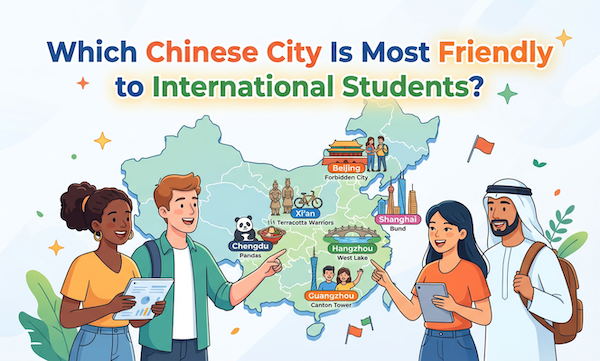
This article breaks down five cities — Beijing, Shanghai, Hangzhou, Shenzhen, Chengdu — across the things that actually affect your daily life and your post-graduation options. Not the brochure version. The real version.
The numbers, side by side
Let’s start with what can be measured. These numbers are based on 2025 data from multiple sources including university international student offices, cost-of-living surveys, and municipal education bureaus.
| Metric | Beijing | Shanghai | Hangzhou | Shenzhen | Chengdu |
|---|---|---|---|---|---|
| Monthly living cost (food, transport, phone, no rent) | ¥3,000–4,500 | ¥3,500–5,000 | ¥2,500–3,500 | ¥3,000–4,500 | ¥2,000–3,000 |
| Rent (single room, decent area, near metro) | ¥4,000–7,000 | ¥5,000–8,000 | ¥2,500–4,500 | ¥3,500–6,000 | ¥1,500–3,000 |
| International student population (2025) | ~¥45,000 | ~¥65,000 | ~¥22,000 | ~¥12,000 | ~¥18,000 |
| English accessibility (daily life) | Moderate | High | Moderate-High | Moderate | Low-Moderate |
| Post-graduation work visa ease | Moderate | High (pilot policies) | Moderate-High | High (Greater Bay Area) | Moderate |
| Job market for internationals | Strong (SOEs, tech, culture) | Very strong (MNCs, finance, tech) | Strong (e-commerce, tech) | Strong (hardware, tech, manufacturing) | Moderate (gaming, new consumer brands, culture) |
| “International feel” | High | Highest | Moderate-High | Moderate (newer city) | Low-Moderate |
A few things jump out immediately.
Shanghai is the most expensive, but also the most international. If your Chinese is limited when you arrive, Shanghai is the city where you can function best with English alone. It’s also where multinational companies recruit international graduates most actively.
Chengdu is the cheapest by a wide margin. Your monthly cost, rent plus living, can be under ¥5,000 if you’re careful. In Shanghai, that same budget gets you a single room and instant noodles.
Shenzhen and Hangzhou are younger cities with faster-growing job markets for tech. Beijing and Shanghai have more established pipelines, but also more competition per opening.
Hangzhou punches above its weight in e-commerce and digital economy jobs. Alibaba is headquartered there. If your interest is in digital business, Hangzhou’s ecosystem is hard to beat.
None of these numbers tell the full story, though. Let me talk about what the data doesn’t capture.
What “friendly” actually means in each city
“Friendly” isn’t one thing. A city that’s friendly to a French master’s student looking for an MNC job is different from a city that’s friendly to a Pakistani PhD student on a tight budget.
Beijing: the political and academic center
Beijing is where policy gets made. If you’re studying international relations, law, or Chinese language and culture at a deep level, Beijing is unmatched. Peking University, Tsinghua, Renmin, Beijing Language and Culture University — the concentration of top-tier institutions is dense.
The downsides are practical. Air quality is a recurring complaint. The cost of living is high but not Shanghai-high. The commute is long — the metro system is massive but the city is spread out.
For employment, Beijing is strong if you’re targeting SOEs (state-owned enterprises), government-adjacent organizations, or academic/research roles. For private-sector tech or MNC jobs, Shanghai has more openings.
One thing Beijing does better than anywhere else: the concentration of international students creates a community. You’re rarely the only foreigner in your program.
Shanghai: the most “international” experience
If your mental model of studying abroad involves coffee shops, English-language networking events, and being able to order food without a translation app, Shanghai is the closest thing China has to a “default international city.”
The job market for international graduates is the strongest in China. MNCs with China operations recruit actively from Shanghai’s universities. Finance, consulting, luxury, and consumer brands all have a heavy Shanghai presence.
The cost is the downside. Rent in decent areas near your university will take a significant chunk of your budget. Competition for internships is fierce — you’re competing with both top Chinese students and other international students.
But the safety and convenience are real. Midnight convenience stores, reliable metro until 11pm, food delivery in 30 minutes, and an expat ecosystem that means you can find help when you need it.
Hangzhou: the e-commerce and tech hub
Hangzhou is where Alibaba is headquartered. If your interest is in e-commerce, digital marketing, or tech business models, Hangzhou gives you proximity to the ecosystem in a way no other city does.
The city is cleaner and more livable than Beijing or Shanghai. The West Lake area is genuinely beautiful. Cost of living is moderate — not cheap, but not Shanghai.
The downside: the international community is smaller. If you need an English-speaking doctor, a notary who understands foreign documents, or just people who’ve been through the international student experience before you, Hangzhou has fewer of them than Shanghai.
For jobs, Alibaba and its ecosystem are the big draw. But the competition is intense and increasingly targets top-tier Chinese graduates. International students who’ve built China-specific skills (not just “I speak English and my native language”) do better here.
Shenzhen: the youngest city, the most “immigrant” mindset
Shenzhen was a fishing village 40 years ago. Today it’s a city of 17 million people, almost all of whom migrated there from somewhere else. That creates a culture where “being from somewhere else” is normal — because everyone is.
For international students in tech and engineering, Shenzhen is genuinely one of the best places in China. Huawei, Tencent, DJI, BYD — these are Shenzhen-headquartered companies that recruit globally. The city government also has proactive policies for attracting talent, including international graduates.
The city feels newer and more planned than Beijing or Shanghai. The metro is clean and logical. The Bao’an Airport connection is straightforward. The demarcation between “city center” and “suburbs” is less sharp than in older cities.
The tradeoff: Shenzhen has less historical and cultural depth than the other four cities. If your reason for coming to China includes “experiencing 3,000 years of continuous culture,” Shenzhen isn’t where you’ll find it. It’s a city of the last 40 years, not the last 400.
Also: in summer, it is hot and humid. Plan accordingly.
Chengdu: the lowest cost, the most distinctive local culture
Chengdu is where your money goes furthest. A decent single room near the university district can be ¥1,500–2,500. Food is cheap and exceptionally good — Chengdu is one of China’s great food cities, and unlike Shanghai or Beijing, the best meals don’t require a ¥300 budget.
The city has a reputation for “slow living” within China — teahouses, mahjong, a pace that isn’t Shanghai’s constant rush. For many international students, this is the appeal. You can study, but you can also have a life.
The job market for international graduates is smaller than the other four cities. Gaming companies (Chengdu has a cluster), some new consumer brands, and local companies expanding internationally are the main pathways. It’s not the place to come if your plan is “graduate and work at a Fortune 500 in China” — there are fewer of those here.
What Chengdu does offer is an authentic experience of “China that isn’t built for foreigners.” The expat bubble is thin. Your Chinese will improve faster here than in Shanghai because you can’t fall back on English as easily.
Three students who actually did it
Numbers and descriptions only get you so far. What it’s actually like — the texture of daily life, the moments where a city clicks or doesn’t — comes from people who’ve done it.
Lola, France — Shanghai, and why she stayed
Lola grew up in a quiet coastal town in western France where “everything closes early and nothing really changes.” When she finished high school, she felt her world was too small. She applied for a master’s program in International Marketing and Communications in Shanghai. She couldn’t speak Chinese and had never been to Asia, but she said yes anyway.
“The first night, I walked into a convenience store at midnight holding a warm tea egg, and I was surrounded by people shopping and laughing. I realized: this is completely different from home.”
That was the start. Over two years in Shanghai, Lola learned to order food in Chinese, to navigate the crowded metro lines, to haggle in markets, and to walk home alone at night without fear. The safety was something she mentioned explicitly — for a woman living abroad, she said, that feeling matters more than you expect.
When graduation approached, the mood among the international students shifted. Everyone realized that job-hunting in China as a foreigner is a different game from job-hunting in your home country. Lola spent mornings scanning job boards for foreigners, afternoons tweaking her resume for Chinese employers, and evenings practicing interview answers.
She applied to a renewable energy technology company. A few days later, a reply. Then a video interview. Then another round. Then an offer — Brand and Content Specialist, working in both Chinese and English.
She’s still in Shanghai. When she talks about why she stayed, it’s not about the city’s skyline or the expat events. It’s about the combination of professional challenge, real friendships, safety, and a kind of daily independence she hadn’t quite found before.
“I arrived as Lola, unsure of who I was. I stayed because I became 罗拉 — someone braver, more capable, and more certain of her place in the world.”
Bella, Indonesia — Shenzhen, law school and the bridge she’s building
Bella is a lawyer. She’d been practicing law in Indonesia for seven years before she applied to Peking University’s School of Transnational Law in Shenzhen.
“The first time I applied for the scholarship, I was rejected.” She recorded more than 20 practice interview videos over the next six months, fixed her application, and got in.
Shenzhen was a conscious choice. “I wanted to understand how Chinese companies operate, because so many Indonesian companies now work with Chinese partners. If I understand both systems, I can be the person who helps deals actually happen.”
The things she notices about Shenzhen are practical. The metro system — she can get almost anywhere with one line and at most one transfer. The apps — one platform does payments, food delivery, and restaurant reviews. The balance — Shenzhen moves fast, but the parks along Shenzhen Bay are where she runs on weekends, and the creative parks (OCT Loft) are where she goes when she needs to remember that Shenzhen also has an artistic side.
There was a moment early on when she was looking for a restaurant and got lost. A security guard who spoke no English walked her there. “He didn’t explain. He just started walking, and I followed. That’s when I understood: the infrastructure makes the city work, but these small human moments make it livable.”
Bella graduates soon. Her plan is to work on deals between Chinese companies and Indonesian clients. She’s not looking for a generic “international law” job. She’s building something specific — and Shenzhen is where she needed to be to make it possible.
Hira, Pakistan — Chengdu, and the city that made her dream come true
Hira is a PhD student in Economics and Management at the University of Electronic Science and Technology of China in Chengdu. She’s been in China since 2022.
“I’d dreamed of coming to China since I was in Pakistan. I’d seen the history, the cultural heritage, the economic growth on TV and in books. In 2022, the dream became real.”
Chengdu was not what she expected — in a good way. The city is clean, the food is extraordinary (she mentions the Sichuan peppercorns specifically, and the first time she understood what “spicy” really means in Chinese), and the pace is something she describes as “fast enough to be exciting, slow enough to be livable.”
The cultural moments stayed with her. There was the Spring Festival package the university prepared for international students — snacks, a red envelope (hóngbāo), the experience of receiving a gift from an elder figure, which she learned is a tradition of blessing. There was the Lantern Festival — walking through parks and shopping areas where every surface had colored lanterns, and trying to guess the riddles attached to them. There was the weekend trip to the Chengdu Research Base of Giant Panda Breeding, where she realized that seeing a panda in person is different from seeing one on a screen.
“People say ‘Shanghai is for careers, Beijing is for connections, Chengdu is for living.’ I think there’s truth in that. My budget goes twice as far here as it would in Shanghai. I can focus on my research, learn the language properly, and actually have a life outside the library.”
She’s not done yet — the PhD is ongoing — but when she talks about Chengdu, the word that comes up most often is “grateful.”
“Chengdu makes your dreams come true. I know it sounds like a slogan. But it’s been true for me.”
How to choose: a decision guide
There’s no single “most friendly” city. There’s the city that matches what you’re here for.
| If your main goal is… | Start with… | Why |
|---|---|---|
| Getting a job in China after graduation | Shanghai ≥ Shenzhen | MNCs recruit actively in Shanghai; Shenzhen tech companies hire globally |
| Minimizing cost while getting a good education | Chengdu > Hangzhou > Shenzhen | Rent + living costs vary dramatically between these cities |
| An English-friendly environment with less culture shock | Shanghai > Beijing | Highest internationalization, largest expat ecosystems |
| Tech, hardware, or engineering | Shenzhen ≈ Hangzhou | Huawei, Tencent, BYD, Alibaba — the ecosystem is there |
| Experiencing “real China,” not the expat bubble | Chengdu ≈ Hangzhou | More local culture preserved; fewer shortcuts in English |
| E-commerce, digital marketing, business | Hangzhou | Alibaba ecosystem; the city is built around digital commerce |
One note on Beijing: I’ve put it lower in “job after graduation” than Shanghai and Shenzhen. That’s not because Beijing’s job market is small. It’s large. But the path from international student to employed graduate is more straightforward in Shanghai (MNC recruiting pipelines) and Shenzhen (talent policies that explicitly target international graduates).
A few things the rankings won’t tell you
A few closing thoughts from watching international students navigate these choices.
First: your Chinese proficiency will matter more than your city choice. Lola stayed in Shanghai because her Chinese was good enough that a Chinese company could take a chance on her. Bella is building a career because she can work in the space between Indonesian and Chinese legal systems. Hira is thriving in Chengdu because she’s learning the language deeply, not just functionally.
The city enables this, but it doesn’t do it for you. Shanghai won’t magically make your Chinese fluent, and Chengdu won’t magically keep you isolated. The city changes the difficulty setting. It doesn’t change the requirement.
Second: visit if you can, before you commit. Every one of these cities feels different in person than it does in a brochure. Shenzhen feels newer and more planned than Beijing. Chengdu feels more relaxed than Shanghai. These are real differences, and they affect your daily life for two or three years.
If you can’t visit, try to talk to a current student at the university you’re targeting. Not the admissions office — a student. Ask what they wish they’d known before they came.
Third: your goal might change after you arrive. Plenty of international students who arrive thinking “I’ll study Chinese and go back home” end up looking for China jobs. And some who arrive thinking “I’ll build a China career” end up falling in love with the language and going into academia instead. The city you pick should give you options, not lock you in.
The bottom line
Shanghai is the safest bet if your priority is post-graduation employment and an international environment. Shenzhen is the best choice if you’re in tech or engineering and want to be where the companies are. Hangzhou is the sleeper pick if e-commerce or digital business is your angle. Beijing is unmatched for academic prestige and political/ cultural access — but the job hunt after graduation is more of a climb. Chengdu is the choice if you want your money to last, your Chinese to improve, and your experience to feel less like an expat bubble and more like a real Chinese city.
The “most friendly” city is the one that matches what you’re here for. Figure that out first, and the choice gets a lot easier.
Pros and cons at a glance
A side-by-side view of what each city gives and what it asks of you, drawn from the sections above.
| City | Strengths for international students | Things to weigh |
|---|---|---|
| Beijing | Unmatched academic concentration (Tsinghua, Peking), a dense international student community, and the strongest pipeline to SOEs, research, and Chinese studies | Cost runs higher than Chengdu or Hangzhou, air quality is a recurring complaint, and the post-graduation job hunt is more of a climb |
| Shanghai | The most international city, where English works in daily life, MNC recruitment is the most active, and safety plus convenience are real | The most expensive rent of the five, and internship competition is fierce because you compete with top Chinese and other international students |
| Hangzhou | Cleaner and more livable than Beijing or Shanghai, an e-commerce and digital-economy ecosystem built around Alibaba, at a moderate cost | A smaller international community, so English-speaking doctors, notaries, and peer support are thinner than in Shanghai |
| Shenzhen | The youngest, most immigrant-minded city, with global tech recruiters (Huawei, Tencent, BYD) and proactive Greater Bay Area talent policies | Less historical and cultural depth than the other four, and summers are hot and humid |
| Chengdu | The lowest cost by a wide margin, an authentic local culture, the fastest Chinese improvement, and the panda-city appeal | A smaller international job market, with fewer Fortune 500 China offices than Shanghai or Beijing |
Key authorities and official resources
The links below are the official bodies and reference sources behind the facts in this article. They are the pages you will actually use to verify a university, check visa rules, or plan your city choice.
- Shanghai municipal portal (English) – The official Shanghai government portal with city services and international-student information.
- Beijing municipal portal (English) – The official Beijing government portal covering education, visas, and living in the city.
- Shenzhen municipal portal (English) – The official Shenzhen government portal, including Greater Bay Area talent policies.
- Hangzhou municipal portal – The official Hangzhou government portal for city services and development plans.
- Chengdu municipal portal – The official Chengdu government portal covering living, study, and business in the city.
- Tsinghua University – Beijing’s top university and a common target for international graduate applicants.
- Peking University – Beijing’s other flagship university, strong in humanities, law, and international relations.
- Fudan University – A leading Shanghai university with large international programs.
- Shanghai Jiao Tong University – A top Shanghai university strong in engineering, business, and medicine.
- Zhejiang University – Hangzhou’s flagship university at the heart of the Alibaba ecosystem.
- Southern University of Science and Technology – Shenzhen’s fast-rising research university in science and engineering.
- Sichuan University – Chengdu’s largest comprehensive university with a growing international body.
- China Scholarship Council (CSC) official – The official source for Chinese government scholarships and admission policy.
- National Immigration Administration (English) – The authority that sets student visa (X1/X2), residence permit, and post-graduation work rules.
- Ministry of Education Study in China (official) – The official education ministry portal for studying in China.
- QS World University Rankings 2026 – The global ranking employers and admissions offices read when comparing universities.
Frequently asked questions
Which Chinese city has the most international students?
Shanghai. During China’s 14th Five-Year Plan period, Shanghai hosted nearly 80,000 international students across its universities, the largest concentration of any Chinese city. Beijing is second, with the article’s 2025 table showing roughly 45,000. Hangzhou, Shenzhen, and Chengdu each host between 12,000 and 22,000 international students.
Which Chinese city is cheapest for international students?
Chengdu. With careful budgeting, rent plus daily living can stay under CNY 5,000 a month. In Shanghai the same budget covers a single room and little else. Hangzhou and Shenzhen sit in the middle, and Beijing runs higher than those two but below Shanghai.
Which city is best if I do not speak Chinese yet?
Shanghai. It has the highest daily-life English accessibility of the five, the largest expat ecosystem, and the most international networking events. Beijing is the next-best English-friendly option. Chengdu ranks lowest on English access, which is exactly why many students there improve their Chinese fastest.
Which city is best for tech, engineering, or hardware jobs?
Shenzhen and Hangzhou. Shenzhen is home to Huawei, Tencent, DJI, and BYD, and the city government runs proactive talent policies for international graduates. Hangzhou centers on e-commerce and the digital economy through Alibaba’s ecosystem. Both have faster-growing tech job markets than the older hubs.
Which city makes it easiest to work in China after graduation?
Shanghai and Shenzhen. Shanghai has the most established multinational recruiting pipelines, and Shenzhen benefits from Greater Bay Area talent policies, including residence permits of up to five years for qualified international professionals. Beijing’s job market is large, but the international-student-to-employment path is less direct than in those two cities.
Can international students work part-time or stay to work after graduating?
Studying in China normally requires an X1 (long-term) or X2 (short-term) student visa and a residence permit, and part-time work is restricted and needs school and immigration approval. After graduation, international students who secure a job can apply for a work-type residence permit or a relevant visa. The National Immigration Administration sets the rules, and cities like Shanghai and Shenzhen run graduate stay-and-work pilot policies.