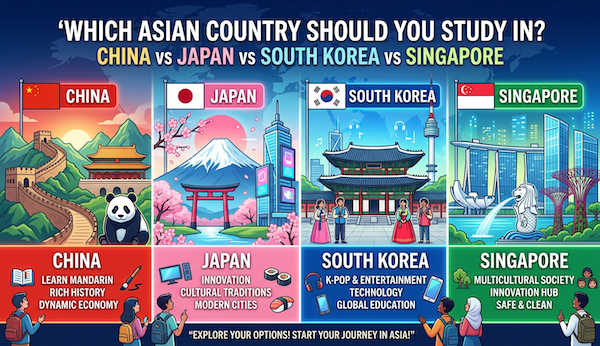
A data-driven comparison for international degree-seeking students choosing between Asia’s top four study destinations.
You have narrowed your study abroad search to Asia. You know you want a quality degree without the US/UK/Australia price tag. But now you are staring at four countries, and the choice feels impossible.
Each country has world-class universities, generous government scholarships, and a genuine welcome for international students. But the differences matter: a year in Singapore costs three times what a year in Chengdu costs. A CS graduate in Seoul faces a different job market than one in Tokyo. English is everywhere in Singapore; it is rare outside campus in Wuhan.
This guide compares all four countries across the dimensions that actually determine your experience: cost, university quality, language barriers, safety, scholarships, and what happens after graduation.
Quick decision matrix
Scan this first. If one column instantly matches you, skip to that section.
| Factor | China | Japan | South Korea | Singapore |
|---|---|---|---|---|
| Annual budget (self-funded) | $6,000–15,000 | $14,000–25,000 | $9,000–21,000 | $20,000–40,000 |
| Best-known scholarship | CSC (full ride + stipend) | MEXT (full ride + stipend) | GKS (full ride + stipend) | MOE Tuition Grant (bond required) |
| QS Asia Top 100 | 25 universities | 12 universities | 15 universities | 2 universities |
| English on campus | Growing (700+ programs) | Limited but growing | Common at top unis | Universal |
| Need local language | Strongly recommended | Almost essential for daily life | Helpful | Not needed |
| Post-study job hunt window | In-country conversion (2026) | Up to 1 year | 6 months to 3 years | Up to 1 year (no work allowed) |
| Safety (homicide rate) | 0.46 / 100,000 | 0.23 / 100,000 | ~0.6 / 100,000 | 0.17 / 100,000 |
| Best for | Affordability + scale of opportunity | Deep cultural immersion | Pop culture + tech jobs | No language barrier + global career |
1. Cost: what you actually pay per year
Money is the first filter for most students. Here is the honest math.
Tuition (per year, USD)
| Degree Level | China | Japan (National) | Japan (Private) | Korea (National) | Korea (Private) | Singapore |
|---|---|---|---|---|---|---|
| Language program | 1,100–3,500 | N/A | N/A | N/A | N/A | N/A |
| Bachelor’s | 2,800–4,900 | 3,600 | 5,400–8,100 | 2,600–6,000 | 4,500–11,200 | 12,700–25,300 |
| Master’s | 3,500–6,300 | 3,600 | 5,400–8,100 | 2,600–6,000 | 4,500–11,200 | 14,900–30,000 |
| Medicine | 4,200–8,400 | 3,600–8,100 | 7,000–12,000 | 6,000–15,000 | 9,000–15,000 | 25,000–55,000 |
What jumps out: China is the cheapest at every level. Japan’s national universities cost slightly less than China’s mid-range programs. Korea’s private universities land in a middle bracket. Singapore’s tuition starts where the others peak. NUS fees are closer to Western prices.
Living costs (monthly, USD)
| City Tier | China | Japan | South Korea | Singapore |
|---|---|---|---|---|
| Capital / Tier-1 | $490–700 (Beijing/Shanghai) | $1,000–1,400 (Tokyo) | $650–900 (Seoul) | $1,100–1,700 |
| Second city | $350–490 (Chengdu/Wuhan) | $800–1,100 (Osaka/Fukuoka) | $550–750 (Busan/Daejeon) | N/A (city-state) |
| Dormitory | $55–140/month | $100–200/month | $225–450/month | $400–700/month |
The gap is stark. A student in Chengdu living in a dorm and eating at canteens can get by on 350/month.InSingapore,adormroomalonecostsmorethanthat.Japan′shousingcostsarethehiddenfactorpushingitstotalbudgetupward.AprivateapartmentinTokyoruns270–470/month.
Total annual budget scenarios
| Scenario | China | Japan | South Korea | Singapore |
|---|---|---|---|---|
| Budget (dorm + canteen) | $6,000–8,000 | $13,000–16,000 | $9,000–12,000 | $20,000–25,000 |
| Mid-range (shared apartment) | $8,000–12,000 | $16,000–20,000 | $13,000–18,000 | $28,000–35,000 |
| On full scholarship | $0–3,000 (stipend covers living) | $0–5,000 (stipend partial) | $0–5,000 (stipend partial) | Tuition grant only (still pay living) |
Bottom line: China and South Korea are the budget options. Japan costs about 50–80% more than China. Singapore costs roughly 3× what China costs for the same lifestyle.
2. University quality: rankings told honestly
QS Asia University Rankings 2026 snapshot
| Country | Top 100 count | Highest | Highlight |
|---|---|---|---|
| China (Mainland) | 25 | #2 Peking | 394 total ranked institutions |
| South Korea | 15 | Yonsei (top 20) | 6 in top 20; 31 universities improved |
| Japan | 12 | #26 U-Tokyo | 8 in top 50; strong employer reputation |
| Singapore | 2 | =#3 NUS & NTU | Highest per-capita quality |
The raw numbers favor China, but the picture shifts when you look at density. Singapore has two universities in the top 3. South Korea has six in the top 20. China dominates by volume, not by per-capita elite concentration.
What employers think
QS measures Employer Reputation as 20% of the ranking. The University of Tokyo scored highest in Asia on this indicator. Singapore’s two universities had the highest collective employer reputation score (64.5 average). For students whose main goal is a job after graduation, these two countries carry disproportionate weight per institution.
Here is the honest take: if you attend Peking, Tsinghua, Fudan, NUS, NTU, U-Tokyo, SNU, KAIST, or Yonsei, your degree will be recognized globally. The difference emerges when you step outside the top 5–10 in each country. A degree from a mid-tier Chinese university carries less international brand recognition than one from a mid-tier Japanese or Korean university. Part of this reflects history: Japan and Korea have been sending students abroad and building international academic recognition for longer.
3. Scholarships: who pays for your degree
All four countries offer government-funded, full-ride scholarships. The differences are in coverage depth and competitiveness.
| Scholarship | Country | Tuition | Monthly Stipend (USD equiv.) | Airfare | Housing |
|---|---|---|---|---|---|
| CSC (Type A) | China | Full | $350–490 | Yes | Covered |
| MEXT | Japan | Full | ~$800 | Yes | Partial subsidy |
| GKS (UG) | Korea | Full (up to ₩5M/sem) | ~$670 | Yes | Covered |
| GKS (Grad) | Korea | Full | ~$1,030 + research | Yes | Covered |
| MOE Tuition Grant | Singapore | Partial (covers ~50–70%) | None | No | No |
What the stipends actually mean
A CSC student in China receives ¥2,500–3,500/month (350–490).InChengduorWuhan,thiscoverseverythingwithmoneyleftover.InBeijing,itcoversbasiccostsbutleaveslittlemargin.TheGKSgraduatestipendof₩1,380,000( 1,030) plus research support in Seoul is livable but tight. Seoul is expensive. MEXT’s ¥117,000 (~$800) in Tokyo covers the basics but leaves little margin.
One key difference: only the MOE Tuition Grant requires a bond. Non-Singaporean graduates must work in Singapore for 3 years after graduation. The other three scholarships are unconditionally free. No required return to your home country. No required work period.
How competitive are they?
CSC receives roughly 50,000–60,000 applications for 30,000+ awards. Acceptance rate hovers around 50–55%, but varies sharply by country (lower for Pakistan/India, higher for smaller source countries). GKS accepts about 1,300–1,500 students per year globally across both tracks. It is significantly more competitive than CSC. MEXT numbers are similar to GKS. The MOE Tuition Grant in Singapore is broadly available but remember the bond.
4. Language: the biggest daily-life variable
This is where the four countries diverge most sharply. It is also where students are often underprepared.
| China | Japan | South Korea | Singapore | |
|---|---|---|---|---|
| English on campus | Growing fast | Limited outside top programs | Common at top 10 | Universal |
| English-taught degree programs | 700+ | ~200+ | ~200+ | All programs |
| English in daily life | Rare outside major cities | Rare even in Tokyo | Uncommon outside Itaewon/Hongdae | Universal |
| Language requirement for admission | HSK 4–5 (Chinese-taught) | JLPT N2 (Japanese-taught) | TOPIK 3–4 (Korean-taught) | IELTS/TOEFL only |
| Need local language to thrive | Recommended | Almost essential | Helpful | Not at all |
Where English actually works
Singapore: English is the language of instruction, business, and daily life. If language barrier is your #1 concern, the decision is made here.
China: 700+ English-taught programs exist, concentrated in medicine (MBBS), engineering, and business. The top 20 universities all offer English tracks. Outside the university gate, expect almost zero English. Ordering food, taking a taxi, visiting a hospital will all require Chinese or a translation app. This is not a dealbreaker. Tens of thousands of international students manage it. But it is a daily reality you should not underestimate.
South Korea: Most top universities (SNU, Korea, Yonsei, KAIST) offer significant English-taught coursework, especially at graduate level. Undergraduate English programs are growing but concentrated in international studies, business, and engineering. Daily life: Seoul has enough English signage and young Koreans with basic English to survive. Busan or Daegu will test you.
Japan: English-taught programs exist at top national universities (U-Tokyo, Kyoto, Tohoku, Waseda) but remain limited in number and field diversity. Graduate programs have more English options than undergraduate. Daily life: Japan has the lowest English proficiency among the four countries. Even in Tokyo, basic daily interactions like banking, hospital visits, and city hall paperwork will require Japanese or significant help.
5. Safety: what the numbers say
All four countries are safe by global standards. The differences are in type of risk, not magnitude.
| Safety Metric | China | Japan | South Korea | Singapore |
|---|---|---|---|---|
| Homicide rate (per 100K) | 0.46 | 0.23 | ~0.6 | 0.17 |
| Numbeo Safety Index | 76.0 | ~78 | ~74 | ~77 |
| Global Peace Index (approx.) | ~85–95 | Top 12 | ~40–55 | Top 6 |
| Main safety concern for int’l students | Traffic (right-turning vehicles) + job/rental scams | Earthquakes + language barrier in emergencies + train groping (chikan) | Nightlife areas + voice phishing (smishing) targeting foreigners | Strict drug laws (death penalty) + dengue/heat risks |
The practical reality: violent crime against international students is rare in all four countries. Property crime (phone theft, bicycle theft) is the most common incident across all four. But each country has specific risks that international students—especially first-time visitors to the region—should know about before arriving.
China: At pedestrian crossings, right-turning vehicles do not reliably stop even when the walk signal is green. Job and housing scams targeting international students circulate on social media and WeChat groups; never transfer money for a rental deposit without viewing the room in person. Campus CCTV density is a unique advantage: students who lose phones or bikes routinely get them recovered through campus security footage.
Japan: Earthquakes and typhoons are genuine risks, but the bigger problem for international students is the language barrier during emergencies. Emergency broadcasts, evacuation instructions, and city hall communications are overwhelmingly in Japanese. Train groping (chikan) remains a persistent issue on crowded commuter lines; women should use women-only cars during rush hours. Rare but documented, some international students have encountered refusal of service or entry based on race or nationality, particularly in smaller cities and rural areas where foreign encounter is infrequent.
South Korea: Nightlife districts like Itaewon carry real risks. In October 2022, a crowd crush in Itaewon killed 159 people, many of them young international visitors. Drink spiking in club districts has been reported by foreign students. Voice phishing (smishing) is a widespread scam in Korea that specifically targets newly arrived foreigners who don’t yet recognize the tactic: callers pretend to be bank officials or police and extract personal financial information. Foreign students are frequent targets because they are less familiar with local scam patterns.
Singapore: Crime is extremely low, but Singapore has risks that are less visible. The Misuse of Drugs Act carries a mandatory death penalty for trafficking and up to 10 years for possession of even small amounts—a fact many international students are unaware of until warned by campus orientation. Dengue fever is endemic; students living in dormitories near vegetated areas should use repellent. Heat exhaustion is a real risk for students arriving during the hot season (March–May). Unlike the other three countries, Singapore has essentially zero property crime—you can leave a laptop in a café and it will still be there an hour later.
6. After graduation: stay and work, or leave?
This section determines whether your degree unlocks a career or just a diploma.
Post-study work pathways
| China | Japan | South Korea | Singapore | |
|---|---|---|---|---|
| Job-seeking period | In-country conversion (2026 policy) | 6 months + 6 month extension (1 year max) | 6 months to 3 years (D-10) | Up to 12 months (LTVP, no work) |
| Work visa sponsor needed | Yes (employer) | Yes (employer) | Yes (employer) | Yes (employer) |
| STEM advantage | Strong: 85% Z visa approval vs 62% liberal arts | Moderate | Strong: fast track options | Strong (tech sector growth) |
| Path to permanent residency | 5+ years continuous residence | 10 years (5 for HSP) | Points-based (F-2-7, ~3 years for graduates) | 2+ years on EP |
| Realistic starting salary (USD) | $1,200–2,500/month | $1,800–2,500/month | $1,500–2,500/month | $2,500–4,000/month |
What the numbers don’t show
China’s 2026 policy shift is worth paying attention to. STEM graduates can now convert from an X1 student visa to a Z work permit without leaving the country. Previously, graduates had to exit China and reapply from abroad, a process that cost weeks and left a visa gap. This change signals that China actively wants international STEM talent to stay.
China’s industry scale is the part most comparisons overlook. China leads the world in several sectors where international graduates can build careers: industrial robotics (45% global market share), EVs and batteries (BYD, CATL dominate), AI implementation at scale (computer vision, autonomous driving, facial recognition), drones (DJI holds ~70% global consumer drone market), and the world’s largest 5G/tech manufacturing ecosystem. For STEM graduates—especially in electrical engineering, computer science, and data science—China offers something the other three countries cannot: the chance to work at the center of global supply chains and next-generation technology deployment. Foreign-invested enterprises (FIEs) in China—including Apple, Tesla, Siemens, and Huawei—actively recruit international graduates who combine technical skills with cross-cultural fluency.
The growth gap matters more than the density gap. China’s economy is not only large—it is still growing fast. GDP growth in 2025–2026 is running at 4–5% annually, compared with ~0.5–1.5% in Japan, ~1–2% in South Korea, and ~1–2% in Singapore. Fast growth means new companies, new divisions, and new graduate hiring pipelines are being created every year. In the other three countries, graduate hiring is largely a zero-sum game: you are competing for existing positions in mature, slow-growing economies. In China, the pie is still expanding. For international students willing to navigate the language and visa logistics, this growth translates into real opportunity: more entry-level openings, more sectors hiring, and more room for rapid promotion than in any of the other three countries.
Japan’s approach is employer-driven throughout. The job-seeking visa exists, but without a job offer, you leave after a year. Japanese hiring culture (group interviews, rigid timelines, heavy emphasis on Japanese language) creates friction for international graduates. Non-Japanese speakers face a dramatically smaller job pool, though English-speaking tech roles in Tokyo are growing.
South Korea’s D-10 visa is the most flexible among the four. Points-based (TOPIK, degree level, work experience) and renewable up to 3 years for high scorers. The K-pop and tech sectors actively recruit international talent. Competition is intense, and salaries for entry-level international hires are modest compared to Singapore.
Singapore has the tightest post-study framework. The LTVP does not permit work, and an employer must sponsor your EP or S Pass. But if you clear that hurdle, Singapore offers the highest salaries, the most international work environment, and the fastest path to permanent residency (2+ years). The English-language work environment means your degree’s value is not diminished by a language barrier.
7. Which country fits you? A student-type guide
Choose China if:
- Budget is your primary constraint and you want a full-ride scholarship (CSC)
- You want a country with massive scale. 394 ranked universities means a program exists for almost every field and budget level
- You are comfortable navigating daily life with translation apps and learning basic Chinese
- Your home country has strong trade or employment ties with China (Pakistan, Southeast Asia, Africa, Central Asia)
- You are in STEM and want the clearest path to post-graduation employment
- You are interested in AI, robotics, EVs, semiconductors, or manufacturing tech. China is the global leader in industrial robotics deployment, the world’s largest EV market, and a top-tier AI research hub. A degree in these fields from a Chinese university gives you proximity to the companies defining these industries.
- You want a fast-growing job market. China’s economy is still expanding at 4–5% annually, creating new graduate hiring pipelines every year. By contrast, Japan, South Korea, and Singapore are all mature, slow-growth economies where you are largely competing for existing positions. In China, the pie is still getting bigger.
Choose Japan if:
- You value deep cultural immersion and are willing to invest in learning Japanese
- You want strong employer reputation per institution. U-Tokyo, Kyoto, and Waseda carry real weight with global recruiters
- You are willing to navigate a more demanding daily-life language environment
- You are interested in traditional engineering, robotics, or humanities research
- You enjoy structure, order, and a society that runs on predictability
Choose South Korea if:
- You want a middle-ground budget with excellent scholarship options (GKS)
- You want the best study-to-work visa flexibility in Asia (D-10 up to 3 years)
- You are in tech, semiconductors, or entertainment/media (Korea’s fastest-growing export sectors)
- You want a country where enough English exists to survive but full immersion is available when you want it
- You value a dynamic, fast-paced urban culture
Choose Singapore if:
- Language barrier is your dealbreaker. You want zero friction between campus and career
- You can afford the higher cost or secure a Tuition Grant (and accept the 3-year bond)
- Your career goal is a global company, and Singapore’s status as a regional HQ hub matters
- You want the highest entry-level salaries in Asia
- You prefer a compact, efficient environment. Singapore is a city-state, which means no second-tier city tradeoffs
8. Student voices
Real experiences from students who made the choice.
Nguyen Van Hui, Vietnamese, Shanghai Jiao Tong University (China): Hui graduated with a CS master’s in 2025 and converted his student visa to a work permit under China’s 2026 in-country policy. “This policy saved me at least two months and thousands of yuan. I could start working immediately after my defense instead of waiting for visa approval.” He now works in Shanghai’s tech sector.
A Korean engineering student’s experience (China): “Last year, I developed a fever at 1 AM. I messaged the international student office contact. Someone arrived within 10 minutes, took me to the community health center, and helped me contact my parents. These reflect standard response protocols at universities with international student populations.” (Composite case derived from university support service reports.)
Meera, Indian, completed a master’s in Japan: Meera did not secure a job before graduation. She applied for Japan’s Designated Activities visa and spent four months job-hunting while improving her Japanese. She secured a full-time position at an IT company and converted to a work visa. Her advice: “Start job searching 6–12 months before graduation. The timeline is everything.”
A Pakistani student’s comparison (Reddit, anonymized): “I studied in both Korea and China. Korea’s university life is more social, more organized for international students. China is less structured. You have more freedom but also more responsibility to figure things out yourself. Cost-wise, China wins by a lot. Career-wise, it depends on your field.”
(Note: Directly attributed quotes are from published sources and university reports. Some student perspectives are composite cases constructed from documented experiences. Actual individual experiences vary.)
9. Final recommendation matrix
| Your Priority | Best Choice | Runner-Up |
|---|---|---|
| Lowest total cost | China | South Korea (national university) |
| Best scholarship (no strings) | CSC (China) or GKS (Korea) | MEXT (Japan) |
| No language barrier | Singapore | (no close second) |
| Easiest post-graduation stay | South Korea (D-10) | China (STEM, 2026 policy) |
| Highest starting salary (nominal USD, before tax) | Singapore | Japan |
| Strongest tech/STEM industry ecosystem | China | Singapore |
| Most universities to choose from | China (394 ranked) | Japan (147 ranked) |
| Safest by the numbers | Singapore | Japan |
| Best employer reputation per school | Singapore | Japan |
| Cultural immersion depth | Japan | China |
| Fastest path to PR/citizenship | Singapore (2+ years) | South Korea (points-based) |
The country you choose matters less than the specific university, program, and what you do with your time there. A CS degree from Zhejiang University opens different doors than the same degree from a provincial university, even though both are in China. The scholarship you win, the internship you land, the language you learn, and the network you build will matter far more than the flag on your diploma.
But the country sets the stage. It determines your daily cost of living, who you will meet, how hard daily life will be, and whether you can stay after graduation. Choose the stage that fits your tolerance for cost, language friction, and long-term career geography.
Data sources: QS Asia Rankings 2026, study-abroad.org country cost guides, Study in Japan Official Website, GKS 2026 application guidelines (NIIED), MEXT 2025 application guidelines, Singapore MOE Tuition Grant Scheme, Numbeo Safety Index 2025, China National Immigration Administration 2026 policy documents, Global Peace Index 2025 (IEP, Vision of Humanity). Prices in USD at June 2026 exchange rates. Verify specific program costs and visa policies with each institution and immigration authority before applying.
Pros and cons at a glance
| Pros of choosing China | Cons and things to weigh |
|---|---|
| China is the cheapest option at every level, with self-funded budgets from 6,000 to 15,000 USD a year | Daily life outside campus needs Chinese, and English is rare even in big cities |
| The CSC scholarship is a full ride with a monthly stipend and no bond or return requirement | Mid-tier Chinese universities carry less international brand recognition than mid-tier Japanese or Korean schools |
| STEM graduates can convert an X1 visa to a work permit inside China under the 2026 policy | Starting salaries are lower than Singapore and roughly level with Japan and Korea |
| The scale of industry (AI, EVs, robotics) creates careers the other three countries cannot | The language barrier makes everyday emergencies harder to handle without help |
Key authorities and official resources
- Campus China: official CSC admissions and university application portal for China
- Study in Japan: the Japanese government official portal for international students
- Study in Korea: the Korean government official portal for international students
- Ministry of Education Singapore: official source for tuition grants and study policy