If you have looked into studying in China for more than five minutes, you have heard of the CSC scholarship. Full tuition, free dormitory, monthly living allowance, and comprehensive health insurance, all paid by the Chinese government. For many international students, especially from developing countries, CSC is the difference between studying in China and not studying at all.
The question everyone asks: just how hard is it to actually get one?
The short answer: about 20% of applicants succeed. But that number hides a much more complicated reality. Some applicants walk in with a 60% chance without even realizing it. Others apply with a 5% chance and spend months wondering why they never heard back.
This article breaks down what the data actually says, where most applicants go wrong, and what you can do to put yourself on the right side of those odds.
The numbers: what the data actually shows
CSC does not publish real-time success rates. But based on application volumes, quota announcements, and data aggregated from multiple sources, here is what the picture looks like:
| Year | Estimated Applicants | Estimated Awards | Success Rate |
|---|---|---|---|
| 2018 | ~25,000 | ~5,000 | 20.0% |
| 2019 | ~28,000 | ~5,500 | 19.6% |
| 2020 | ~26,000 | ~4,800 | 18.5% |
| 2021 | ~29,000 | ~6,000 | 20.7% |
| 2024-2026 | ~30,000-35,000 | ~6,000-7,000 | ~18-22% |
The 2020 dip is easy to explain: COVID-19 disrupted global mobility. The recovery since then is strong but uneven. The overall trend: more people applying every year, while quotas grow more slowly.
How does CSC compare to other major scholarships?
| Scholarship | Estimated Success Rate |
|---|---|
| CSC (Chinese Government) | ~20% |
| Fulbright (US) | ~15% |
| DAAD (Germany) | ~15-20% |
| Chevening (UK) | 1.5-3% |
| Rhodes (Oxford) | ~0.7% |
On paper, CSC looks generous. 20% is genuinely higher than most globally competitive scholarships. But this average is deceptive.
For broader scale: China hosted about 380,000 international students in 2024/2025, and CSC-funded students account for roughly 8% of that population (around 30,400 enrolled scholars), according to China Daily citing Ministry of Education data.
Why? Because the 20% is not evenly distributed.
The most important thing nobody tells you: Type A vs Type B
CSC Scholarship is not one scholarship. It is at least three distinct programs, and the two most common routes, Type A and Type B, work completely differently.
Type A: embassy route (the one most people apply for)
You apply through the Chinese embassy in your home country. The embassy screens applications and forwards them to CSC in Beijing.
The critical mechanic: country quotas.
Each country gets a fixed number of Type A spots, negotiated through bilateral agreements. Pakistan might get 300 spots. A small European country might get 15. If 500 Pakistanis apply for 300 spots, that is a 60% rate. If 200 applicants from a small country compete for 15 spots, that is 7.5%.
Your real competition is not global. It is the other applicants from your country.
Key facts about Type A:
- ✅ Full package: tuition + dorm + living allowance (¥2,500-3,500/month) + insurance
- ✅ Can list up to 3 university preferences
- ❌ Country quota is the biggest bottleneck
- ❌ Embassy processing speed varies a lot by country
Type B: university route (the underrated alternative)
You apply directly to a Chinese university. The university reviews your application, ranks you against other applicants, and recommends the top candidates to CSC in Beijing.
No country quotas. You compete globally, but within one university’s batch.
Key facts about Type B:
- ✅ Tuition waiver + dorm
- ❌ Usually no monthly living allowance — this is the biggest catch
- ✅ Only one university to apply to (simpler, but less flexible)
- ✅ Pre-admission letter from a professor is a major advantage
Here is the comparison side by side:
| Type A (Embassy) | Type B (University) | |
|---|---|---|
| Funding | Full: tuition + dorm + ¥2,500-3,500/month + insurance | Usually tuition + dorm only (no stipend) |
| Competition | Country quota — varies by country | No country quota, global pool per university |
| University choice | Up to 3 preferences | 1 university |
| Key advantage | Living allowance | Pre-admission letter path |
| Best for | Students who need full financial support | PhD applicants with professor connections |
| Annual value | ¥59,200-99,800 (~$8,500-14,000) | ¥26,000-58,000 (~$3,700-8,300) |
What actually gets you selected (and what gets you rejected)
Based on guidance from CSC, university admissions offices, and patterns reported by successful applicants, here is how the evaluation roughly works:
What matters most (approximately ranked)
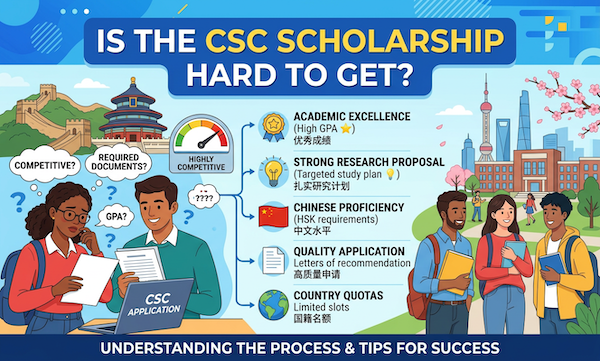
- Study plan / research proposal — This is where most rejections happen. A generic, copy-pasted plan signals “I did not think about this seriously.” A specific plan that connects your research interests to a real Chinese professor’s work signals “I know exactly what I am doing here.”
- Academic record (GPA, publications) — Strong grades are the baseline, not a differentiator. For PhD applicants, published research is a real advantage.
- Pre-admission or supervisor acceptance letter — Not required, but having a professor say “I want to supervise this student” changes everything. For Type B, this is practically essential at competitive universities.
- Recommendation letters — Two letters from professors who actually know your work. Generic letters with no specifics do almost nothing.
- Language proficiency — HSK for Chinese-taught programs, IELTS/TOEFL for English-taught programs. Necessary but not sufficient. Nobody wins CSC because they scored 6.5 on IELTS instead of 6.0.
- University prestige of your target schools — Counterintuitively, applying to Tsinghua or Peking University is harder, even though they have more CSC slots. The application volume is huge.
Common reasons applicants get rejected
- Submitted a generic study plan that could apply to any university in any country
- Applied only to top-tier universities in Beijing/Shanghai with no backup
- Chose the wrong application type (Type A when Type B would have been easier)
- Missed the pre-admission letter window
- Did not research the country quota for Type A
- Applied for a field with no professor match at the target university
Where most people get the strategy wrong
After looking at the data and the evaluation logic, here is where the typical applicant goes off track:
Mistake 1: Treating CSC like a lottery.
Most people fill out the form, upload their documents, and wait. That is like applying for a job by sending a generic resume to a company with no cover letter and no contact inside the company. The people who get CSC treat it like a targeted application, not a lottery ticket.
Mistake 2: Obsessing over Type A and ignoring Type B.
Type A gets more attention because people see the monthly stipend and think it is the only “real” scholarship. But Type B at a well-funded university can be an easier path, especially for PhD applicants. And some top universities like Tsinghua and Zhejiang supplement Type B with their own stipends. You need to check each university’s policy.
Mistake 3: Applying only to famous universities.
Every year, thousands of applicants list the same 5-10 universities as their preferences. Meanwhile, strong regional universities in places like Kunming, Harbin, or Dalian receive far fewer CSC applications. The program quality may be comparable. The competition is not.
Mistake 4: Not getting a pre-admission letter because it is “optional.”
Technically true — it is optional. Practically, at competitive universities, applicants with pre-admission letters are prioritized. This is not a secret. It is how the system is designed to work.
How to actually increase your chances: practical strategy
Here is a step-by-step strategy based on what successful applicants consistently do:
1. Apply both Type A and Type B simultaneously
Yes, you can. CSC reviews them independently. If accepted through both, you choose which to take.
If your country has generous Type A quotas and you need the living allowance, prioritize Type A. If your country has tiny quotas or your local embassy is slow and bureaucratic, Type B at a targeted university is the smarter play.
2. Get the pre-admission letter before you apply
This is the highest-ROI action you can take. Here is how:
- Identify 3-5 professors at your target universities whose research matches your interests
- Email them with a brief, specific message: who you are, what you want to study, why their work interests you, and that you are applying for CSC
- Attach a one-page research proposal and your CV
- If one professor says yes and issues a pre-admission or acceptance letter, your application immediately moves into a different tier of priority
3. Write a study plan that a professor would actually want to read
Do not write “I want to study computer science because China is advanced in technology.” A good study plan answers:
- What specific problem do you want to research?
- What existing work has been done on this problem?
- What methodology would you use?
- Why does this research need to happen in China specifically?
- Which professors at this university work in this area?
- What is your semester-by-semester plan?
This is the document that separates the 20% who get it from the 80% who do not.
4. Apply to at least one “underapplied” university
Add at least one university outside Beijing, Shanghai, and Guangzhou to your list. The education quality at provincial universities like Yunnan University, Harbin Institute of Technology, or Dalian University of Technology is strong. The CSC competition is significantly lower.
5. Build a professor connection before the deadline
The CSC application window opens around November-December and closes around March-April. Start emailing professors in September or October. If you wait until February, most professors have already committed to other students.
Two application experiences (what success and failure actually look like)
These are composite cases built from documented application patterns, public university records, and forum discussions. They reflect how the process actually plays out for real applicants.
Case 1: the strategic applicant (Type B, success)
Background: Chemical engineering master’s applicant from Nigeria. GPA 3.4/4.0. One published conference paper. IELTS 7.0.
What he did right:
- Started in August, four months before the CSC window opened
- Identified three professors at Zhejiang University of Technology (not Zhejiang University — slightly lower profile, much less CSC competition) whose research matched his interests
- Emailed all three with a one-page research proposal on wastewater treatment using materials he had studied in his undergraduate thesis
- Got a positive response from one professor, who agreed to issue a pre-admission letter after a video call
- Applied Type B with the pre-admission letter attached
- Wrote a detailed study plan that referenced the professor’s recent publications
Result: Awarded CSC Type B (tuition + dorm). The university also provided a supplementary monthly stipend of ¥1,500 from its own funds.
The point: The pre-admission letter and targeted study plan turned a 20% generic probability into something much closer to a sure thing.
Case 2: the lottery player (Type A, rejection)
Background: Business administration master’s applicant from a Southeast Asian country. GPA 3.1/4.0. IELTS 6.5. No publications.
What went wrong:
- Started preparing two weeks before the deadline
- Applied Type A through the local Chinese embassy without checking his country’s quota (which was small — roughly 20 spots for all degree levels)
- Listed Peking University, Fudan University, and Shanghai Jiao Tong University as his three preferences — all top-tier, all extremely competitive for CSC
- Wrote a generic study plan: “I want to study business administration to understand Chinese management practices”
- Did not contact any professors or seek a pre-admission letter
- Submitted standard recommendation letters that said he was a “good student” with no specifics
Result: Rejected. Status never moved past “submitted.”
Why: At every decision point, his application looked like every other application in the pile. He was competing for 20 spots in a country with hundreds of applicants, targeting the three most competitive universities, with no professor connection and no differentiated study plan. The system did not fail him — his strategy did.
What he could have done differently: Applied Type B to a provincial university instead, started professor outreach earlier, and written a study plan with a specific research angle rather than a generic statement of interest.
CSC Type A vs Type B: which should you choose?
Use this decision framework:
| Your Situation | Recommended Path |
|---|---|
| You absolutely need the monthly living allowance to survive | Type A — nothing else covers it |
| Your country has a generous CSC quota (Pakistan, Bangladesh, Thailand, Nigeria, Ethiopia, etc.) | Type A — your odds are above average |
| Your country has a tiny CSC quota (most European countries, small nations) | Type B — avoid the country bottleneck |
| You are a PhD applicant with published research | Type B + pre-admission letter — this is your strongest path |
| You have already connected with a professor who wants to supervise you | Type B with that professor’s university |
| You want to maximize options | Apply both: 1-2 Type A + 1 Type B |
| You are flexible about university location | Type B to a provincial university — lowest competition of all |
Important: Even if Type B does not include a stipend, some universities (especially well-funded ones) add their own monthly allowance on top. Always check with the specific university’s international student office before ruling out Type B.
Pros and cons of the CSC scholarship
No scholarship is purely good or bad. Here is the realistic balance, drawn from how the program actually works.
| Pros | Cons |
|---|---|
| Full funding: tuition, dormitory, monthly stipend (¥2,500-3,500) and insurance | About 20% average success rate, and far lower in small-quota countries |
| Open to most nationalities, with generous quotas for many developing countries | Type B (university route) often excludes the monthly living allowance |
| Strong prestige and alumni network inside China | Extremely competitive at elite universities such as Tsinghua and Peking |
| You can apply through both Type A and Type B at once | Requires early, strategic preparation: pre-admission letter, tailored study plan |
| Official portal and process are centralized and free to apply | Chinese-taught programs require HSK 3-4; the bar is real |
The honest verdict
Is the CSC scholarship hard to get?
If you approach it as a lottery — fill out the form, submit your documents, and hope — your odds are roughly 20% at best, and much lower if your country quota is small or you only target elite universities.
If you approach it strategically — identify the right application type, contact professors early, get a pre-admission letter, target at least one underapplied university, and write a study plan that demonstrates genuine research intent — your odds shift from 20% into territory where most well-prepared applicants succeed.
The CSC scholarship is not hard because the requirements are impossible. It is hard because information about how the system actually works is scattered across embassy websites, university pages, and forums in three languages. Most applicants never learn the rules of the game they are playing. The ones who do, win.
Frequently asked questions
What is the real CSC scholarship success rate?
About 20% on average, but that single number hides everything. Your real odds depend on your country’s Type A quota and which route you take. Applicants in countries with large quotas can face 50-60% odds, while those in small-quota countries may sit near 5-10%.
What is the difference between CSC Type A and Type B?
Type A (Bilateral Program) runs through your local Chinese embassy and is limited by a fixed country quota, but it includes the monthly living allowance. Type B (Chinese University Program) goes straight to a university with no country quota, but it usually excludes the stipend. You can apply to both at the same time.
Does the CSC scholarship cover living expenses?
Yes, for Type A. The Chinese government pays tuition, on-campus housing, comprehensive medical insurance, and a monthly living allowance of ¥2,500 for undergraduates, ¥3,000 for master’s students, and ¥3,500 for PhD students. Type B often covers tuition and housing only, so always check the university’s own policy.
Do I need HSK to get a CSC scholarship?
It depends on the teaching language. Chinese-taught programs generally require HSK 3 for undergraduates and HSK 4 for master’s and PhD applicants. English-taught programs do not require HSK, but you must meet the university’s English proficiency requirement (usually IELTS or TOEFL).
When is the CSC application deadline?
The application window usually opens in November or December and closes between February and April for a September intake. Start contacting professors in September or October, because popular supervisors fill their slots early.
Can I apply for Type A and Type B at the same time?
Yes. CSC reviews the two routes independently, and if you are accepted through both you simply choose which offer to take. Applying to both widens your chances, especially if your home country has a small Type A quota.
Sources: Application volume and success rate estimates from panda-admission.com and cross-referenced with CSC program documentation. Type A vs Type B comparison drawn from ScholarshipUnion and multiple university international admissions pages. Application tips synthesized from published guidance by CSC, individual university international offices, and community forums. Composite cases reflect real application patterns but are not attributed to single named individuals.