When people ask “how can I get a scholarship to study in China?”, they almost always hear the same three answers: CSC, provincial government, or Confucius Institute. But there is a fourth category hiding in plain sight , scholarships funded directly by Chinese companies.
These corporate scholarships work differently from the ones you know. They are not listed on a central government portal. They rarely show up in English search results. And most international students never even learn they exist.
This guide pulls together everything we have been able to verify about Chinese corporate scholarships for international students. We cover which companies offer them, how to find them, what they actually cover, and how to decide whether chasing one makes sense for you.
Part 1: How Chinese Corporate Scholarships Actually Work
If you are used to scholarships from Western companies , where a corporation writes you a check and you use it at any university , Chinese corporate scholarships work almost entirely differently.
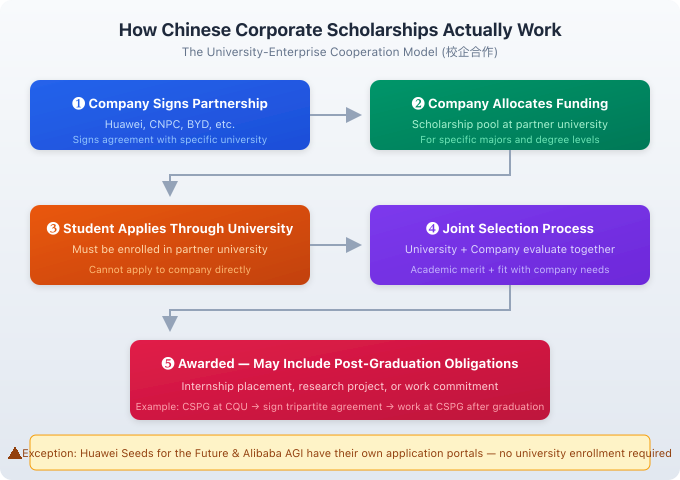
The dominant model is university-enterprise cooperation (校企合作):
- A company signs a partnership agreement with a specific Chinese university
- The company allocates funding to a scholarship pool at that university
- Students enrolled at that university , in specific majors , can apply
- Selection is handled jointly by the university and the company
- Some programs include mandatory internships, research projects, or post-graduation work commitments
This means you cannot just “apply to CNPC for a scholarship.” You must first be admitted to a university that has a CNPC partnership, then apply through that university’s scholarship office.
The upside: fewer applicants per scholarship because the eligibility pool is naturally limited.
The downside: you have to do the legwork of finding which universities have which corporate partnerships, since no central database exists in English.
Part 2: Quick Overview , Major Chinese Corporate Scholarship Programs
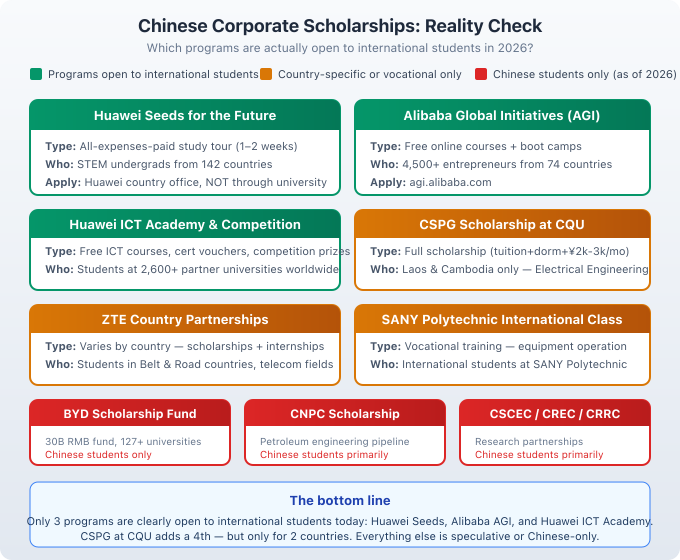
| Company | Industry | Program Name | What It Covers | Open to Intl Students | Apply Through |
|---|---|---|---|---|---|
| Huawei | Telecom/ICT | Seeds for the Future | China trip + training, certificate | ✅ Yes | Huawei country office |
| Huawei | Telecom/ICT | ICT Academy & Competition | Free courses, cert vouchers, prizes | ✅ Yes | Partner universities |
| Alibaba Group | E-commerce/Tech | Global Digital Talent Program | Free training, mentorship | ✅ Yes | AGI website |
| BYD | EV/Manufacturing | BYD Scholarship Fund | Tuition, stipend (varies) | ❌ Chinese only | Partner universities |
| CNPC | Oil & Gas | CNPC Scholarship | Tuition, stipend | ❌ Chinese primarily | Partner universities |
| China Southern Power Grid | Energy | CSPG Scholarship at CQU | Full: tuition, dorm, living allowance, insurance | ⚠️ Laos & Cambodia only | Chongqing University |
| ZTE | Telecom | ZTE Scholarship (country-specific) | Tuition, internship | ✅ In some countries | ZTE local offices |
| China State Construction (CSCEC) | Construction | University partnerships | Research grants | ❌ Chinese primarily | Partner universities |
| China Railway Group (CREC) | Infrastructure | University partnerships | Research grants, internships | ❌ Chinese primarily | Partner universities |
| SANY Heavy Industry | Heavy Machinery | SANY Polytechnic + partnerships | Training, internship | ⚠️ Polytechnic only | SANY Polytechnic / subsidiaries |
Key: ✅ = confirmed open to international students. ⚠️ = limited international eligibility (country-specific or vocational only). ❌ = currently Chinese students only (may change).
Part 3: Tech & Telecom Companies
Huawei: Two Tracks for International Students
Huawei runs the most internationally accessible corporate programs in China. There are two distinct tracks, and many students confuse them.
Track 1: Seeds for the Future
This is Huawei’s flagship global talent program. Since 2008, it has brought students from 142 countries to China for short-term ICT training.
What you actually get:
- A one-week to two-week trip to China (Huawei covers flights, accommodation, meals)
- Hands-on training in 5G, AI, cloud computing, and digital transformation
- Visits to Huawei’s Shenzhen headquarters and R&D labs
- A certificate of completion
- Networking with students from dozens of countries
Who can apply: Undergraduate students in STEM fields from participating countries. The program now commits to at least one-third female participation. Application happens through Huawei’s local country offices, NOT through Chinese universities.
Important: This is not a degree-granting scholarship. You do not enroll at a Chinese university through this program. Think of it as an all-expenses-paid study tour with serious educational content.
Track 2: Huawei ICT Academy & Competition
Huawei has partnered with over 2,600 universities worldwide through its ICT Academy network. If your university is a partner, you get:
- Free access to Huawei’s ICT certification courses
- Vouchers for certification exams (HCIA, HCIP, HCIE levels)
- Eligibility to enter the annual Huawei ICT Competition
Competition winners receive cash prizes, trips to China, and priority consideration for internships. Several past winners have gone on to full-time Huawei roles.
How to check: Visit the Huawei ICT Academy website and look for the partner university list. If your school is listed, contact the ICT Academy coordinator at your university.
Alibaba Group: Rather than funding students to study at Chinese universities, Alibaba runs its own training programs through Alibaba Global Initiatives (AGI). The platform offers free online courses, certificate programs (like the Digital Lion Program), and occasional in-person boot camps in Hangzhou covering AI, e-commerce, and digital business strategy. Over 4,500 entrepreneurs from 74 countries have participated in various AGI programs. These are training credentials, not degree-granting scholarships, but they carry weight in the digital commerce world and cost nothing. Apply through: agi.alibaba.com
ZTE: Country-Specific University Partnerships
ZTE has university cooperation programs in multiple countries. For example, in 2025, ZTE and New Uzbekistan University announced a strategic partnership including scholarships and mentorship for students in AI and telecommunications. Similar partnerships may exist in other Belt and Road countries where ZTE has active infrastructure projects.
For students wanting to study in China: ZTE has partnerships with several Chinese universities, including cooperation with schools in Nanjing, Xi’an, and Shenzhen, typically tied to telecommunications engineering. Contact ZTE’s education cooperation department or check with the international student office at universities known for telecom programs (BUPT, Xidian, Nanjing University of Posts and Telecommunications).
Part 4: Energy & Infrastructure Companies
CNPC (China National Petroleum Corporation)
CNPC is one of China’s largest state-owned enterprises and operates one of the longest-running corporate scholarship programs in the country.
How it works:
- CNPC funds scholarship pools at dozens of Chinese universities, with the largest programs at China University of Petroleum (Beijing and Qingdao campuses)
- Scholarships typically cover full or partial tuition plus a monthly stipend
- Most programs target petroleum engineering, geological sciences, chemical engineering, and energy-related fields
- The scholarship exists primarily to build a talent pipeline for CNPC’s global operations
The reality for international students: historically, CNPC scholarships at Chinese universities have been overwhelmingly for Chinese students. However, as CNPC expands operations across Africa, Central Asia, the Middle East, and Latin America, the company has growing motivation to support international students. Some partner universities report that international student slots are gradually being added to their CNPC scholarship allocations, though this varies significantly by university and country.
How to check: If you are applying to China University of Petroleum or a university with strong petroleum/energy programs (Southwest Petroleum University, Northeast Petroleum University, Yangtze University), ask the international student admissions office directly whether CNPC scholarship slots are available for international applicants.
China Southern Power Grid at Chongqing University
This is one of the most concrete and well-documented corporate scholarships for international students in China — but it comes with a major geographic restriction.
As of 2026, the CSPG Scholarship is a full scholarship (tuition waiver, free on-campus accommodation, medical insurance, plus monthly living allowance of ¥2,000 for undergraduates and ¥3,000 for master’s students, paid 10 months/year). It covers undergraduate and master’s programs in Electrical Engineering at Chongqing University, taught in Chinese (HSK 4 for UG, HSK 5 for MS).
The catch: this program is currently limited to students from Laos and Cambodia. It is designed as a targeted talent pipeline for CSPG’s ASEAN power infrastructure projects. Admitted students must sign a tripartite agreement and may be recruited to work on CSPG’s international projects after graduation.
If you are from Laos or Cambodia and interested in electrical engineering, this scholarship should be near the top of your list. The application deadline for 2026 was May 31 — check Chongqing University’s international student admissions page for future rounds.
Other Energy Sector Players
Sinopec: Like CNPC, Sinopec maintains scholarship programs at select universities (China University of Petroleum, several chemical engineering schools). These are primarily for Chinese students. International student slots are not publicly documented — if they exist, they would be handled case-by-case through individual university partnerships. Ask admissions offices directly.
China Three Gorges Corporation: CTG has well-publicized CSR projects in countries where it operates (Brazil, Pakistan, several African nations), but these are typically community development programs, not university scholarships. If you are from a CTG project country, you may find internship opportunities or short-term training programs rather than full scholarships targeting study at Chinese universities.
Part 5: Manufacturing & Heavy Industry
BYD: A 30-Billion-RMB Bet on Education
BYD is currently the most aggressive Chinese company in the education funding space. In late 2024, the company announced a 30-billion-RMB (roughly 4.1 billion USD) education charity fund, with a significant portion allocated to university scholarships.
Confirmed university partnerships include:
- Northeast Normal University (NENU) , BYD Scholarship Fund
- Beijing International Studies University (BISU) , BYD Scholarship and Teaching Awards
- Xidian University , BYD Scholarship Program
BYD’s motivation is clear: the company is hiring aggressively for its global EV expansion and needs talent familiar with both Chinese and international markets. International students with backgrounds in electrical engineering, battery technology, materials science, or automotive engineering should watch this space closely.
Current limitation: As of 2026, BYD scholarship slots are for Chinese students. The company’s rapid international expansion (EV factories in Brazil, Hungary, Thailand, and Indonesia) and its explicit interest in global talent suggest this will eventually shift toward including international students — but that has not happened yet. If you apply to a BYD partner university as an international student, mention your interest in BYD scholarship opportunities in your application. The worst that happens is they say “not yet.”
SANY Heavy Industry and CRRC
SANY: One of the world’s largest construction machinery manufacturers, operating in over 150 countries. SANY runs its own vocational college (SANY Polytechnic) with an international class program for overseas students, focused on equipment operation and maintenance. For university-level scholarships at partner institutions (Hunan University, Central South University), these are internships and co-op programs primarily for Chinese students. International students may find internship opportunities through SANY’s overseas subsidiaries rather than through Chinese university partnerships.
CRRC: The world’s largest rolling stock manufacturer has research partnerships with railway-focused universities (Southwest Jiaotong University, Beijing Jiaotong University). If you are from a country building or expanding rail infrastructure with Chinese cooperation, these partnerships may lead to research internships. However, dedicated CRRC scholarships for international students do not appear to be publicly documented.
CSCEC (China State Construction)
CSCEC is the world’s largest construction company by revenue. It partners with architecture and civil engineering universities for research funding. While most documented programs are research grants rather than student scholarships, universities with strong CSCEC partnerships (Tongji, Southeast University, Tianjin University) may have corporate-funded research positions for graduate students in civil engineering and architecture — though these are typically for Chinese nationals.
Part 6: How to Find Corporate Scholarships , A Practical Guide
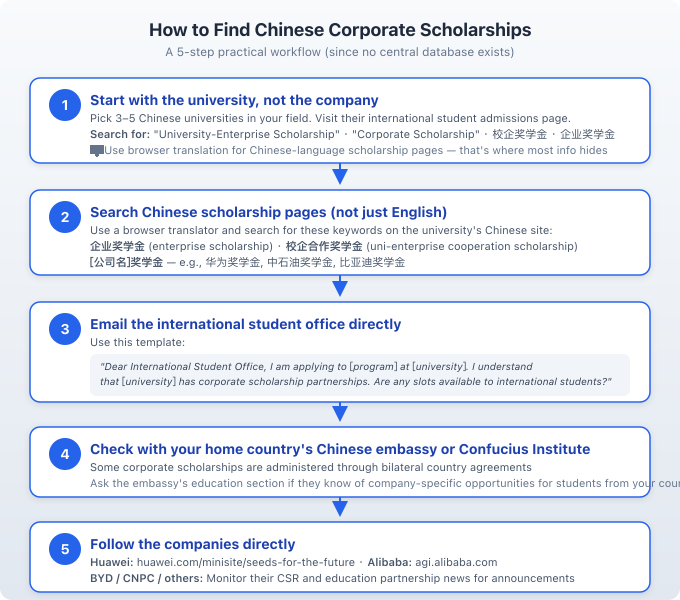
Since no central database exists, here is a practical workflow:
Step 1: Start with the university, not the company.
Choose 3-5 Chinese universities in your field. Go to their international student admissions page. Look for terms like:
- “University-Enterprise Scholarship” (校企奖学金)
- “Corporate Scholarship”
- “Enterprise Scholarship”
- “Company-sponsored”
- Any specific company name in the scholarship section
Step 2: Search university scholarship pages in Chinese.
Many corporate scholarships are listed only on Chinese-language pages. Use a browser translator and search for:
- 企业奖学金 (enterprise scholarship)
- 校企合作奖学金 (university-enterprise cooperation scholarship)
- [公司名]奖学金 (e.g., 华为奖学金, 中石油奖学金)
Step 3: Ask the international student office directly.
Send an email with this structure:
> “Dear International Student Office, I am applying to [your program] at [university]. I understand that [university] has corporate scholarship partnerships with companies like [name companies you have found]. Are any of these corporate scholarship slots available to international students? What is the application process?”
You will be surprised how often a direct question gets a useful answer that is nowhere on the website.
Step 4: Check with your home country’s Chinese embassy or Confucius Institute.
Some corporate scholarships are administered through bilateral agreements. Your local Chinese embassy’s education section or Confucius Institute may know about company-specific scholarship opportunities for students from your country.
Step 5: Follow the companies themselves.
- Huawei: Check huawei.com/minisite/seeds-for-the-future for Seeds for the Future applications, which open annually by country
- Alibaba: Follow agi.alibaba.com for program announcements
- BYD/CNPC/Sinopec: Monitor their CSR (corporate social responsibility) and education partnership news
Part 7: Corporate Scholarship vs. CSC vs. Provincial , Which Should You Choose?
Here is the honest comparison:
| Factor | Corporate Scholarship | CSC Scholarship | Provincial Scholarship |
|---|---|---|---|
| Availability | Very limited, hard to find | Widely available | Moderately available |
| Competition | Lower (smaller applicant pool) | Very high | Moderate |
| Coverage | Varies widely | Usually full coverage | Partial to full |
| Flexibility | Tied to specific university/major | Relatively flexible | Some restrictions |
| Career pipeline | Often leads to company jobs | No direct job connection | No direct job connection |
| Obligations | May include work commitment | Usually none | Usually none |
| Information access | Very poor (scattered) | Excellent (centralized) | Good |
| Application certainty | Low (unpredictable availability) | Moderate (clear process) | Moderate |
The strategy:
Do not choose between them , pursue them in parallel. The CSC application is your baseline. Corporate scholarships are your high-upside supplements.
If you get both, you can sometimes combine them. Some universities allow stacking: CSC covers tuition and living allowance, while a corporate scholarship provides an additional stipend, research funding, or internship placement.
Part 8: Common Mistakes When Applying for Corporate Scholarships
Mistake 1: Assuming corporate scholarships work like CSC.
The biggest mistake. CSC has a standardized application system, clear deadlines, and published criteria. Corporate scholarships are the opposite: fragmented, university-specific, and often not publicly documented. Do not wait for an announcement. Go find them yourself.
Mistake 2: Applying to the company, not the university.
Unless it is Huawei Seeds for the Future or Alibaba AGI (which have their own application portals), most Chinese corporate scholarships are administered through universities. You cannot send your CV to CNPC’s HR department and expect a scholarship. You must be enrolled at a partner university first.
Mistake 3: Ignoring the work commitment.
Some corporate scholarships , especially in energy and infrastructure , come with expectations of post-graduation employment with the company. This can be a great deal if you want a career at CNPC, or a trap if you do not. Read the fine print.
Mistake 4: Limiting your search to English.
Most corporate scholarship information exists only in Chinese. If you are not willing to use translation tools to search Chinese university websites, you will miss most opportunities.
Mistake 5: Assuming “no information = no scholarship.”
Just because a university’s English page does not mention corporate scholarships does not mean none exist. Many programs are small, informal, or managed by individual academic departments rather than the central scholarship office. Always ask.
Part 9: Three Realistic Scenarios
Scenario 1: The petroleum engineering student from Nigeria
You are applying for a master’s in petroleum engineering and targeting China University of Petroleum. You apply for CSC, but also email the admissions office directly: “I notice CUP has CNPC and Sinopec scholarship partnerships. Are any slots available for international master’s students in petroleum engineering?”
Result: CSC covers your tuition and living allowance. Separately, CNPC provides a research grant and a guaranteed internship at a CNPC overseas project. After graduation, you have a job waiting.
Scenario 2: The electrical engineering student from Laos
You are from Laos and want to study electrical engineering. You discover that Chongqing University has a China Southern Power Grid full scholarship specifically for Lao and Cambodian students in Electrical Engineering programs. You apply through the university’s College of International Education, pass the HSK requirement, and sign the tripartite training agreement.
Result: CSPG scholarship covers your full tuition, accommodation, insurance, and a monthly living allowance. After graduation, you are recruited to work on CSPG’s power infrastructure projects in Laos — exactly the career you wanted.
Scenario 3: The e-commerce student from Kenya
You are interested in digital trade but cannot afford to study in China full-time. You apply for Alibaba Global Initiatives’ training programs and get accepted for a six-month online program with an in-person boot camp in Hangzhou.
Result: No traditional scholarship, but you graduate with a certificate from Alibaba, practical e-commerce skills, and a network that includes Alibaba business mentors. You build a cross-border trade business connecting Kenyan agricultural products to Chinese buyers.
Part 10: FAQ
Q: Can I get a Huawei scholarship to study a full degree at a Chinese university?
A: Not directly. Huawei’s programs (Seeds for the Future, ICT Academy) are training and certification programs, not degree-granting scholarships. However, some Chinese universities that are Huawei ICT Academy partners may have Huawei-funded scholarships for enrolled students. Ask the specific university.
Q: Do I need to speak Chinese for corporate scholarships?
A: It depends. Huawei and Alibaba programs are conducted in English. University-based corporate scholarships may require Chinese proficiency depending on the program language. Always check.
Q: Can I combine a corporate scholarship with CSC?
A: Often yes, but confirm with both the university and the company. Some universities allow stacking, meaning CSC covers the basics and the corporate scholarship adds a top-up.
Q: Are Chinese corporate scholarships available for undergraduate students?
A: Most corporate scholarships target graduate students (master’s and PhD), but there are exceptions. Huawei Seeds for the Future accepts undergraduates. Check individual programs.
Q: How much money are we talking about?
A: It varies enormously. A CNPC scholarship at China University of Petroleum might cover full tuition plus ¥2,000-3,000/month. A smaller corporate scholarship at a provincial university might offer a one-time ¥5,000 award. Huawei Seeds for the Future covers your entire China trip but does not pay a stipend. Always ask for the specific coverage amount.
Key Resources & Links
- Huawei Seeds for the Future: https://www.huawei.com/minisite/seeds-for-the-future/
- Huawei ICT Academy: https://e.huawei.com/en/talent/ict-academy/
- Alibaba Global Initiatives: https://agi.alibaba.com/
- BYD Official Site (Education CSR): https://www.byd.com/
- China Southern Power Grid: https://www.csg.cn/
- CNPC Official Site: https://www.cnpc.com.cn/
- China Scholarship Council (CSC): https://www.csc.edu.cn/
- Chongqing University International Students (CSPG Scholarship): https://study.cqu.edu.cn/
Disclaimer: This guide is based on publicly available information and direct university communications as of mid-2026. Corporate scholarship availability changes frequently and international student eligibility is often not publicly documented. As of writing, most Chinese corporate scholarships at universities are primarily for Chinese students — the few programs explicitly open to international students (Huawei Seeds for the Future, Alibaba AGI, CSPG at CQU for Laos/Cambodia) are the exception, not the rule. Always verify directly with the relevant university’s international student office before making application decisions.