A month-by-month guide for international students applying to Chinese universities for the 2027 intake. Covers CSC scholarships, self-funded programs, HSK scheduling, visa processing, and the dates nobody tells you about until it is too late.
Here is what most application guides do not tell you: the hardest part of applying to a Chinese university is not the grades, the language test, or even the competition. It is the timeline.
Chinese university admissions run on a calendar that is earlier and less flexible than what most international students expect. CSC scholarship applications open in October, a full 11 months before the semester begins. Top self-funded programs at Tsinghua and Peking close in March, six months before classes start. If you begin preparing in April, you are already late for the scholarship round and on the back foot for everything else.
This guide walks through the entire application calendar, phase by phase, so you know what to do and when to do it. It covers all three main tracks: CSC scholarships (Type A and Type B), self-funded degree programs, and provincial/university scholarships.
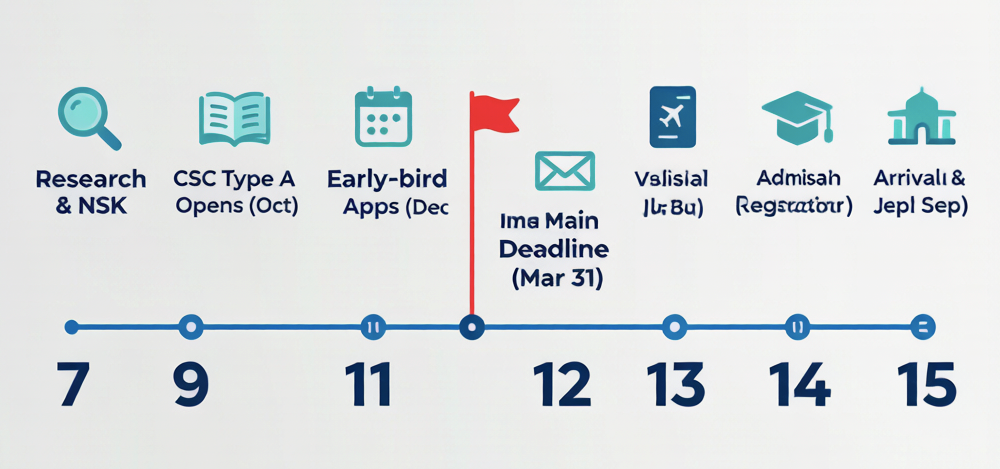
The master timeline at a glance
| When | What | Track |
|---|---|---|
| Jun–Dec (15–9 months before) | Research universities, take HSK, gather documents | All |
| Oct–Nov (11–10 months before) | CSC Type A application opens | CSC Type A |
| Nov–Dec (10–9 months before) | Early-bird applications (e.g., Zhejiang University Dec 15) | Self-funded |
| Dec–Feb (9–7 months before) | CSC Type B + embassy pre-selection deadlines | CSC Type A/B |
| Jan–Mar (8–6 months before) | Main self-funded application window | Self-funded |
| Mar 1–31 (6 months before) | Primary deadline for most top universities | Self-funded |
| Mar–May (6–4 months before) | Provincial scholarship deadlines | Provincial |
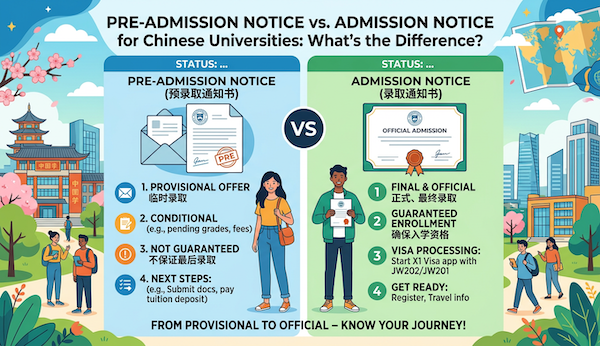
| Jun–Jul (3–2 months before) | Admission letters issued, JW202 form sent | All |
| Jul–Aug (2–1 month before) | X1/X2 visa application | All |
| Late Aug–Sep | Arrival, registration, residence permit | All |
Phase 1: Research and language prep (June–December, 15–9 months before enrollment)
This is the phase most students skip, and it shapes everything that follows.
What you need to do
1. Choose 5–8 target universities.
You cannot build a timeline until you know where you are applying, because each university has its own deadline. Pick a mix: 2–3 reach schools (Tsinghua, Peking, Fudan), 2–3 match schools (Zhejiang, Nanjing, Wuhan), and 1–2 safety options with later deadlines.
2. Take the HSK, and take it early.
If you are applying for a Chinese-taught program, you need an HSK certificate. Most undergraduate programs require HSK 4 (score 180+). Graduate programs typically require HSK 5 (score 180+). English-taught programs require IELTS (6.0+) or TOEFL (80+).
HSK internet-based tests are offered more frequently than paper-based tests (which run roughly every other month). Registration deadlines vary by test center but typically close 1–4 weeks before the test date. Scores take 15–30 days to arrive.
Here is the thing: do not wait until spring to take the HSK. If your target university’s deadline is March 31, the last HSK test you can use is the January or early February session. Taking it in March means scores arrive in April, after most deadlines have passed.
For 2027 intake planning, the last safe HSK test dates are the January 2027 session (scores typically arrive by mid-February) for March deadlines, and the November 2026 session for December early-bird deadlines.
3. Check the HSK 3.0 transition.
HSK 3.0 adds Levels 7–9 and adjusts vocabulary requirements for lower levels. The 3.0 rollout has been slow: as of mid-2026, some test centers have switched while others still use the 2.0 standard. Check which version your test center administers and whether your target university has a preference. If you hold an older HSK 2.0 certificate, confirm it is still accepted.
4. For English-taught programs: take IELTS/TOEFL.
IELTS scores are valid for two years. Book your test at least three months before your earliest application deadline. Test slots fill up fast in many countries.
Research checklist
| Task | Recommended deadline | Why |
|---|---|---|
| Shortlist 5–8 universities | October | Each has a different deadline; you need the list to build your calendar |
| Take HSK | November–January | Scores take 15–30 days; March deadline means January is the last safe test |
| Take IELTS/TOEFL | October–December | Scores take 1–5 days (IELTS computer), 13 days (IELTS paper), 4–8 days (TOEFL) |
| Renew passport | Immediately if expiring | Official visa requirement: 6 months beyond stay. CSC recommends 12 months. Aim for 18+ months as a safety margin. |
| Start contacting recommenders | October–November | Professors need 3–4 weeks to write strong letters |
Phase 2: CSC Type A opens (October–November, 11 months before enrollment)
The Chinese Government Scholarship (CSC) Type A is the earliest-closing track. If you want a full-ride scholarship, this is where the clock starts.
What is CSC Type A?
Type A is the embassy-nominated route. Your home country’s Chinese embassy or Ministry of Education nominates you. You apply through the CSC online portal and through your local nominating agency.
Key dates for 2027 intake (projected from 2026 calendar)
| Milestone | Approximate Date |
|---|---|
| CSC online application opens | Late October 2026 |
| Embassy pre-selection deadline | January–March 2027 (varies by country) |
| Example: Indonesia | January 31, 2027 |
| Example: Germany (DAAD) | February 15, 2027 |
| CSC central review | March–May 2027 |
| Final results announced | By July 31, 2027 |
The actual deadline depends on your country’s nominating agency. Check your local Chinese embassy website. Do not rely on the general CSC calendar alone. Embassy deadlines may not appear on the central CSC portal.
Documents needed for CSC Type A
| Document | Requirement |
|---|---|
| CSC online application form | Fill on campuschina.org |
| Notarized highest degree certificate | Translated to Chinese or English |
| Notarized transcripts | All years of previous study |
| Two recommendation letters | From professors or associate professors |
| Study plan or research proposal | 500–800 words in Chinese or English |
| HSK or IELTS/TOEFL certificate | Valid, not expired |
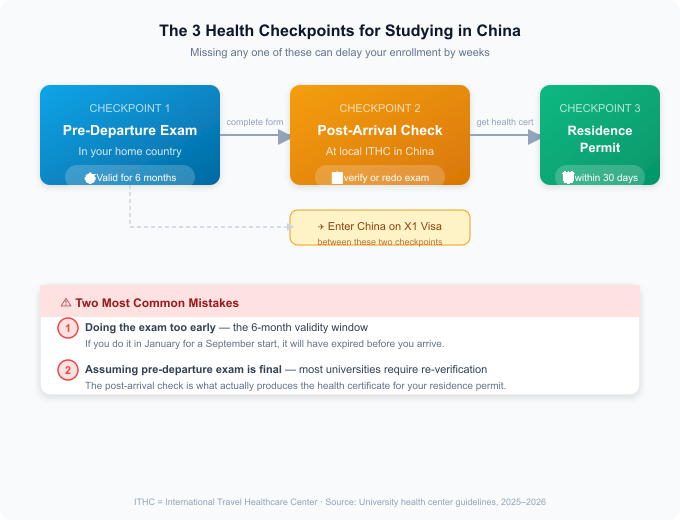
| Foreigner Physical Examination Form | Completed within 6 months |
| Valid passport copy | 18+ months of validity (official visa minimum: 6 months; CSC suggests 12 months) |
| Pre-admission letter (optional) | From a Chinese university, strengthens application |
Incomplete or expired documents are a leading cause of CSC application failure. Missing notarization, expired physical exam forms, and incorrect passport copies are especially common. Start gathering documents early and double-check every requirement before submission.
Phase 3: Early-bird and CSC Type B (November–February, 9–7 months before)
CSC Type B: the university-nominated route
Type B means you apply directly to a Chinese university that holds its own CSC quota. You do not need embassy nomination. The university selects you and forwards your name to the CSC.
| Milestone | Date |
|---|---|
| University application opens | November–December 2026 |
| CSC Type B deadline | February 28 or March 15, 2027 (university-specific) |
| CSC review | April–May 2027 |
| Results | June–July 2027 |
You can apply for both Type A and Type B simultaneously. If you win both, the CSC system awards only one and the other is automatically invalidated. Applying through both tracks increases your odds but requires managing two separate application processes.
Early-bird self-funded applications
A few top universities offer early admission rounds with priority scholarship consideration.
| University | Early Deadline | What You Get |
|---|---|---|
| Zhejiang University | December 15, 2026 | Priority scholarship review |
| Some C9 universities | January 2027 | Early admission + housing priority |
Early-bird applications are less competitive because fewer students know about them. If your documents are ready by November, this is a strategic advantage.
Phase 4: Main self-funded application window (January–March, 8–6 months before)
This is the busiest application period. Most international students apply during this window.
Major university deadlines for September 2027 intake (projected)
| University | Deadline | Notes |
|---|---|---|
| Tsinghua University (graduate) | March 1, 2027 | Most schools; some extend to April 15 |
| Peking University | March 15, 2027 | Window opens October 15, 2026 |
| Fudan University | March 31, 2027 | Standard deadline |
| Shanghai Jiao Tong University | March 31, 2027 | Standard deadline |
| Zhejiang University | March 31, 2027 | After early-bird round |
| Most other top-200 QS universities | March 31, 2027 | Standard deadline |
| Provincial universities | May 31–June 30, 2027 | Secondary round |
What happens after the March 31 deadline
Missing the March 31 cutoff does not end your chances. Many universities open a second round closing May 31 or June 30. But be aware:
- Scholarship availability drops sharply in the second round; most CSC and university scholarship seats are filled in round one
- Dormitory rooms are mostly assigned in the first round; late applicants may need to arrange off-campus housing
- Popular programs (MBBS, CS, International Business) may be full by round two
If you miss both rounds, the March 2028 spring intake opens around October 2027.
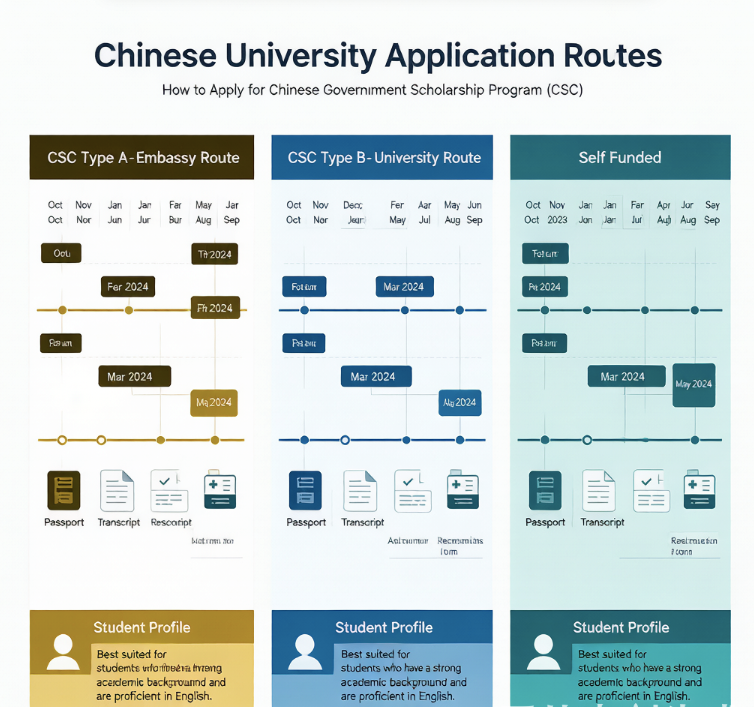
Phase 5: Provincial scholarships and late applications (March–May, 6–4 months before)
Provincial government scholarships
Several Chinese provinces offer their own scholarship programs with separate deadlines.
| Scholarship | Approximate Deadline | Coverage |
|---|---|---|
| Beijing Government Scholarship | May 15, 2027 | Partial to full tuition (varies by level) |
| Shanghai Government Scholarship | April 30, 2027 | Partial to full tuition |
| Jiangsu Government Scholarship | May 2027 | Partial tuition |
| Guangdong Government Scholarship | May 2027 | Partial tuition |
These are less competitive than CSC but do not include a living stipend. They work well as a backup if you miss the CSC window.
International Chinese Language Teachers Scholarship (formerly Confucius Institute Scholarship)
For Chinese language and culture programs only.
| Round | Application Window | Enrollment |
|---|---|---|
| Round 1 | March 1 – April 15, 2027 | September 2027 |
| Round 2 | May 1 – June 15, 2027 | September/October 2027 |
| Round 3 | September 1 – October 15, 2027 | March 2028 |
Covers tuition, accommodation, and ¥2,500–3,000 monthly allowance.
Phase 6: Admission results and JW202 (June–July, 3–2 months before)
Admission letters: when to expect them
| University Type | Typical Release |
|---|---|
| Early-bird applicants | January–February 2027 |
| CSC Type A/B (first-round) | June–July 2027 |
| Self-funded (first-round) | June–July 2027 |
| Second-round applicants | July–August 2027 |
Most universities issue admission notices in late June to early July. Peking University typically releases graduate admission results around late June.
The JW202 form: what it is and why it matters
The JW202 is the official visa application document for self-funded international students. It confirms that:
- You have been officially admitted
- The university is authorized to host foreign students
- Your enrollment is registered with Chinese education authorities
JW202 is the self-funded version. CSC scholarship students receive the JW201 form instead. The university sends it with your admission package, either digitally or by courier.
Check your JW202 immediately. Errors on this form (wrong name, wrong passport number, wrong program duration) will block your visa application. If you find a mistake, contact the university’s international student office right away. Corrections take time and can push your visa timeline into dangerous territory.
Phase 7: Visa application (July–August, 2–1 month before)
X1 vs X2: which one do you need?
| Visa Type | For | Duration |
|---|---|---|
| X1 | Degree programs, long-term language programs | More than 180 days |
| X2 | Semester exchange, summer programs, short courses | Less than 180 days |
Most degree-seeking students need the X1 visa. X1 is usually issued as a single-entry visa. You must convert it to a residence permit within 30 days of arriving in China.
Visa application timeline
| Step | When | Notes |
|---|---|---|
| Receive admission letter + JW202 | June–July | Check all details for errors |
| Book visa appointment | Immediately after receiving documents | Slots fill up in peak season |
| Submit application at Chinese embassy/visa center | By mid-July | Standard processing: 4–5 working days at most embassies, but appointment queues and country-specific document checks can push total turnaround to 1–6 weeks |
| Receive visa | 1–6 weeks after submission | Most countries: 1–2 weeks; some take longer due to high volume or additional review |
| Latest safe submission date | July 15, 2027 | For September 1 arrival with buffer |
Visa document checklist
| Document | Notes |
|---|---|
| Valid passport | 18+ months validity beyond arrival (official minimum: 6 months; 18+ is a safety margin) |
| Visa application form | Complete online, print, sign |
| Passport photo | Meeting Chinese embassy specifications |
| Admission letter | Original or certified copy |
| JW202 or JW201 form | Original |
| Foreigner Physical Examination Form | Completed within 6 months of application |
| Additional documents | Some embassies request financial proof, accommodation details, police certificate |
Do not book flights until you have your visa in hand. Visa processing delays happen. An August 15 visa approval for a September 1 semester start leaves two weeks to book flights and arrange departure, which is tight but manageable. A late-August approval leaves almost no margin.
Phase 8: Pre-departure and arrival (August–September)
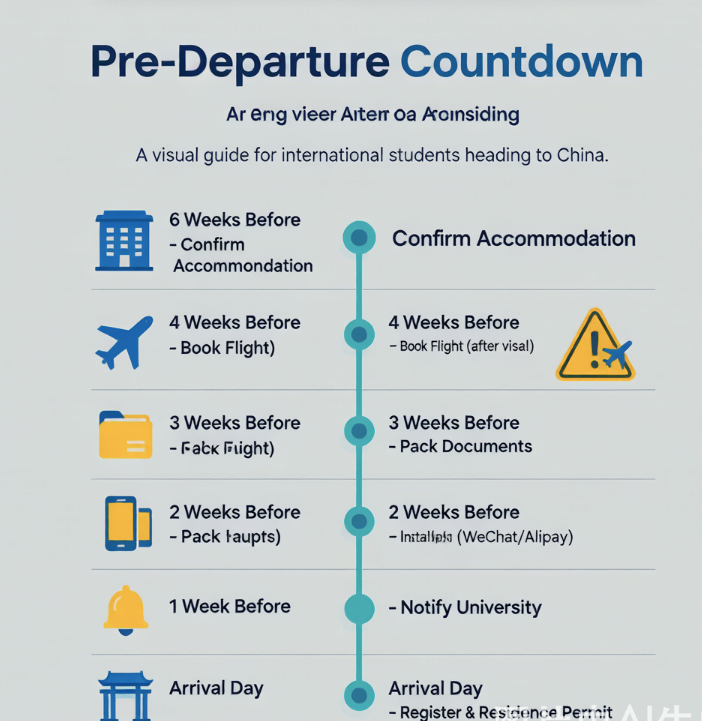
Pre-departure checklist (4 weeks before)
| Task | When | Notes |
|---|---|---|
| Confirm accommodation | As soon as admitted | Dormitory or off-campus; dorm rooms fill first |
| Book flight | After visa approval | Do not book before |
| Arrange health insurance | Before departure | Required for registration |
| Pay tuition deposit | Per university deadline | Some require payment before registration |
| Download translation apps | Before departure | Pleco, Baidu Translate, WeChat |
| Install WeChat + Alipay | Before departure | Essential for daily life in China |
| Notify university of arrival | 1–2 weeks before | Some offer airport pickup |
| Pack documents (carry-on) | Day before flight | Never check your admission letter or passport |
Arrival timeline
| Step | Deadline | Notes |
|---|---|---|
| Register at university | First week of September (typical) | Bring all original documents |
| Register address with police | Within 24 hours of arrival | Only if staying off-campus. Dormitory residents: the university handles this. |
| Apply for residence permit | Within 30 days of entry | Replaces X1 visa; required for legal stay |
| Medical check (if required) | Within 30 days | Some cities verify overseas exam results locally |
| Open bank account | After receiving residence permit (2–4 weeks) | Most banks require the formal residence permit, not the application receipt. Bring passport + residence permit. |
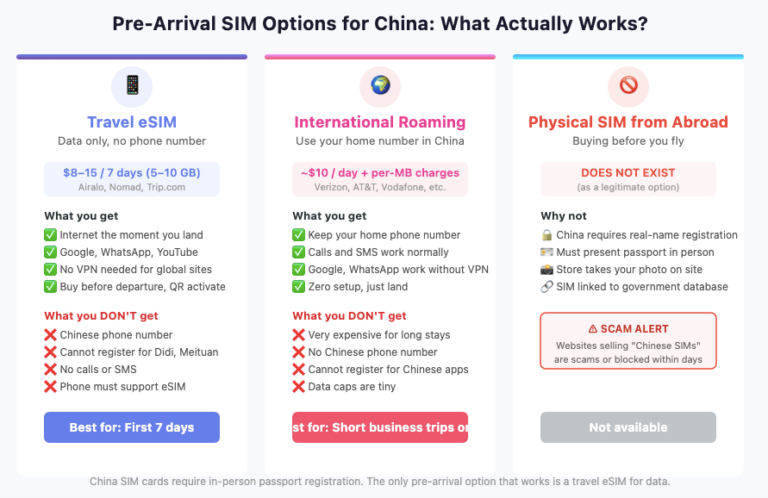
| Get local SIM card | First few days | Bring passport |
Alternative timeline: March 2027 intake (spring semester)
If you do not want to wait until September 2027 or prefer a smaller starting cohort, the March 2027 intake is a real option.
| Milestone | Date |
|---|---|
| Application opens | August 2026 |
| Application deadline | October 15 – November 30, 2026 |
| Admission results | December 2026 – January 2027 |
| Visa application | January–February 2027 |
| Arrival | Late February 2027 |
Keep in mind:
- Spring intake is mainly for Chinese language programs, some master’s programs, and exchange students
- Full degree programs (especially undergraduate) are rare in spring
- CSC scholarships are almost never available for spring intake
- Dormitory availability is better because fewer students arrive in spring
The five most common timeline mistakes
These are the errors that derail applications every year. They are all avoidable.
Mistake 1: Taking the HSK too late.
You need scores in hand by your application deadline, not just a test date. If your deadline is March 31, the January HSK session is your last safe option. The March session will produce scores too late.
Mistake 2: Applying for CSC Type A without checking the embassy deadline.
The general CSC calendar says “applications open in October.” But your local Chinese embassy may close its pre-selection in January. The embassy deadline is the one that matters. If you miss it, your CSC application goes nowhere.
Mistake 3: Not notarizing documents in time.
Degree certificate notarization and translation can take 2–4 weeks depending on your country. Start this process in October for a March deadline. Waiting until January means gambling on your local bureaucracy.
Mistake 4: Booking flights before the visa is approved.
Visa processing at most Chinese embassies takes 4–5 working days once your documents are submitted. However, appointment availability during peak summer season, document verification, and country-specific review procedures can push total turnaround to 2–6 weeks in some locations. You do not know which category your local embassy falls into until you are in the process. Wait for the visa.
Mistake 5: Forgetting that JW202 corrections take time.
If your JW202 form has an error, the university must reissue it through the provincial education authority. This is not a one-day fix. Check the form the moment you receive it. The window between receiving your JW202 (late June) and your earliest safe departure (mid-August) is only six weeks. An error that takes two weeks to fix eats a third of that window.
A student’s timeline: how one application actually played out
Amina, a Nigerian student, applied for a master’s in Computer Science at a C9 university in Shanghai (self-funded, September 2025 intake). Here is how her calendar actually ran:
| Date | What happened |
|---|---|
| June 2024 | Started researching universities; shortlisted 6 |
| August 2024 | Took IELTS (score 7.0); started gathering degree documents |
| September 2024 | Requested notarized transcripts from her undergraduate university |
| October 2024 | Contacted two professors for recommendation letters |
| December 2024 | Submitted applications to 4 universities (ahead of March deadlines) |
| February 2025 | Submitted 5th application (safety school) |
| March 2025 | Received first admission offer (safety school) |
| April 2025 | Received admission from target university (Shanghai) |
| May 2025 | Confirmed enrollment, paid deposit |
| Late June 2025 | Received admission package with JW202 form |
| July 10, 2025 | Submitted visa application |
| August 3, 2025 | Received X1 visa |
| August 25, 2025 | Arrived in Shanghai |
| August 26, 2025 | Registered at university |
| September 1, 2025 | Classes began |
Total timeline: 15 months from first research to first day of class. The application itself took 3 months (December–February). But the preparation, document gathering, and testing that made the application possible started six months before that.
(Note: This is a composite timeline built from documented application processes and typical student experiences. Individual timelines vary by country, university, and program.)
Quick-reference calendar: what to do each month
For September 2027 intake
| Month | Action |
|---|---|
| June–August 2026 | Research universities. Take HSK or IELTS. Renew passport if expiring. |
| September 2026 | Start document gathering: contact your undergraduate university for transcripts and notarized degree certificates. Physical exam timing: see warning below — the 6-month validity window means you may need a second exam later. |
| October 2026 | CSC Type A online application opens. Finalize university shortlist. Contact recommenders. |
| November 2026 | Submit early-bird applications (Zhejiang University: December 15). Continue document notarization. |
| December 2026 | Early-bird deadline for some universities. CSC Type B applications open at most universities. Begin drafting study plan/research proposal. |
| January 2027 | Take HSK (last safe date for March deadlines). Check your embassy’s CSC pre-selection deadline. Submit remaining self-funded applications. |
| February 2027 | CSC Type B deadline (February 28 for many universities). Continue self-funded applications. |
| March 2027 | Main self-funded deadline (March 31 for most top universities). Provincial scholarship applications begin. |
| April 2027 | Late self-funded applications (second-round). Provincial scholarship deadlines. |
| May 2027 | Last provincial scholarship deadlines. Second-round self-funded applications continue. |
| June 2027 | Admission letters begin arriving. Check JW202/JW201 form for errors. |
| July 2027 | Visa application. Book appointment immediately. Submit documents. Do not book flights yet. |
| August 2027 | Wait for visa. Prepare departure. Download apps. Arrange accommodation. Book flight after visa approval. |
| September 2027 | Arrive. Register. Apply for residence permit within 30 days. Classes begin. |
⚠️ Important: Physical exam validity trap
The Foreigner Physical Examination Form is valid for 6 months from the date it is completed. This creates a timing problem that catches many students:
- CSC application (Oct–Feb deadline): A September exam is fine for early (Oct–Nov) submissions, but if you submit in January or February, your exam may be close to expiring. Consider doing it in October–November instead.
- Visa application (July–Aug): A September exam will have expired by July — a full 10 months later. You will almost certainly need a second physical exam for the visa stage.
- Residence permit (after arrival): Some cities require a local medical verification regardless of your overseas exam. Budget time and cost for this.
Bottom line: If you are on the CSC track and can complete the exam in October–November 2026, it will cover both your CSC application and (if your visa processing is fast) potentially your visa application. For most students, though, expect to do at least one more exam closer to your visa submission date. Do the first one when you actually need it, not on a generic calendar recommendation.
Final summary: the numbers that matter
| Metric | Value |
|---|---|
| Total timeline (research to arrival) | 12–15 months |
| Application window length (CSC) | 3–4 months (Oct–Feb) |
| Application window length (self-funded) | 3–6 months (Dec–May) |
| Document preparation lead time | 3 months minimum |
| HSK score turnaround | 15–30 days |
| IELTS score turnaround | 1–13 days (computer vs paper) |
| Degree notarization time | 2–4 weeks |
| Physical exam validity window | 6 months |
| Admission letter release | June–July |
| JW202 delivery | Late June–July |
| X1 visa processing | Standard 4–5 working days; total turnaround 1–6 weeks with appointments |
| Residence permit deadline (after arrival) | 30 days |
The Chinese university application timeline is earlier, tighter, and less flexible than most international students expect. But it is predictable. The deadlines barely shift from year to year. The document requirements are clearly published. The phases follow the same sequence every cycle.
The students who get admitted are not necessarily the ones with the highest grades or the best HSK scores. They are the ones who started early enough to beat the deadlines. If you are reading this in the fall for a September intake the following year, you are in good shape. If you are reading this in April, you are probably too late for the scholarship track but can still make self-funded second rounds. If you are reading this in June, start planning for the spring intake or the following year.
Sources: China Scholarship Council 2025–2026 Application Guidelines, QS Asia University Rankings 2026, Study in China official portal (campuschina.org), Tsinghua University International Admissions 2026, Peking University International Student Division 2026, Zhejiang University International College 2026 admissions calendar, HSK Test Official Schedule 2026 (chinesetest.cn), individual university international admissions pages. Projected 2027 dates are estimates based on 2026 calendars and may shift. Always verify deadlines with each university’s international admissions office.
Pros and cons at a glance
| Pros | Cons and things to weigh |
|---|---|
| The calendar is published and barely shifts year to year, so your planning is predictable | The full arc runs 12 to 15 months, demanding early commitment and discipline |
| Multiple tracks (CSC Type A, CSC Type B, self-funded, provincial) let you spread applications | Missing your embassy CSC pre-selection deadline ends the scholarship track entirely |
| Applying before March keeps scholarship seats and dorm rooms available | JW202 errors and the 6 month exam validity window can derail the visa stage |
| Clear document checklists reduce guesswork at each phase | Second-round applications after March 31 lose most scholarships and housing options |
Key authorities and official resources
- Campus China: official CSC admissions and university application portal
- Chinese Proficiency Test (HSK): official HSK test dates, centres, and score delivery
- National Immigration Administration of China: official source for X1/X2 visas and residence permits
- Ministry of Education of China: the governing body behind admission and scholarship policy