- 29,000 Pakistani students are in Chinese universities. Pakistan is the #3 source country globally.
- HEC recognizes degrees from listed Chinese universities; PMDC has tightened medical recognition since July 2024.
- CPEC creates a direct job pipeline: Chinese companies in Pakistan actively prefer China-educated graduates.
- Engineering, IT, and trade degrees offer the clearest ROI. Medicine is viable but regulatory hurdles are increasing.
- A Chinese degree costs US$10,000–20,000 total for a 4-year bachelor’s, far less than Western alternatives.
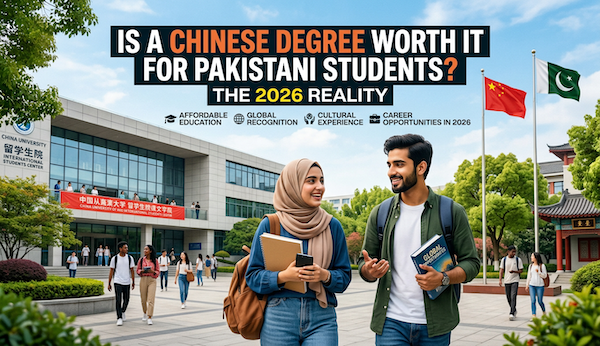
Nearly 29,000 Pakistani students are studying at Chinese universities right now. Pakistan ranks third globally among countries sending students to China, behind only South Korea and Thailand.¹ The question every Pakistani family asks before signing the papers is the same: will anyone in Pakistan take this degree seriously when I come back?
The short answer: yes, with conditions. The long answer depends on what you study, where you study it, and what you want to do after.
The official recognition story: HEC, PMDC, and PEC
Pakistan has three bodies that decide whether your Chinese degree means anything at home. Each works differently.
HEC equivalence: the gatekeeper for most degrees
The Higher Education Commission (HEC) issues equivalence certificates for all foreign degrees. Without one, your Chinese degree is just a piece of paper for any government job, university teaching position, or professional license in Pakistan.²
The process takes 3 to 6 months. You apply through the HEC e-services portal, submit your degree and transcripts, and wait while HEC contacts your Chinese university directly to verify everything. This verification step is the bottleneck. Chinese university administrative offices are not famous for speed.
HEC maintains a list of recognized foreign institutions. If your university is on it, equivalence is straightforward. If it is not, your degree may be rejected entirely. Some less prominent Chinese provincial universities are not on the HEC list. Check before you commit.
The practical rule: if a Chinese university is in the top 100 nationally, HEC almost certainly recognizes it. If it is a third-tier provincial college you have never heard of until an agent showed you a brochure, verify.
PMDC for medical graduates: the rules tightened in 2024
Medicine is the single most popular degree for Pakistani students in China. It is also the most regulated.
In July 2024, the Pakistan Medical and Dental Council (PMDC, formerly PMC) introduced stricter requirements for students pursuing MBBS abroad.³ The key changes: all students must now pass MDCAT with at least 50%, register with PMDC before leaving Pakistan, and attend only universities recognized by both PMDC and WFME (World Federation for Medical Education). The new rules also mandate a minimum 6-year program (5 years academic + 1 year internship).
There are currently 45 Chinese universities authorized by China’s Ministry of Education to offer MBBS in English.⁴ But PMDC recognition does not map one-to-one to this list. You need both: English-medium approval from MOE for the degree to work in China, and PMDC-approved status for the degree to work in Pakistan. If your university is on neither list, you cannot practice medicine in Pakistan with that degree.
After graduating, you must pass the National Licensing Examination (NLE) to get a practicing license in Pakistan. PMDC-approved graduates can register for the NLE directly. Graduates from non-recognized institutions need additional qualifications (for example, a license from another country) before they qualify.
One thing medical graduates from China consistently report: the clinical training gap. Chinese hospitals do not give international students the same hands-on patient exposure that Pakistani medical colleges provide. You will need to compensate for this during your house job and NLE preparation. It is manageable, but it is real.
PEC for engineers: simpler, but not automatic
The Pakistan Engineering Council (PEC) registers engineers. For Chinese engineering degrees, PEC generally follows HEC’s recognition framework: if HEC gives you equivalence, PEC registration usually follows. The process is less contentious than medicine because engineering does not have a separate recognition list.
The catch: PEC registration for foreign degrees often requires passing an engineering practice exam, depending on your specialization and the specific university.
The CPEC advantage: something no other country offers
Here is where the Pakistan-specific story diverges from every other “is a Chinese degree worth it” discussion on the internet.
The China-Pakistan Economic Corridor (CPEC) is not just an infrastructure project. It has created a direct employment pipeline that connects Chinese companies in Pakistan with Pakistani graduates. Chinese-educated graduates are at the front of that line.
Some numbers that matter:
- 20 Chinese companies offered 500+ jobs at the Pak-China Job Fair in Islamabad in May 2025, specifically targeting skilled Pakistani youth.⁵
- A new initiative launched in January 2026 by the Pakistani Embassy in Beijing explicitly connects Pakistani graduates and professionals in China with Chinese enterprises. Plans are underway to expand placements beyond Pakistan to other countries where Chinese companies operate.⁶
- Pakistani student associations in China have begun organizing job fairs in Beijing specifically for China-educated Pakistani graduates, with Chinese companies as the primary recruiters.⁷
What this means in practice: if you graduate from a Chinese university, you walk into a job market where a large and growing category of employers (Chinese state-owned and private companies in Pakistan) actively prefer your profile. They want people who speak both languages, understand both cultures, and can bridge the two sides of CPEC projects.
This is the single biggest argument for a Chinese degree over a Western one for Pakistani students. A degree from the UK or US gives you a recognizable brand name. A degree from China gives you a direct employment channel that no Western degree opens.
By degree type: which ones travel best
Not all Chinese degrees carry the same weight in Pakistan. Here is how they actually play out:
| Degree | Recognition | Employment Pipeline | Best For |
|---|---|---|---|
| Engineering (Civil, Electrical, Mechanical, CS) | ✅ Strong | ✅ Very strong — CPEC demand | Chinese companies in Pakistan, Pakistani engineering firms, CPEC projects |
| Medicine (MBBS) | ⚠️ Complicated — PMDC tightening | ⚠️ Depends on NLE score | Clinical practice in Pakistan after NLE + house job |
| Business & Management | 🔶 Mixed — depends on university brand | 🔶 Good for China-Pakistan trade roles | Import-export, supply chain, trade finance |
| Chinese Language | ✅ Not questioned — skill-based | ✅ Mandarin speakers earn premium | Translation, business liaison, CPEC roles |
Engineering (civil, electrical, mechanical, computer science)
Chinese engineering programs, especially at C9 universities and Project 211 institutions, are globally competitive. Pakistani employers in the private sector do not question the technical quality of a Chinese engineering degree. CPEC infrastructure projects have normalized the idea that Chinese-trained engineers are valuable.
PEC registration is generally straightforward for HEC-equivalenced degrees. The main friction is the equivalence timeline. Budget 6 months after graduation before you can present a fully recognized credential.
Medicine (MBBS)
China is still the most affordable English-medium MBBS option for Pakistani students. It costs a fraction of what private medical colleges in Pakistan charge, and a rounding error compared to the UK or Australia. But the regulatory gate is tightening.
If you are in a PMDC-recognized university, pass the NLE, and complete a house job, your path to practice in Pakistan is clear. The degree itself is not questioned. The licensing process is what filters people out. PMDC publishes NLE pass rates for foreign medical graduates by country. Check the latest PMDC data for Chinese-university pass rates before committing.
Business, economics, and management
A business degree from Tsinghua, Peking, Fudan, or Shanghai Jiao Tong carries weight in Pakistani corporate hiring. These names are increasingly recognized. A business degree from a mid-tier provincial university carries less weight than a degree from IBA or LUMS.
Why prestige shows up in the numbers: In the QS World University Rankings 2026, five mainland Chinese universities sit in the global top 50: Peking University (#14), Tsinghua (#17), Fudan (#30), Shanghai Jiao Tong (#47), and Zhejiang (#49). Thirty-three mainland universities appear in the QS top 500. Pakistani employers who know little about Chinese universities respond to these rankings, so lead with them when you present your degree.
Chinese business programs have an unusual advantage for Pakistani students: the China-Pakistan trade connection. If you want to work in import-export, supply chain, or trade finance between the two countries, a Chinese business degree plus Mandarin skills is a unique combination that Pakistani employers in these sectors actively look for.
Chinese language and literature
This is a separate category because the value here is not about institutional recognition. No one asks whether your Chinese language degree is HEC-equivalenced. They ask whether you can actually speak, read, and write Chinese at a professional level.
Demand for Chinese speakers in Pakistan has grown with CPEC and with the number of Chinese companies operating in the country. Salaries for fluent Mandarin speakers in Pakistan are well above the market average for language-proficient roles, because supply is low relative to demand.
What employers actually think
Government and public sector
Bureaucratic. HEC equivalence is mandatory, period. Your degree will be processed through the same verification system as every other foreign degree. A Chinese degree from a recognized university is treated the same as a degree from any other recognized foreign university. No special treatment, positive or negative.
Chinese companies in Pakistan
Strongly positive. This is the group that actively recruits China-educated Pakistanis. They understand the Chinese university system, they know the top institutions, and they value the cultural and linguistic bridge you provide. For jobs at Huawei Pakistan, ZTE, China Railways, China State Construction, and dozens of other Chinese firms operating in Pakistan, a Chinese degree plus Mandarin is a genuine hiring advantage.
A pipeline you can point to: According to the Pakistani Embassy in Beijing, about 29,000 Pakistani students are currently in China, and roughly 6,000 of them hold some form of scholarship (Pakistani Embassy in Beijing). On the hiring side, the May 2025 Pak-China Job Fair in Islamabad drew about 4,300 Pakistani graduates to roughly 500 jobs from 20 Chinese companies, and the All-Pakistan Chinese Enterprises Association reports its member firms employ more than 30,000 Pakistani staff (The News). The channel is real, not hypothetical.
Pakistani private sector
This is where it gets nuanced. Large multinational corporations and top Pakistani firms (Engro, Nestle Pakistan, Unilever Pakistan, etc.) evaluate Chinese degrees the same way they evaluate any foreign degree: by university reputation. A degree from a top Chinese university is respected. A degree from an institution the hiring manager has never heard of faces the same skepticism as an unknown Western university.
Smaller Pakistani firms and family-run businesses are the least informed about Chinese higher education, and this is where you will sometimes encounter the “why not the UK or US” question. It is not usually a rejection. It is unfamiliarity. Having strong HEC equivalence documentation ready closes this gap.
The scholarship pipeline
The Chinese government scholarship program (CSC) for Pakistan goes through HEC. HEC is the nominating agency (Type-A). For the 2026–27 cycle, the bilateral program offered 75 seats: 35 for Bachelor’s, 25 for Master’s, and 15 for PhD.⁸
This is the formal bilateral quota. In practice, many Pakistani students get CSC scholarships through university-specific channels, directly applying to Chinese universities that have their own CSC allocations. The university-direct route accounts for a far larger number of scholarship recipients than the HEC bilateral quota.
What a full CSC scholarship covers: tuition, on-campus housing, and comprehensive medical insurance, plus a monthly living stipend of CNY 2,500 for undergraduates, CNY 3,000 for master’s students, and CNY 3,500 for PhD students, according to the official China Scholarship Council portal. The university-direct (Type B) route is typically far larger than the 75-seat HEC bilateral quota.
Provincial scholarships add another layer. The Gansu provincial government, for example, runs scholarship programs specifically for Pakistani students. Several Chinese provincial governments with strong Pakistan trade ties (Xinjiang, Sichuan, Yunnan) have their own scholarship tracks.
Self-funded Pakistani students typically pay tuition of RMB 15,000–35,000 per year for undergraduate programs (USD 2,000–5,000), with medicine on the higher end and humanities on the lower end. Living costs vary by city, from RMB 1,000/month in smaller provincial cities to RMB 2,500+/month in Beijing or Shanghai.
What nobody tells you
Between the official recognition frameworks and the CPEC employment pipeline, the story sounds clean. But there are gaps.
- The timeline problem. HEC equivalence takes 3–6 months. PMDC NLE registration and exam scheduling can take a year or more from the time you graduate. You will almost certainly have a gap between returning to Pakistan and having your credentials fully recognized. Plan for it financially and mentally.
- The Mandarin premium varies wildly by industry. In engineering and trade, Mandarin is a concrete salary multiplier. In medicine, it adds almost nothing to your earning potential in Pakistan because clinical practice is in Urdu and English. Decide early whether Mandarin is part of your career strategy, and choose your degree accordingly.
- The “top university” override. A degree from Tsinghua, Peking, Fudan, or Zhejiang opens doors in Pakistan that degrees from lesser-known Chinese universities do not, regardless of HEC status. If you have the option, the name on your degree matters more than almost any other factor. This is not fair, but it is the reality of how hiring works everywhere, not just in Pakistan.
- The self-funded math. If you are paying your own way, a Chinese degree costs roughly USD 10,000–20,000 total for a four-year undergraduate program including living expenses. Compare that to UK, US, or Australian options, where a single year costs more than a full Chinese degree. The value proposition is clear. But it only works if you pick a degree field with a real employment pipeline. Engineering and technology are much safer bets than humanities or social sciences for self-funded students.
| Pros | Cons and watch-outs |
|---|---|
| HEC recognizes degrees from listed Chinese universities | Equivalence takes 3-6 months and can stall on university verification |
| Tuition far below the UK or US (USD 10,000-20,000 total for four years) | Self-funded cost is still a real burden for many families |
| CSC, provincial, and university scholarships are available (about 6,000 Pakistanis hold one) | HEC bilateral CSC quota is only 75 seats, so competition is real |
| CPEC creates a direct job pipeline with Chinese companies in Pakistan | Value depends heavily on your major and the university’s name |
| Mandarin fluency is a direct career multiplier in engineering and trade | Mandarin adds little to clinical earning power in medicine |
| QS top-50 names such as Peking and Tsinghua open doors | Lesser-known Chinese universities need explaining in every interview |
Should you do it? A decision guide
- You want to work for a Chinese company in Pakistan — the hiring pipeline is real and growing
- You are studying engineering, IT, or trade — degrees with direct CPEC-related demand
- You want to learn Mandarin and build a career bridging China and Pakistan
- You cannot afford or gain admission to a Pakistani medical college — China remains the most affordable English-medium MBBS option
- You are open to working across the Belt and Road network beyond Pakistan
- You want a government job — your path is the same as any foreign degree holder, HEC equivalence is the only thing that matters
- You are studying at an unrecognized or obscure provincial university — the brand deficit is real
- You are studying humanities or social sciences as a self-funded student — the employment ROI is significantly weaker than STEM
The 29,000 Pakistani students already in China are not there by accident. They are there because the cost-to-opportunity ratio works, because CPEC has created a structural demand for China-educated Pakistanis that did not exist a decade ago, and because the alternative (an expensive Western degree or an oversubscribed Pakistani institution) does not always add up to a better outcome.
The degree is recognized. The question is whether you use it in the ways that make it valuable.
Frequently asked questions
Is a Chinese degree recognized in Pakistan?
Yes. Pakistani graduates complete HEC equivalence for foreign degrees. The process takes about 3 to 6 months and requires HEC to verify your Chinese university directly. About 29,000 Pakistani students are currently studying in China, so the pathway is well established.
How much does it cost to study in China without a scholarship?
Undergraduate tuition at public universities runs about RMB 15,000 to 35,000 per year (roughly USD 2,000 to 5,000), with medicine at the higher end. Including living costs, a four-year bachelor’s costs about USD 10,000 to 20,000 total, a fraction of a UK, US, or Australian degree.
Can Pakistani students get a scholarship to study in China?
Yes. The Chinese Government Scholarship (CSC) runs through HEC as the nominating agency, with 75 bilateral seats for 2026-27 (35 bachelor’s, 25 master’s, 15 PhD). A full CSC award covers tuition, housing, insurance, and a monthly stipend of CNY 2,500 to 3,500. University-direct and provincial routes add many more places, and about 6,000 Pakistanis already hold some form of scholarship.
Do I need to speak Mandarin to study in China?
It depends on the program. Chinese-taught degrees require HSK 5. English-taught degrees require HSK 3-4 by graduation, plus IELTS for admission. Many programs are English-taught, but daily life and the CPEC job market work better with practical Chinese.
Which majors are worth it?
Engineering, IT, and trade offer the clearest return because Chinese companies in Pakistan actively hire. Medicine is viable but PMDC tightened the rules in 2024 (MDCAT 50 percent, PMDC registration before departure, WFME-recognized university). Business pays off with university prestige plus Mandarin.
Can I work in Pakistan after graduating from a Chinese university?
Yes, after HEC equivalence. The strongest path is Chinese companies in Pakistan tied to CPEC: the May 2025 Pak-China Job Fair in Islamabad offered about 500 jobs from 20 Chinese companies to roughly 4,300 applicants, and the All-Pakistan Chinese Enterprises Association says its members employ more than 30,000 Pakistani staff.
Sources:
¹ The Nation — Pakistan ranks third in international students in China (April 2025)
² HEC Pakistan — Recognition & Equivalence of Foreign Degrees
³ PMDC — Pakistan Medical and Dental Council Official Site
⁴ Crossline Education — MOE-Approved MBBS Programs in China 2026
⁵ CPEC Info — China-Pakistan Job Fair 2025: 500+ Opportunities (May 2025)
⁶ UrduPoint — New Initiative Connects Pakistani Graduates with Chinese Enterprises (Jan 2026)
⁷ China Economic Net — Beijing Job Fair Bridges Pakistani Graduates & Chinese Enterprises (May 2026)
⁸ HEC Pakistan — Chinese Government Scholarship Program 2026-27