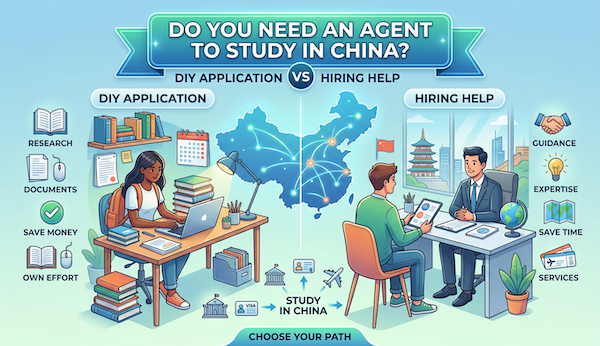
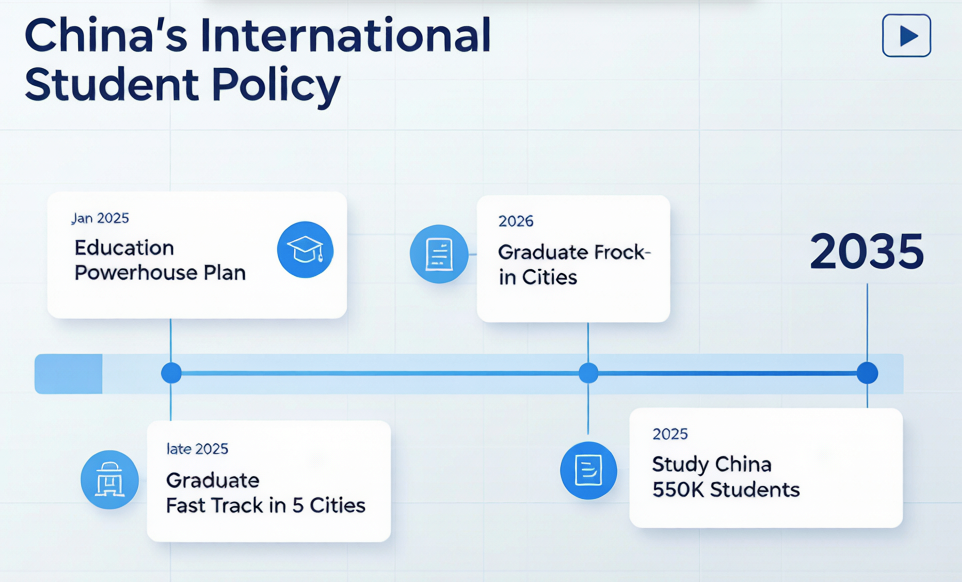
China released its Education Powerhouse Plan (2024-2035) in January 2025, reshaping international student policy for the next decade. The big picture: more scholarships, more work visa pathways, and new programs like TNE and the K visa. But also: higher admission standards, growing domestic pushback against student benefits, and real job market competition. If you’re planning to study in China in 2026 or 2027, here is what changed and what it means for you.
1. The Year Everything Shifted
In January 2025, something quiet happened that will define your study experience in China more than any scholarship adjustment or visa tweak.
The Chinese government released the Education Powerhouse Construction Plan (2024-2035). It is a 5,000-character document that most people will never read, but it lays down the law on international education policy for the next decade.
Around the same time, 108 Chinese universities were sitting inside the ARWU top 500 global rankings. International student enrollment stood at 380,000 in the 2024–2025 academic year, according to the Ministry of Education, still recovering from pandemic lows and below the 2018 peak of 492,185. About 205,000 of those were degree-seeking students. The student body is overwhelmingly Asian (61.1%), followed by Africa (16.2%), Europe (15.6%), and the Americas and Oceania combined (7.1%). The “Study in China” brand was no longer a slogan: it was a line item in a national strategy.
If you are reading this as a prospective student, you are landing at a strange moment. The door is opening wider than ever in some directions, and quietly closing in others. The purpose of this article is to tell you exactly where those doors are.
2. The Document That Runs the Show
The Education Powerhouse Plan has three articles that directly affect you.
Article 1: Build the “Study in China” brand. That means more centralized marketing, standardized scholarship programs, and tighter quality control on universities that accept international students. For you, it means better information and more consistent admission standards. It also means wild-west era schools that handed out easy admissions to anyone with a passport are getting squeezed.
Article 2: Encourage foreign universities, especially in STEM, to set up campuses in China. This is the TNE (transnational education) push. In 2025 alone, 285 new Sino-foreign cooperative programs were approved, a new record. More on this later, because it might be your third option.
Article 3: Improve the admission examination and assessment system for international students. This is the one to watch. Right now, admission for international students is a patchwork: each university sets its own rules, some barely require more than a passport and a pulse. The Plan signals that a standardized test, similar to what China’s domestic gaokao does for local students, may be coming. No date yet. But the direction is clear.
3. CSC Scholarships: More Money, Smarter Strategy
Let me start with what did not change: CSC scholarships are still free. If anyone asks you for money to apply, walk away.
Here is what is different.
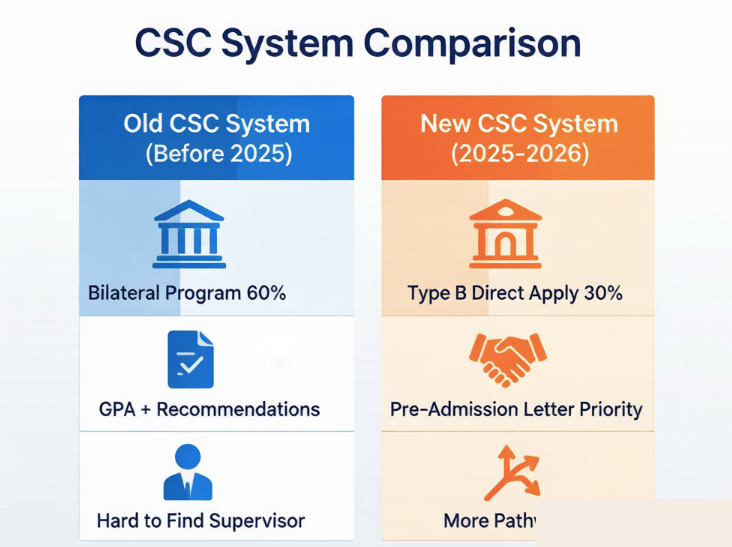
The old CSC system funneled most scholarships through bilateral government agreements. Your home country embassy picked candidates and sent names to Beijing. If your country did not have a strong bilateral relationship with China, or if embassy staff did not know the program existed, you were out of luck.
Since 2024, the system has added the University Program pathway: you apply to the university first, get a pre-admission letter, then submit that to CSC. According to the official CSC application guide, “admission documents will serve as a priority of admission in granting the Chinese Government Scholarship.”
Translation: finding a supervisor who wants you matters more than your GPA. I have seen students with mediocre transcripts get full CSC funding because a professor wrote a strong pre-admission letter. I have also seen 4.0 GPA students get rejected because they applied cold with no university contact.
The numbers are bigger too. At the 2024 FOCAC summit, China committed 60,000 new scholarships for African students. The monthly stipends have not budged much (undergraduates still get 2,500 RMB/month, master’s 3,000, PhD 3,500), but in an inflationary environment, real purchasing power is slowly eroding.
One more thing: provincial and university-level scholarships have been expanding. Zhejiang, Jiangsu, and Guangdong provinces each run their own scholarship programs now, often covering tuition for students who miss the CSC cutoff. These programs get far fewer applicants because nobody knows they exist.
4. Getting In: What Is Actually Required Now
Language. For Chinese-taught programs, the official CSC minimum is HSK 3 for undergraduate and HSK 4 for postgraduate. In practice, top universities filter at HSK 5 or 6. If you show up to a Tsinghua or Fudan interview with HSK 4, you are competing against students holding HSK 6 certificates. English-taught programs (ETPs) have expanded significantly, with the highest concentration in engineering, computer science, and business. But here is the catch: ETPs are popular, which means the competition for those spots is thicker. And if you graduate from an ETP without reaching HSK 5, your job options in China shrink to basically teaching English. I cannot think of a single non-education employer in China who hires English-only graduates with zero Chinese.
Degree authentication. On January 28, 2023, CSCSE announced the permanent end of its pandemic-era exemption for remote learning. Any degree obtained through purely online study, whether from a Chinese or foreign institution, will not be authenticated. We covered this in detail in our previous article on fake “China online degree” programs.
The sleeper issue: actual cutoff scores. Every university publishes a “minimum requirement.” These numbers are for show. The real admission threshold, especially for CSC-funded slots, sits significantly higher. This gap is not unique to China. But it catches students off guard because no one tells you about it. The practical takeaway is simple: if a university says “minimum GPA 3.0,” treat 3.5 as your real target.
5. The K Visa: What It Means for Students
In August 2025, the State Council announced the K visa, designed to attract foreign STEM researchers without requiring employer sponsorship. The announcement got a lot of attention in international student communities.
Let me be direct: the K visa is not for you, not yet.
The K visa targets researchers with published work, existing projects, and institutional connections inside China. If you are an undergraduate or master’s student, this pathway does not apply. If you are a PhD candidate with publications, it might, but only after you finish.
The real significance of the K visa for students is directional. It tells you that China wants to keep STEM talent. It tells you that the policy environment around international researchers is loosening, not tightening. Compare this to the US, where the H-1B lottery odds keep getting worse, or the UK, where visa fees just went up again. China is signaling the opposite. The pathway you should actually care about is the Graduate Fast Track, which we cover next.
6. After Graduation: Easier Than Before, Harder Than You Think
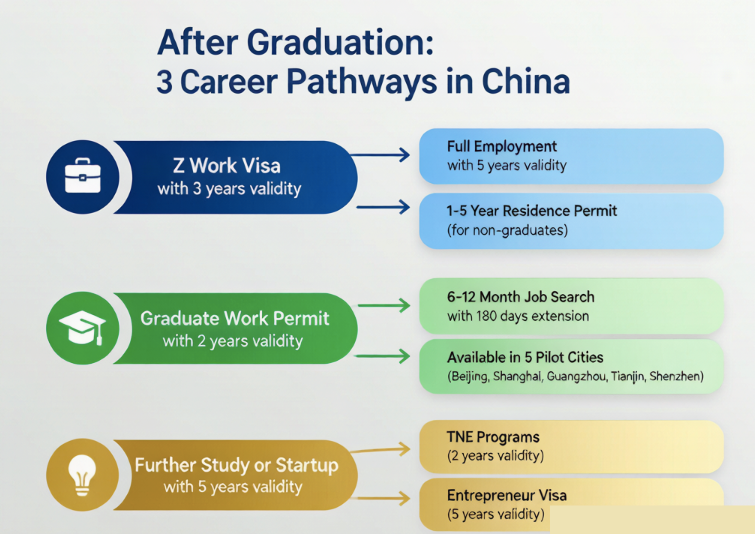
Here is the headline number: 68,000 international graduates transitioned to work visas in China in 2025, a 22% jump from the previous year. That is a real, measurable trend.
Shanghai, Beijing, Shenzhen, Guangzhou, and Hangzhou now run “Fresh Graduate Fast Track” programs. If you graduate from a QS top-200 Chinese university, you can skip the 2-year work experience requirement and apply directly for a Type B work permit. For Tsinghua, Peking, Fudan, Zhejiang, and SJTU graduates, this alone makes the degree worth it.
Five industries are hiring international graduates at scale in 2026:
| Industry | Entry Salary (RMB/mo) | Top Cities |
|---|---|---|
| Technology & AI | 25,000-40,000 | Shenzhen, Beijing, Shanghai, Hangzhou |
| Finance & Consulting | 20,000-35,000 | Shanghai, Beijing |
| Engineering & Manufacturing | 18,000-28,000 | Shenzhen, Guangzhou, Suzhou, Wuhan |
| Education & EdTech | 15,000-25,000 | All major cities |
| Cross-Border E-Commerce | 15,000-22,000 | Guangzhou, Shenzhen, Yiwu |
Now let me tell you what the numbers do not show.
China is graduating 12.22 million domestic students every year. Youth unemployment remains a persistent political headache. There is growing public discussion on Chinese social media about perceived preferential treatment of international students: better dorms, easier admission standards, scholarship benefits that local students do not get. Whether this translates into concrete policy changes remains to be seen, but universities are under increasing pressure to justify the gap between international and domestic student benefits.
If your major is outside the five industries above, finding a job in China as an international graduate is genuinely difficult. Your degree from a Chinese university carries weight in China. Outside China, that weight is very uneven by country and by employer. A degree from Tsinghua opens doors in Southeast Asia and Africa. It does less heavy lifting in London or New York, where a familiar brand name from a Western university still dominates recruiter attention spans.
One more thing worth knowing: after 4 consecutive years of working in China with a valid residence permit, you can apply for permanent residence, the so-called “Chinese green card.” Processing times have come down to 6 to 12 months. This was nearly impossible a decade ago. It is still rare. But it exists now, and that matters.
7. The Third Option: Transnational Education
There is a path I did not expect to be writing about, but the numbers demand it.
China approved 285 new Sino-foreign cooperative education programs in 2025, a single-year record. The Ministry of Education has set a target of 8 million TNE students, up from roughly 800,000 today.
For international students, TNE currently means this: study at a joint campus in China, earn a degree from a foreign university that carries mutual recognition, and access both the Chinese job market through physical presence and global markets through a recognizable degree brand. NYU Shanghai, Duke Kunshan, and Xi’an Jiaotong-Liverpool are the flagships.
The catch is that TNE programs are overwhelmingly designed for Chinese students. International-facing TNE is in its infancy. NYU Shanghai admits a small number of international students, and Duke Kunshan has started doing the same, but the numbers are tiny. The infrastructure exists. The degree recognition agreements are in place. What is missing is awareness, on both sides: international students do not know TNE is an option, and TNE programs have not yet built the recruitment pipelines for international applicants.
If you want to be a bridge between China and the world, TNE is worth tracking. The growth rate, 285 new programs in a single year, suggests it will be a serious option within 3 to 5 years. And the advantage is unique: you get a degree from a university your home country employers recognize, while spending your student years inside China’s economy, network, and language environment. No other pathway offers both.
8. Three Things to Be Excited About, Three Things to Watch Out For
Opportunities
✅ Scholarship pathways have diversified. Pre-admission letters now outweigh raw GPA. Provincial scholarships exist and are under-applied.
✅ Work visa conversion is genuinely easier for graduates from top Chinese universities, with fast-track programs in five major cities.
✅ Chinese university rankings are rising, and the degree is gaining recognition, especially across Asia and Africa.
Risks
⚠️ Public sentiment toward international student benefits is souring. Better dorms and lower admission bars are under political scrutiny.
⚠️ Job competition is real. If your field is outside tech, finance, engineering, education, or e-commerce, the numbers are not on your side.
⚠️ Admission is shifting from “easy to get in” to “easy to apply, harder to get in.” Standardized testing is likely coming.
9. If You Are Applying in 2026 or 2027
Here is the short version of what I would tell a friend.
Sources
- Education Powerhouse Construction Plan (2024–2035) — State Council of China, January 2025
- China attracts 380,000 international students — China Daily, April 2026
- Academic Ranking of World Universities 2025 — ShanghaiRanking Consultancy
- CSC Application Guide — China Scholarship Council / CampusChina
- FOCAC 2024: 60,000 new scholarships for African students — Africa China Review
- CSCSE announcement on ending remote degree certification — Chinese Service Center for Scholarly Exchange, January 2023
- China to launch K visa for young science and technology professionals — State Council, August 2025
- China rolls out employment push for record 12.22 million graduates — State Council Information Office, July 2025
- Chinese TNE approvals surge in 2025 — British Council, March 2026
- China leverages higher education capacity with expanded TNE partnerships — ICEF Monitor, September 2025
- Guidelines for Approval of Foreign Nationals’ Eligibility for Permanent Residence in China — National Immigration Administration
Last updated: July 2026. Policy details current as of this date. I update this page when major policy changes are announced.