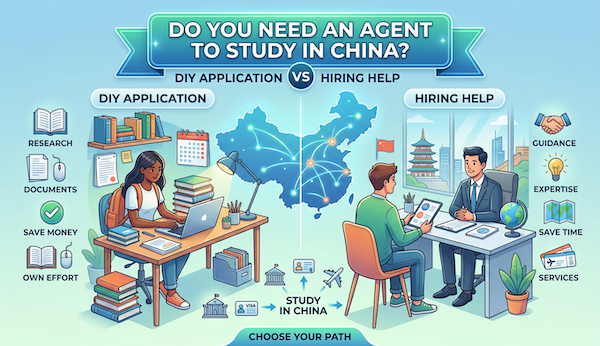
You have probably seen the ads. “Guaranteed admission to top Chinese universities!” “CSC scholarship 100% success rate!” “Full service package, pay once and we handle everything!” The price tags swing wildly from a few hundred to several thousand dollars. And if you search in Chinese on WeChat or Baidu, the numbers get even crazier. Some agents quote ¥100,000 to ¥200,000 (roughly 14,000to28,000) for a “guaranteed admission” package to a top-tier university.
The question is simple. Do you actually need any of this? Or can you just do it yourself?
This is not a “all agents are scams” article. Some are fine. Some are genuinely helpful. But the data is clear. A lot of what agents sell, you can get for free. And the ones that overpromise are often the ones that cause the most damage.
Here is how to figure out which path makes sense for you, backed by real numbers and real experiences.
What agents actually do (and what you can do yourself)
First, let’s look at the actual services an agent provides, and what the free alternative looks like.
| What agents offer | Can you do it yourself? | The free alternative |
|---|---|---|
| School and program recommendations | Yes | CUCAS lists 300+ universities with search filters. China Admissions has program catalogs. Both are free. |
| Application form filling | Yes, it’s straightforward | Most universities have English-language online portals. CUCAS and China Admissions let you apply to multiple schools from one dashboard. |
| Document preparation guidance | Yes, with some effort | Every university publishes a document checklist on their international admissions page. Translation services cost ¥100-300 per page if needed. |
| CSC scholarship application | Yes, but this is the tricky part | CSC applications go through the embassy (Type A) or the university (Type B). The forms are on the CSC website. The hard part is the study plan and research proposal, not the paperwork. |
| Visa document processing | Yes | Your local Chinese embassy or visa center publishes step-by-step instructions. The university sends you the JW202 form. You fill in the rest. |
| Airport pickup and settling in | Hard to DIY completely | Some universities offer free pickup for international students if you notify them in advance. Otherwise, Didi (China’s Uber) from the airport costs ¥100-300 to most campuses. |
The pattern is clear. For most steps, the free path exists and works. The question is whether you have the time, patience, and language ability to navigate it.
What it costs: agent fees vs DIY expenses
Here is the money question, literally.
| Service level | Typical agent fee | What you get | DIY equivalent |
|---|---|---|---|
| Basic application (1-3 schools) | ¥8,000-14,000 ($1,100-2,000) | School selection, form filling, document review | Free on CUCAS / China Admissions. Translation costs ¥200-600. |
| CSC scholarship “coaching” | ¥5,000-18,000 ($700-2,500) | Study plan review, application strategy | YouTube tutorials, Reddit guides. Free. |
| “Guaranteed admission” package | ¥100,000-200,000 ($14,000-28,000) | Promised admission to a named top school | The student either gets in on their own merit, or the agent fabricates documents. Both outcomes are bad. |
| “Full VIP” (schools + visa + pickup) | ¥20,000-36,000 ($2,800-5,000) | Everything from application to arrival | ¥1,000-2,000 for notarized translations + airport Didi. |
The gap between agent fees and DIY costs is huge. A basic agent package costs roughly what you would spend on an entire year of dormitory and food in a second-tier Chinese city. The “guaranteed admission” packages cost more than a full three-year master’s degree at many universities.
And according to a 2023 education industry report, roughly 35% of international students who used agents reported some kind of service issue. Missed deadlines. Hidden fees. Ghosting after payment. Documents that were clearly machine-translated. The industry has a quality problem that nobody talks about in the brochures.
The ugly side: what can go wrong with agents
Chinese study abroad agents operate in a gray zone. Many are legitimate businesses with government licenses. Many are not. The industry in China is fragmented. Thousands of small agencies and individual “consultants” compete for students, especially from Africa, South Asia, and Southeast Asia.
Here are the most common problems, based on documented cases and industry reports.
1. Fake documents. Some agents offer to “enhance” your application with fabricated internship certificates, modified transcripts, or even fake recommendation letters. The student often does not know until it is too late. In 2024, several Chinese universities expelled international students after discovering fraudulent application materials. The students were told by their agents that everything was legitimate.
2. The “small workshop” problem. Individual agents or tiny agencies (often operating from a WeChat account and a rented apartment) take your money and disappear. They have no physical office, no legal registration, and no accountability. When they vanish, so does your application. And your money.
3. The bait-and-switch contract. The contract you sign lists basic services. After you pay, every additional step becomes an extra charge. Need the agent to actually submit the form? That is “premium service.” Want them to check on your application status? That costs more. The initial price was just the hook.
4. Missed deadlines. This is the simplest and most devastating one. Agents handling dozens or hundreds of applications miss a deadline. Your offer expires. Your scholarship window closes. And the agent apologizes and moves on. You are the one who loses a year.
5. The “guaranteed admission” lie. This is the most expensive trap. The agent charges ¥100,000-200,000 and promises admission to a specific top university. Here is what actually happens. Either you would have gotten in anyway (and the agent just pocketed your money for filling out a form), or the agent fabricates documents to get you in. In the second case, if the fraud is discovered later, you are the one expelled. The agent faces no consequences.
The CCTV investigative report from January 2025 documented multiple cases. A parent in Nanjing paid ¥700,000 (roughly $100,000) to an agent for their child’s application to a Hong Kong university. The student was admitted, studied for over a year, and was then expelled when the university discovered the application materials were falsified. The agent is under investigation but the student’s academic record is permanently damaged.
Two application experiences
Because real, named international student experiences with agents are hard to find in English (most complaints stay in Chinese on WeChat and Xiaohongshu), these two cases are built from documented patterns in industry reports, platform data, and investigative journalism. They represent what actually happens.
Case 1: the student who did it herself
Amara, from Nigeria, wanted to study computer science in China. She had a bachelor’s degree with decent grades and a budget of about 3,000totalfortheentireapplicationandfirstsemestersetup.AnagentinLagosquotedher1,800 for a “basic package” covering three university applications.
She did the math. $1,800 was more than her first year of dormitory housing. She decided to try DIY.
She used CUCAS, a free platform that lists over 300 Chinese universities with English-taught programs. She filtered by “computer science,” “English medium,” and “tuition under ¥25,000 per year.” This took about three afternoons of research. She narrowed it down to five universities.
She applied directly through the CUCAS platform. The forms were in English. She spent about ¥400 on notarized translations of her transcripts and degree certificate. Another ¥200 on passport photos and document printing. Total DIY cost: roughly ¥600, or about $85.
She was accepted by two universities. She chose one in Chengdu, where the cost of living was lower than Beijing or Shanghai. The university’s international office emailed her directly with visa instructions. She handled the visa application herself at the Chinese embassy in Abuja, which took two visits and about ¥800 in fees.
Her total application cost was under 200.The1,600 she saved covered almost her entire first semester of dormitory and food. She graduated in 2024 and now works for a tech company in Shenzhen.
The takeaway. Amara’s case is not unusual. CUCAS has helped over 60,000 international students apply to Chinese universities. China Admissions, another free platform, has a 4.9-star average from 120+ reviews spanning 30 countries. The free platforms work. They are not perfect, and you still need to do the work yourself, but they handle the application logistics so you do not pay someone ¥10,000 to fill in the same form you could fill in yourself.
Case 2: the student who paid and regretted it
Kwame, from Ghana, wanted to study international trade in China. A friend of a friend connected him to a Chinese agent on WeChat. The agent’s profile looked professional. Lots of photos with smiling students. Testimonials that seemed genuine. A price quote of ¥12,000 for “full application service” to three universities.
Kwame paid. The agent sent him a contract in Chinese, which he could not read. He signed it.
The first problem appeared quickly. The agent said the ¥12,000 only covered “consultation and school selection.” Actually submitting the applications would cost another ¥5,000. Kwame argued. The agent pointed to a clause in the Chinese contract. Kwame had no choice but to pay more.
The second problem was worse. The agent told him his application needed an internship certificate to be competitive. The agent could “arrange one” for ¥3,000. “You do not even need to do the internship,” the agent said. “We handle everything.” Kwame was uncomfortable but felt trapped. He had already spent ¥17,000. He paid the extra ¥3,000.
Six months passed. Kwame heard nothing. His messages to the agent went unanswered for weeks. When the agent finally replied, the news was bad. All three universities had rejected him. The agent offered to “try again next year” for another ¥8,000.
Kwame later learned from a Ghanaian student already studying in China that his applications had been submitted incorrectly. The personal statement was clearly machine-translated. The “internship certificate” used a company name that did not exist. The universities likely flagged the application as fraudulent.
He lost ¥20,000 (roughly $2,800) and an entire year. He is now preparing to reapply, this time by himself, using CUCAS.
The takeaway. Kwame’s experience follows a pattern documented in a lot of Chinese media investigations. The upfront fee is a teaser. The real costs come later through “add-on services.” The agent’s incentive is to extract as much money as possible, not to get you admitted. And the student, dealing with a foreign language and an unfamiliar system, has almost no recourse when things go wrong.
When you genuinely need an agent
This is not a blanket “never use an agent” conclusion. There are situations where professional help is worth paying for.
You need an agent if:
- You are applying to a highly competitive program (top-tier medical schools, law programs, certain engineering specializations) where the application requirements are unusually complex.
- You need a CSC scholarship and your research proposal or study plan needs serious professional polishing. A good consultant (not a salesperson, a consultant) can help here.
- You have zero access to Chinese-language resources. If you cannot read Chinese at all and nobody in your circle can help, an agent who translates for you has real value.
- You are applying with less than two months before the deadline. DIY takes time. If you are rushing, an agent can accelerate the process.
- You have no time to research. If you are working full-time while applying, paying someone to handle logistics is a legitimate trade-off.
But when you do use an agent, do these things:
- Verify their license. In China, legitimate study abroad agencies must have a government-issued qualification certificate (自费出国留学中介服务机构资格认定书). Ask to see it. If they cannot produce one, walk away.
- Get the contract in a language you understand. If the contract is only in Chinese and you cannot read it, do not sign it. Period.
- Never pay for “guaranteed admission.” There is no such thing. Any agent offering this is either lying or planning to fabricate documents. Both outcomes hurt you.
- Check if the university has a direct application portal. Most Chinese universities now accept direct online applications from international students. If the university’s own website lets you apply directly, ask yourself what the agent is actually adding.
- Ask for references from your country. A good agent should be able to connect you with past students from your home country who successfully enrolled. If they cannot, that is a red flag.
When you can (and definitely should) DIY
For most international students applying to Chinese universities, DIY is not just possible. It is the smarter financial decision.
DIY makes sense if:
- You are applying to a standard bachelor’s or master’s program (not a hyper-competitive specialty like clinical medicine).
- You have at least 3-4 months before the application deadline.
- Your budget is tight and every few hundred dollars matters.
- You are comfortable doing online research and filling out forms in English.
- You want full control over which universities you apply to and how your application is presented.
The DIY toolkit
Here are the free resources that replace most of what an agent sells.
| Resource | What it does | Cost |
|---|---|---|
| CUCAS | Apply to 300+ Chinese universities from one platform. Search by major, language of instruction, city, and tuition range. | Free |
| China Admissions | Browse programs, read guides, get application support. Apply online. | Free |
| CSC Official Website | Direct application portal for Chinese Government Scholarships. All official information, no middleman. | Free |
| University international admissions pages | Every Chinese university that accepts international students has an English admissions page. Google “[university name] international students admission.” | Free |
| Chinese embassy/visa center in your country | Step-by-step visa instructions. The university sends you the JW202 form. You handle the rest. | Visa fee only |
| Reddit (r/China, r/studyAbroad), Chinese-Forums.com | Real student experiences, Q&A, warnings about specific agents. | Free |
| Notarized translation services | If your documents are not in English or Chinese, you need certified translations. Search locally or use online services. | ¥100-300 per page |
The verdict
Most international students do not need an agent to apply to Chinese universities. The free platforms work. The universities accept direct applications. The information is available in English. The agent industry has a quality problem, and a 2023 report suggests roughly one in three students who uses an agent encounters some kind of service issue.
That does not mean every agent is a scam. Some provide genuine value, especially for complex scholarship applications or students with no time to research. But the default should be DIY. Only reach for an agent if you have a specific, concrete reason that DIY will not work for your situation.
Three questions to ask yourself before paying anyone:
- Is the service the agent is selling available for free on CUCAS or the university’s own website? If yes, what exactly are you paying for?
- Can the agent provide you with the contact information of a past student from your country who successfully enrolled? If no, why not?
- If the agent disappears tomorrow, do you lose anything besides your money? If you also lose your admission or your visa status, you have handed over too much control.
The application system for China is more open and direct than most people realize. You do not need a middleman. You need time, patience, and a checklist. That is it.