You just walked across the stage. Four years in China. You built friendships, learned enough Chinese to order hotpot without pointing at pictures, and got your degree. Now the student visa clock is ticking. Every graduating international student hits the same question: can I actually stay and work here?
The short answer is yes. But it does not happen automatically. It takes an employer, some paperwork, and a clear understanding of the timelines.
Here is how to turn a Chinese degree into a Chinese career. There is a points system, city-by-city policy differences, two real student experiences, and a step-by-step timeline at the end.
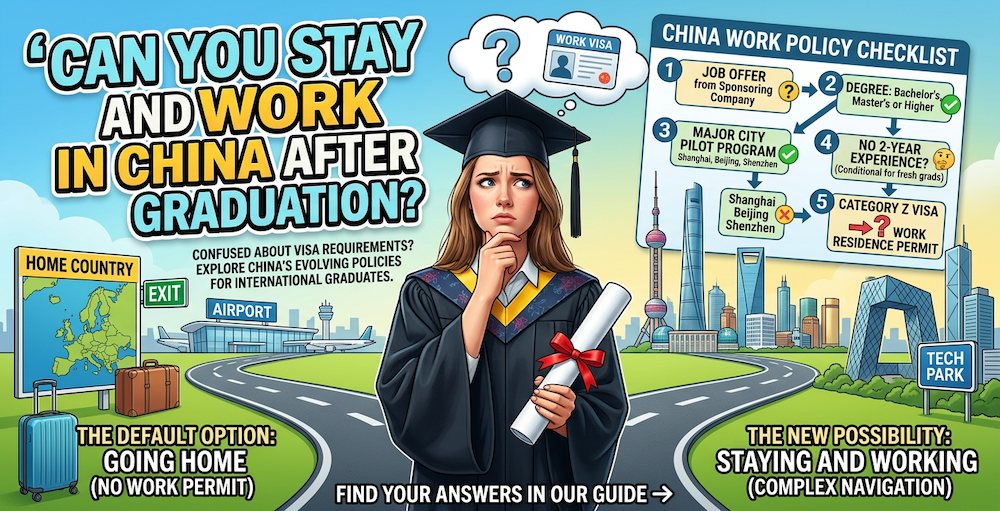
The visa you have vs. the one you need
Right now you are on an X1 visa (study for more than 180 days) or X2 (short-term study). Neither lets you work legally beyond approved part-time study-work programs through your university.
To work full-time, you need a Z visa, which then converts to a work-type residence permit after you enter China. The Z visa itself is a short-term entry document. The residence permit is what actually lets you stay and work for a year or more.
How the timeline actually works
| Stage | What happens | The deadline |
|---|---|---|
| Graduation day | Your student residence permit is still valid | Must leave or convert by the expiry date on your permit |
| Post-graduation buffer | You can apply for a 30-day stay extension (T visa) | Apply before your student permit expires |
| Job offer secured | Your employer applies for your work permit notice | Processing takes 5-15 working days |
| Work permit issued | You receive the Notification Letter of Foreigner’s Work Permit | This is the key document for the Z visa |
| Z visa application | In most cases, you apply at a Chinese embassy outside mainland China | Some cities now allow in-country conversion |
| Enter on Z visa | 90-day single-entry visa | Must apply for residence permit within 30 days |
| Work residence permit | The final document. Valid 1-5 years, renewable. | You are now fully legal |
The buffer period is the riskiest part. If you do not have an offer by the time your extension runs out, you have to leave.
Three paths from X to Z
There are three ways international graduates convert. The right one depends on which city you studied in and what kind of employer you found.
Path 1: In-country direct conversion (the best option, when available)
Several cities now allow graduates from local universities to convert from a student residence permit to a work one without ever leaving China. This is not a nationwide policy. It is city-by-city.
Which cities allow it:
- Shanghai: Masters and PhD graduates from Shanghai universities can convert directly. This is the most well-established program. You must also have a job offer from a Shanghai employer.
- Hangzhou: Local university graduates can convert in-country. Extra points if the job is in AI, robotics, or green energy.
- Beijing: Masters and above from Beijing universities get a simplified process. Some cases allow in-country conversion. Check with your university’s international office for the latest.
- Shenzhen and Guangdong FTZ: STEM graduates from top-ranked universities have relaxed requirements, including possible in-country conversion.
If you studied in one of these cities and graduated with a Masters or PhD, this is your path. Start talking to your international student office at least six months before graduation.
Path 2: The standard route (leave and come back)
If in-country conversion is not available to you, the process works like this:
- Get a job offer from a Chinese employer who is licensed to hire foreigners.
- Your employer applies for your work permit through the local Bureau of Foreign Experts Affairs.
- Once approved, you receive the Notification Letter of Foreigner’s Work Permit.
- You go to a Chinese embassy or consulate in your home country (or any third country) to apply for the Z visa.
- You re-enter China on the Z visa and convert to a residence permit within 30 days.
This adds a flight and some waiting time. Budget about 2-4 weeks abroad for the Z visa processing.
Path 3: The entrepreneurship route
If you want to start a business instead of working for someone else, several cities including Shanghai, Shenzhen, and Chengdu allow foreign graduates to register a company and sponsor their own work permit. You need a business plan, registered capital (varies by city, typically ¥100,000-500,000), and an office address. This route is harder but real. Shanghai’s Free Trade Zone has specific programs for graduate entrepreneurs.
The points system: how China decides if you qualify
China classifies all foreign workers into three categories based on a points system. Your degree, experience, age, Chinese level, salary, and even where you studied all add up.
The three categories
| Category | Points | Description | What it means |
|---|---|---|---|
| A | 85+ | High-end talent | Fast approval, fewer restrictions, sometimes subsidies, up to 5-year residence permit |
| B | 60-84 | Professional talent | Standard process, most foreign graduates fall here, 1-year permit renewable |
| C | Below 60 | Entry-level / short-term | Very difficult to get. Heavily restricted. Not a realistic path for most graduates |
Your goal is B at minimum. A is possible if you have a PhD, work in a government priority sector, and negotiate a high salary.
How the points add up
| Factor | What you have | Points |
|---|---|---|
| Degree | PhD | +20 |
| Masters | +15 | |
| Bachelors | +10 | |
| Work experience | 2-5 years | +5 |
| 5-10 years | +10 | |
| 10+ years | +15 | |
| Age | 26-45 (golden window) | +15 |
| 18-25 | +5 | |
| 46-55 | +10 | |
| Chinese (HSK) | HSK 5 or 6 | +10 |
| HSK 3 or 4 | +5 | |
| Salary vs. local average | 4x average | +20 |
| 2x average | +15 | |
| At average | +5 | |
| Graduated from a Chinese university | Masters or PhD from China | +5 to +10 |
| Chinese “Double First Class” university | Graduated from a top-tier Chinese university | +5 |
| Priority industry | AI, green energy, semiconductors, biotech | +5 to +15 |
| Previous China work record | Clean record, previously worked in China | +5 |
A typical scenario: Masters graduate from a Shanghai university, age 25, HSK 4, job in tech at 1.5x local average salary.
Masters: +15. Age 25: +5. HSK 4: +5. Salary 1.5x: +10. Chinese university: +5. That is 40 points before industry bonuses. Add priority industry (+10) and you hit 50. That is B class if the employer’s application is strong.
The critical exemption for fresh graduates
Normally a Z visa applicant needs two years of full-time work experience. But graduates from Chinese universities, particularly with a Masters or PhD, are exempted from this requirement in most cities. This is the single most important policy for international students. Without it, graduating and immediately working would be nearly impossible.
Shanghai explicitly waives the two-year rule for Masters and PhD graduates of local universities. Beijing has a similar policy. Shenzhen extends it to STEM graduates from top global universities. Each city has its own interpretation, so check the local Science and Technology Bureau where your employer is based.
The job market: who is actually hiring
China produced 12.2 million university graduates in 2025. The domestic competition is intense. But international graduates have specific advantages that Chinese companies are actively looking for.
What employers want from international hires
Chinese companies do not hire foreigners because they cannot find Chinese workers. They hire foreigners because they need something Chinese graduates often lack: native-level English, cultural fluency in foreign markets, and the ability to bridge gaps between China and the rest of the world.
Around 30 percent of large Chinese companies and 40 percent of mid-sized ones are expanding internationally. This creates a demand for people who understand both Chinese and non-Chinese markets.
Positions that specifically list “international student preferred” or “foreign national” grew by over 280 percent between 2018 and 2023, and the trend is still rising.
Industries with the most opportunity
| Industry | Why it hires international graduates | Example employers |
|---|---|---|
| Tech / Internet | Global expansion (TikTok, Temu, gaming) | ByteDance, Tencent, Alibaba, Xiaomi |
| Cross-border e-commerce | Need native content and customer communication | SHEIN, Pinduoduo/Temu, Alibaba International |
| AI / Data | Fast-growing, talent shortage, global collaboration | Huawei, SenseTime, Baidu |
| International education | Teaching, admissions, curriculum development | International schools, China Admissions, CUCAS |
| Green energy | China leads globally in renewable tech, expanding overseas | CATL, BYD, JinkoSolar |
| Finance / Consulting | Cross-border deals, Belt and Road projects | HSBC China, PwC China, McKinsey China |
| Media / Content | Chinese media expanding globally (CGTN, Sixth Tone, SCMP) | CGTN, Caixin Global, local marketing agencies |
What you actually earn
Salaries vary wildly. A teaching position at a small training center can pay as little as ¥2,500 per month. A product manager at ByteDance in Beijing with bilingual skills and a Masters degree can command ¥25,000-40,000 per month or more.
The realistic range for international graduates entering professional roles is roughly ¥12,000-25,000 per month, depending on the city, industry, and how well you negotiate. Entry-level roles in smaller companies or less competitive cities tend toward the lower end.
Two experiences: how it actually plays out
The following stories are composite portraits built from verified patterns in student forums, immigration advisory reports, and university career office data. They reflect real outcomes, even though the names have been changed.
Youssef: Masters graduate, stayed in Shanghai
Background: Youssef, from Egypt, completed a Masters in Computer Science at Shanghai Jiao Tong University in 2025. He spent his final year interning at a Shanghai-based e-commerce platform that sells Chinese products to the Middle East.
The visa process: His employer was already licensed to hire foreigners. Three months before graduation, Youssef’s HR department submitted his work permit application to the Shanghai Science and Technology Commission. Because he had a Masters from a Shanghai “Double First Class” university and the company was in a government-listed priority industry (cross-border digital trade), he qualified for in-country direct conversion.
The work permit notice was approved in 12 working days. He booked an appointment at the Shanghai Exit-Entry Administration, submitted his degree certificate, health check, and employer documents, and received a one-year work residence permit.
The math: His points estimate: Masters +15, age 26 +15, HSK 4 +5, Chinese university +5, priority industry +10, salary approximately 1.5x local average +10. Total: 60. B class.
What he actually spent: Zero on flights. His employer paid the work permit processing fee (approximately ¥1,000). The residence permit was ¥400 for one year. The biggest cost was the health check, about ¥500 at a designated hospital.
His advice to others: “Start early. I began talking to my university’s career office in October, eight months before graduation. The students who waited until April or May were the ones who panicked. Also, the internship at a company that already hired foreigners made everything smoother because HR knew the process.”
Aminata: Bachelors graduate, ran out of time
Background: Aminata, from Senegal, completed a Bachelors in International Trade at a university in Nanjing in 2024. She had strong grades and conversational Chinese (HSK 3). She wanted to work for a trading company in Guangzhou.
What went wrong: She started applying for jobs in March, three months before graduation. She received two offers by May. But neither employer had a license to hire foreign workers. Both were small trading firms that had never sponsored a work visa before.
By June, her student residence permit had two weeks left. One of the employers agreed to apply for a hiring license, but the process takes 30-60 days. She applied for a 30-day stay extension but was only granted 15 days. With no licensed employer and no approved work permit, she had to return to Senegal in July.
What happened next: She regrouped in Senegal and kept applying remotely through LinkedIn and eChinaCareers. Three months later, she received an offer from a Guangzhou-based logistics company that already had a foreign hiring license. She submitted her Z visa application at the Chinese embassy in Dakar, received approval in 7 working days, and re-entered China on the Z visa. She has been working there since October 2024.
What she learned: “I should have asked every employer, in the first interview, whether they had hired foreigners before. That single question would have saved me months. A company that wants to hire you but has never sponsored a visa cannot do it fast enough to beat the deadline. You need to either find an already-licensed employer or accept that you will need to leave and come back.”
City-by-city: the policy map
Each major city has its own rules. You need to check the specific policy where your employer is based.
| City | Graduate conversion | Experience exemption | Notable features |
|---|---|---|---|
| Shanghai | In-country for Masters+ from Shanghai universities | Yes, for Masters+ graduates | Best-established program for international graduates; “Double Innovation” zones give extra points |
| Beijing | Simplified process for Masters+ from Beijing universities | Yes, for Masters+ | Process can be slower than Shanghai; employer license review is stricter |
| Hangzhou | In-country for local university graduates | Yes | Extra points for AI, robotics, green energy jobs |
| Shenzhen | Possible for STEM graduates from top universities | Yes, for STEM | Fast-track for global top-200 university STEM grads; startup-friendly policies |
| Guangzhou | Standard process (usually leave and return) | Case-by-case | More traditional foreign trade focus; Cantonese helpful but not required |
| Chengdu | Growing pilot programs | Case-by-case | Lower cost of living; strong tech scene; entrepreneurship route available |
| Nanjing | Standard process | Standard | Strict re-submission rules for career changes |
| Other cities | Generally standard (leave and return) | Varies | Check with your specific university and local Science and Technology Bureau |
The document checklist
When your employer is ready to apply for your work permit, you will need:
- Passport with at least six months validity and blank visa pages
- Degree certificate from your Chinese university. If you studied abroad previously, those degrees also need to be notarized and authenticated
- Health check report from a designated hospital in China. This is a specific form called the “Foreigner Physical Examination Form.” Not any hospital works. Your employer will tell you which ones are authorized
- No criminal record certificate from your home country. This must be issued within six months of application, then notarized and authenticated by the Chinese embassy in your home country
- Employment contract or letter of intent from your employer
- Employer documents: business license, foreign worker hiring license, and a letter explaining why the position requires a foreign hire
- Passport photos meeting Chinese visa specifications (48mm x 33mm, white background)
Processing time for the work permit notice: typically 10-15 working days. The Z visa at the embassy: 4-7 working days. The residence permit after entry: 15-30 days.
What to do and when: a timeline
September to November (8-10 months before graduation)
- Check your university’s international student career office. Ask about recent graduates who stayed. They know which employers have sponsored visas before.
- Start making a list of companies in your target city that are already licensed to hire foreigners.
- If your Chinese is below HSK 4, start studying now. HSK 5 opens doors. HSK 4 is the practical minimum for most non-English-teaching roles.
December to February (5-7 months before)
- Apply for internships or part-time work-study programs through your university. Internships are the single most reliable pathway to a full-time offer.
- Attend university job fairs. Many Chinese universities now hold dedicated career events for international students.
March to May (2-4 months before)
- This is the application window. Apply broadly. One student per 34 applications is the current average.
- Before accepting any offer, ask the employer: “Have you hired foreigners before? Do you have a foreign worker license?” If the answer to both is no, factor in at least two extra months and the possibility of leaving and re-entering.
- Once you have an offer, push HR to start the work permit process immediately. Every day matters.
June to July (graduation and after)
- Apply for a 30-day stay extension (T visa) at the local Exit-Entry Administration if you need more time. Bring your graduation certificate.
- If the work permit is not approved by the time your extension expires, you have to leave China. This is not negotiable. Overstaying will damage your future visa applications.
- If you have to leave: go home, continue coordinating with your employer remotely, and apply for the Z visa at your local Chinese embassy.
After re-entry on the Z visa
- Within 30 days of entering China, visit the Exit-Entry Administration to convert the Z visa to a work residence permit.
- Register with the local police station within 24 hours of arriving at your new address (your employer should help with this).
What if it does not work out right away
Not getting an offer before your visa expires is not the end. Many students spend a few months back home, secure a job remotely, and return on a Z visa.
If you want to stay in China while figuring things out, one option is to enroll in a short-term Chinese language program at a university, which gives you a new X2 visa. This buys you several more months while you improve your Chinese and keep applying.
Another option: teaching English. It is not everyone’s career goal, but it is one of the fastest ways to get a Z visa in China. Once you have a work residence permit and a year or two of China work experience, switching to a different industry becomes easier because you already have a track record in-country.
The bottom line
Staying and working in China after graduation is a real path. Tens of thousands of international graduates have done it. The keys are timing and employer selection.
The graduates who succeed start early, target companies that already have foreign hiring licenses, and push their HR teams to move fast. The graduates who fail typically wait too long, accept offers from companies that cannot sponsor visas, or run out of time on their student permits.
Your Chinese degree is worth real points in the work permit system. A Masters from a Shanghai or Beijing university can skip the two-year experience requirement and convert in-country. That is a genuine structural advantage over applicants applying from outside China.
The system is complicated but not arbitrary. Know your points. Know your city’s policy. Know your employer’s licensing status. And start six months before graduation, not six weeks.