- Over 21,000 Russian students are studying in China. That number has grown steadily since 2022.
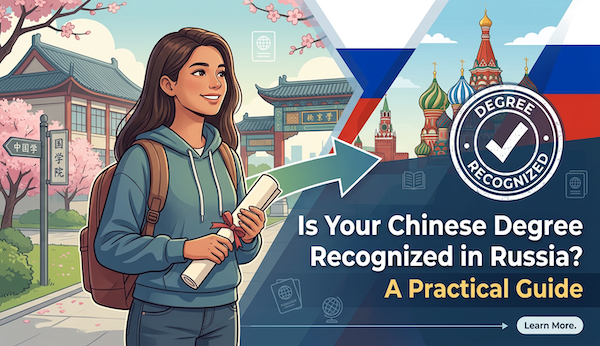
- A 1995 bilateral treaty between Russia and China provides automatic degree recognition. No lengthy nostrification process.
- Chinese auto brands took 49% of Russia’s car market in 2023 and 62% in 2024. That demand translates directly into jobs.
- Engineering graduates have the clearest career path. Business degrees work best in companies with China exposure.
- Chinese language fluency is the multiplier. A Chinese degree with weak Chinese is just a credential. With HSK 5-6, it is a career.
I hear this question a lot from Russian friends and readers: “Alex, if I go study in China, will the degree actually mean anything when I come back?” It is a fair question. You are spending years of your life and a significant amount of money — you should know what you are buying.
Let me give you the big picture first. Over 21,000 Russian students are enrolled at Chinese universities in the 2024–2025 academic year. That figure comes straight from Russia’s Minister of Science and Higher Education, Valery Falkov.¹ Russia-China bilateral trade hit $228 billion in 2025, and Russian job listings requiring Chinese language skills have surged past 13,000. These are not abstract statistics. They are the ground shifting under your feet.
The short answer to the question is yes, a Chinese degree is worth it for a Russian student — under the right conditions. The longer answer depends on which university you choose, which subject you study, and which sector of the Russian economy you are aiming for. Let me walk you through how I think about each of these.
The 1995 Agreement: What It Actually Does
Russia and China signed a mutual degree recognition agreement in Moscow on June 26, 1995.² I mention the date because it matters: this is not some recent diplomatic gesture. It is a binding bilateral treaty that has been in place for over 30 years, under which both countries recognize each other’s higher education diplomas and academic degrees.
Here is what this means if you are planning your studies. Graduate from a recognized Chinese university, and your diploma carries the same legal standing for employment and further study in Russia as a diploma from any Russian university. You do not need to go through Glavexpertcentre — the body under Rosobrnadzor that handles foreign degree recognition — for the baseline recognition that the 1995 agreement already provides.
What employers usually ask for: a notarized Russian translation of your diploma and transcript. That is it. No additional nostrification procedure, no multi-month wait, no expensive expert evaluation — unless you attended a university that is not covered under the agreement. In my experience helping Russian students navigate this, the document side of things is almost never where the problems happen.
The 1995 agreement covers all Chinese public universities on the Ministry of Education’s list of institutions approved to enroll international students. This is almost never an issue with public universities, but I have seen it happen with small private colleges that target international students aggressively. If your university is not on the MOE list, the 1995 agreement does not apply.
Russia also maintains a separate automatic recognition list. As of February 2025, this list includes 384 institutions worldwide, with leading Chinese universities such as Tsinghua, Peking, Fudan, Zhejiang, and Nanjing University on it.³ These universities have an extra layer of streamlined recognition on top of the 1995 agreement. But to be honest, for most practical purposes, being on this extra list versus just being covered by the 1995 agreement does not make a meaningful difference — unless you are dealing with a particularly bureaucratic employer who insists on a Glavexpertcentre certificate.
Speaking of that: if an employer or government body specifically requires a Glavexpertcentre certificate — rare for private-sector jobs, possible for some regulated professions — you go through the standard procedure. Apply through NIC/Glavexpertcentre, submit your diploma with a notarized Russian translation, pay the state fee (6,500 rubles as of the most recent published schedule), and wait up to 45 calendar days. If they need additional verification from the Chinese side, it can take longer. I have seen it go smoothly in three weeks and drag on for two months. Plan accordingly.
The Labor Market: What Russian Employers Actually Think
In 2025, the Russian job portal “Work Russia” listed over 13,000 vacancies requiring Chinese language skills. SuperJob, one of Russia’s largest recruitment platforms, reported that demand for Chinese-speaking specialists rose more than 60% in the first half of 2024 alone. Whenever I check these numbers, they keep going up.
Chinese has now overtaken German and Spanish as the second most demanded foreign language in the Russian labor market, behind only English. And the demand is no longer concentrated in translation and teaching. SuperJob data shows that the industries hiring most aggressively for Chinese speakers are transport and logistics companies, B2B service providers, and industrial manufacturers. This is not about academic talent anymore — it is about people who can make business happen between the two countries.
Here is some real salary data I pulled from Russian job listings in 2024–2025:
| Role | Location | Monthly Salary (RUB) |
|---|---|---|
| Chinese translator | Volgograd | 80,000–120,000 |
| Painter (requires Chinese) | Omsk | 130,000 |
| Chinese language teacher | Moscow | ~75,000 |
| Experienced Chinese translator | Nationwide | Up to 200,000 |
For context: Russia’s average monthly salary was approximately 89,000 rubles in 2024 per Rosstat data, and has risen further since. The 130,000-ruble painter listing sits well above the national average.
I want to pause on that painter listing because it tells you something important. An Omsk construction company is paying 130,000 rubles — well above the national average — specifically for a painter who can communicate with Chinese-speaking supervisors. This is not about being a translation prodigy. It is about Chinese businesses being deeply embedded in the Russian economy at every level, including the shop floor. When I first came across that listing, it changed how I thought about the value of Chinese language skills in Russia. It is not an elite, Moscow-only thing. It is happening in regional industrial cities too.
How employers segment your degree
In my experience, Russian employers break down into three categories that treat a Chinese diploma very differently. You need to know which one you are targeting before you decide if this path makes sense.
Chinese companies operating in Russia. This is the most obvious path and, frankly, the most undervalued by students I talk to. Chinese auto brands — Haval, Chery, Geely, Great Wall, Changan, BYD — together controlled 49% of the Russian car market in 2023, a figure that rose to 62% in 2024.⁴ They run factories, dealership networks, logistics hubs, and parts distribution centers across the country. Huawei, Xiaomi, and the AliExpress Russia ecosystem employ thousands of local staff. These companies have a stated preference for Russian graduates of Chinese universities. You understand both business cultures, you speak the language of headquarters, and your diploma carries brand recognition with the people who sign your paycheck. The salary premium for this combination — Russian market knowledge plus a Chinese degree — can be 20–30% over candidates who have only one of the two. I have seen this play out firsthand in hiring decisions.
Russian companies trading with China. This is the fastest-growing segment of the Chinese-language job market in Russia. In 2025, bilateral trade reached $228 billion, though it dipped 6.9% from the $245 billion peak in 2024 after three years of rapid post-sanctions growth.⁵ Western sanctions have redirected Russian supply chains toward China, and every Russian company that imports equipment, components, electronics, or consumer goods from China needs people who can negotiate with suppliers, read technical documentation in Chinese, and manage quality control on the ground. These companies do not necessarily care which Chinese university you attended — they care that you can read a contract in Chinese and spot the clause the supplier quietly changed. What I tell people is this: a degree from a mid-tier Chinese university plus demonstrated language fluency opens more doors here than a degree from a top Chinese university with rusty Chinese.
Russian government and state-owned enterprises. The most straightforward category. If your diploma is covered by the 1995 agreement — which covers all Chinese public universities approved to enroll international students — it is legally equivalent to a Russian diploma for civil service and state-sector employment. No additional certification is typically required beyond the notarized translation. I rarely hear about problems in this channel.
One thing worth pointing out: there is no widespread cultural preference for Western degrees the way you might see in some Southeast Asian markets. In those places, Australian, British, or American diplomas carry automatic prestige. Russian employers in the sectors where Chinese degrees matter most — trade, logistics, manufacturing, energy — evaluate your diploma on one question: does it make you useful to their business? In many of those sectors, a Chinese degree is frankly more useful than a Western one. I have had Russian hiring managers tell me exactly this.
By Degree: What Holds Value and Where
Not all degrees are valued equally, and I think this is where a lot of the public discussion misses the point. Two students from the same university in different programs can face completely different career outcomes. Here is how I break it down.
Engineering (High Value)
This is the strongest category, no question. China invests more in engineering education than any country in the world, and Russian employers in infrastructure, energy, and manufacturing know this. The Belt and Road Initiative has created an institutional pipeline: joint energy projects, cross-border rail and pipeline construction, and technology transfer agreements all require engineers who can work in both countries.
The programs I see most Russian students going into: mechanical engineering, electrical engineering, civil engineering, computer science, and petroleum engineering. Universities with strong engineering reputations — Tsinghua, Zhejiang, Shanghai Jiao Tong, Harbin Institute of Technology — carry particular weight with Russian technical employers. If you are an engineering student from one of these schools and you speak decent Chinese, you are walking into one of the most favorable job markets I can think of for a Russian graduate right now.
Medicine (Conditional)
Medical degrees from China are recognized under the 1995 agreement, but here is the reality: practicing medicine in Russia requires passing Russian licensing examinations through Roszdravnadzor regardless of where you studied. The advantage of a Chinese medical degree is the quality-to-cost ratio — Chinese MBBS programs, especially those taught in English for international students, cost a fraction of what Russian private medical schools and European alternatives charge. But the regulatory path to practice is the same as for a Russian medical graduate.
One practical thing I always mention to Russian students considering this route: most Chinese medical programs for international students teach clinical terminology in English rather than Russian. If you plan to practice in Russia, you will need to learn Russian medical terminology independently before the licensing exam. It is manageable, but I have seen people underestimate how much work that is. Do not make that mistake.
Business and Economics (Context-Dependent)
A Chinese business degree is worth something in Russia specifically at companies that trade with or operate in China. In a Russian company with no China exposure — a regional retail chain or a domestic food manufacturer — I would be honest with you: a degree from the Higher School of Economics or Moscow State University probably carries more immediate recognition than a degree from a Chinese university, even a highly ranked one. The value depends entirely on how much of your employer’s business touches China.
The exception I would point to: Fudan University, Peking University’s Guanghua School of Management, and Tsinghua’s School of Economics and Management. These three names are sufficiently well-known among Russian business professionals — especially in Moscow and St. Petersburg — to carry independent brand value regardless of China exposure. I have met graduates from these programs who walked into roles at major Russian companies with no China connection, purely on the strength of the brand.
Chinese Language and Linguistics (Skill-Driven, Not Diploma-Driven)
This is the most straightforward path in terms of employability, but the least dependent on the diploma itself. Demand for Chinese language skills in Russia is so high that a graduate with HSK 5 or 6 and any Chinese university degree — in any subject — will find work teaching, translating, or in business development roles. I see the diploma here primarily as evidence that you spent years immersed in the language environment, not as a credential that opens doors by its name alone. The HSK score is what people actually look at.
The Scholarship Pipeline: What Is Available
The Chinese Government Scholarship (CSC) program is the main route for Russian students seeking funded study in China. Russia is a priority country under the Belt and Road Initiative, which means additional quotas beyond the standard bilateral allocation.⁶
Here is what I tell Russian applicants when they ask about the numbers:
- Type A (embassy channel): the primary route for most Russian applicants, handled through the Chinese Embassy in Moscow (CSC agency code 3101). This is the one most people start with.
- Type B (direct university application): no fixed quota — you apply directly to the university, and the number of accepted students depends on the university’s own CSC allocation. I have seen students get in through Type B when Type A did not work out, simply because they found a professor willing to take them on.
- Coverage: full tuition, on-campus accommodation, comprehensive medical insurance, and a monthly living stipend of 2,500 yuan (undergraduate), 3,000 yuan (master’s), or 3,500 yuan (doctoral). This goes a long way in most Chinese cities outside of Beijing and Shanghai.
- Success rate: I would estimate 20–40% with a strong application package. A pre-acceptance letter from a professor significantly improves your odds. If you are serious about this, start reaching out to professors early — I cannot emphasize this enough.
Russian applicants also have access to the Russian government’s “Global Education” program and various university-specific scholarships, though CSC remains the most generous and widely used option in my experience.
Language requirement: for Chinese-taught programs, HSK 4 or above; for English-taught programs, IELTS 6.0 or TOEFL 80. What I find interesting is that many Russian students arrive with very high Chinese proficiency — the average HSK level among Russian students at top Chinese universities is HSK 5, well above the minimum requirement. Russian students tend to take language preparation seriously, and it shows in the outcomes.
What Nobody Tells You
The degree recognition is easy. Using it well is the hard part.
The 1995 agreement means your diploma is legally valid in Russia. No multi-month nostrification process, no uncertain expert evaluation, no administrative maze. You get the notarized translation done and you are ready for the vast majority of jobs. I have helped enough people through this to say with confidence: the paperwork is not the thing that trips people up.
The actual challenge is matching your degree to the right employer.
A Russian graduate with a Chinese engineering degree applying to a Russian oil services company that works on joint Russia-China energy projects is in a strong position. The same graduate applying to a company that exclusively serves the domestic Russian market may find that the hiring manager has never heard of their university and defaults to candidates from familiar Russian institutions. I have seen both scenarios play out, and the difference is entirely about which door you knock on.
What makes the difference: Chinese language fluency. Survey data from Russian employers consistently shows that the salary premium for a Chinese degree in Russia is largely driven by language skills, not by the degree brand itself. A Chinese degree with weak Chinese is a credential with limited market value. A Chinese degree with HSK 5 or 6 is a credential that opens doors across the most dynamic sectors of the Russian economy. I say this to every Russian student who asks me for advice: do not treat the language as a secondary thing. It is the main thing.
This is why the automatic recognition list matters less than it seems. Put an employer in a room with a Fudan graduate who has HSK 4 and a graduate from a lesser-known Chinese university who has HSK 6 and can negotiate a supplier contract in Chinese. More often than not, the HSK 6 candidate wins. In the Russian market, what you can actually do in Chinese matters more than where your diploma is from.
Geographic factor: Russian students from Siberia and the Far East have an additional advantage that I do not think gets talked about enough. The proximity to China — Irkutsk to Beijing is a shorter flight than Irkutsk to Moscow — means that regional employers in these areas have been dealing with Chinese businesses for decades and value Chinese credentials more than employers in European Russia who may have limited China exposure. If you are from Vladivostok, Khabarovsk, or Irkutsk, your Chinese degree is going to be understood and valued in your home region in a way that might surprise you.
The sanctions reality: Western sanctions on Russia have redirected trade flows and investment patterns in ways that directly benefit Chinese-educated Russian graduates. Russian companies that previously sourced equipment and technology from Europe are increasingly turning to Chinese suppliers. Russian graduates who studied their field in Chinese — learning the technical terminology in Chinese while mastering the subject — are entering the labor market at exactly the moment when that combination of skills is in highest demand.⁷ I did not predict this when I started looking at this market, but the data bears it out.
Decision Matrix: Should You Get a Chinese Degree?
| Your Goal | Verdict | Why |
|---|---|---|
| Work at a Chinese company in Russia (Haval, Huawei, etc.) | Strong yes | These companies actively prefer bilingual, bicultural hires from Chinese universities |
| Work in Russia-China trade, logistics, or sourcing | Yes | Language + cultural fluency + on-the-ground China experience are directly monetizable |
| Engineering career in energy, infrastructure, or manufacturing | Yes | China’s engineering education is world-class; the Russia-China project pipeline creates demand |
| Practice medicine in Russia | Conditional | Degree is recognized; you still need Russian licensing exams and medical Russian proficiency |
| Work in a Russian company with no China exposure | Weaker case | Your degree may carry less immediate recognition than a diploma from a well-known Russian university |
| Become a Chinese language teacher or translator | Yes, but | The demand is enormous; your diploma matters less than your HSK level |
| Civil service or government work | Yes | The 1995 agreement provides full legal equivalence |
- You plan to work for a Chinese company operating in Russia — the pipeline is real and growing
- You are studying engineering, logistics, or trade — degrees with direct Russia-China economic demand
- You achieve HSK 5 or above — language proficiency is the multiplier that makes everything else work
- You are from Siberia or the Far East — regional employers already value Chinese credentials
- You want to work in the post-sanctions economy, where Chinese suppliers are replacing Western ones
- You plan to work in a purely domestic Russian industry with no China connection — the degree brand may not carry
- You are not committed to learning Chinese to an advanced level — the degree alone is not the value driver
- Your university is not on the MOE list of institutions authorized to enroll international students
Sources:
¹ TASS — Russian Minister Valery Falkov on Student Exchanges: 21,000+ Russians in China, 56,000+ Chinese in Russia (2024-2025) (Aug 2025)
² NIC/Glavexpertcentre — National Information Centre for Academic Recognition (nic.gov.ru)
³ Tencent News — Russian Government Expands University Recognition List to 384 Institutions (Feb 2025)
⁴ Xinhua — Chinese Automakers Achieve Record 49% Market Share in Russia for 2023 (Jan 2024)
⁵ TASS — Russia-China Trade Reaches $228 Billion in 2025 (Jan 2026)
⁶ China Scholarship Council (CSC) — Official Website
⁷ OSW Centre for Eastern Studies — China-Russia Trade Dashboard
Pros and cons at a glance
| Pros | Cons and things to weigh |
|---|---|
| Automatic recognition under the 1995 Russia-China treaty, with no nostrification step for Chinese public universities on the MOE list | Recognition only covers Chinese public universities approved to enroll international students. Private colleges outside that list are not covered |
| Strong labour demand: 13,000+ Russian vacancies require Chinese, and Chinese is now the number two foreign language in Russia | Medicine still requires Russian licensing exams and medical Russian, even with a recognized degree |
| Chinese companies in Russia (auto, tech, e-commerce) actively prefer bicultural graduates from Chinese universities | A degree alone is weak without HSK 5 or above. Language skill is the real multiplier |
| Generous CSC scholarships with extra Russia quotas under the Belt and Road Initiative | Less immediate recognition in purely domestic Russian industries with no China connection |
| Regional advantage for students from Siberia and the Far East, where employers already value Chinese credentials | Sanctions have reshaped trade, so demand is concentrated in China-facing sectors rather than spread evenly |
Key authorities and official resources
- NIC / Glavexpertcentre: Russia’s National Information Centre for academic recognition (handles foreign degree certificates)
- China Scholarship Council (CSC): official Chinese government scholarship body
- Campus China: official CSC admissions and university application portal
- Ministry of Education of China (English): policy and the list of institutions approved to enroll international students
- Ministry of Science and Higher Education of Russia: Russian higher education authority
- Study in China: official Chinese government portal for international students
- Xinhua English: state news agency, primary source for market-share and trade figures
- TASS: Russian state news agency, source for student-exchange and trade statistics