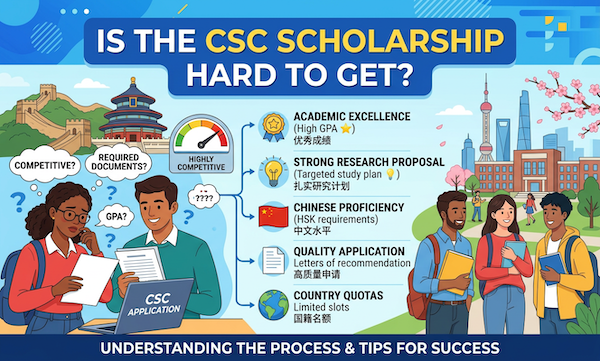
If you are planning to study in China and the Chinese Government Scholarship (CSC) feels like a lottery ticket you are not sure you will win, you are not alone. CSC acceptance rates hover in the single digits for popular programs. That feeling of refreshing the application portal, waiting for a result that never comes, is something many international students know too well.
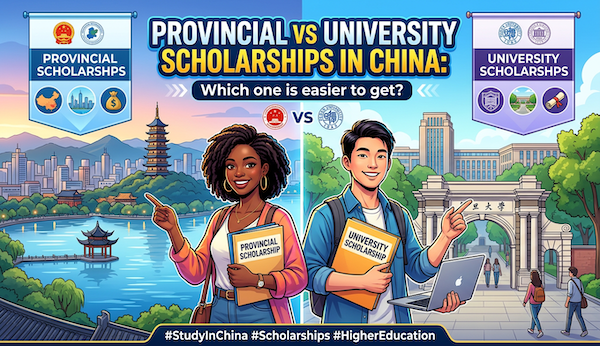
But here is what most applicants miss: there are two other scholarship categories that, combined, fund more international students than CSC does. Provincial government scholarships and university scholarships. And one of them is significantly easier to get than most people think.
This article breaks down the real numbers, the application process, and which one gives you better odds.
How scholarships are organized
First, the hierarchy. China’s scholarship system for international students works in three tiers:
| Tier | Type | Funded By | Typical Coverage | Competition |
|---|---|---|---|---|
| 1 | Chinese Government Scholarship (CSC) | Ministry of Education | Full: tuition + housing + living + insurance | Very high |
| 2 | Provincial Government Scholarship | Provincial governments | Full or partial: tuition + housing + living (varies) | Medium |
| 3 | University Scholarship | Individual universities | Varied: full tuition to partial tuition | Low to medium |
The CSC gets all the attention. Every Google search, every YouTube video, every “Study in China” guide starts with CSC. That is exactly why provincial and university scholarships get overlooked.
As of 2026, at least 26 provincial government scholarship programs exist across China, from Beijing and Shanghai to Guizhou and Liaoning. More than 200 universities offer their own institutional scholarships. The money is there. Most applicants just do not look for it.
What each scholarship actually covers
Provincial government scholarships
These are funded by individual provincial or municipal governments, not the central government. Each province sets its own rules, amounts, and categories. Here is what the major ones offer:
| Province/City | Type | Monthly Stipend | Tuition | Housing | Annual Value (PhD) |
|---|---|---|---|---|---|
| Shanghai (SGS) | Type A (Full) | ¥2,500–3,500 | Covered | Covered | ~¥80,000–100,000 |
| Shanghai (SGS) | Type B (Partial) | None | Partial | No | Varies |
| Beijing (BGS) | Full | ¥3,000 | Up to ¥40,000/yr | No | ~¥76,000 |
| Jiangsu (Jasmine) | Full | Varies | Covered | Covered | ~¥70,000–90,000 |
| Guangdong | — | None | ¥10,000–30,000/yr | No | ¥10,000–30,000 |
| Zhejiang | Type A | None | ¥30,000/yr | No | ¥30,000 |
| Zhejiang | Type B | None | ¥20,000/yr | No | ¥20,000 |
| Hubei | — | None | ¥10,000–20,000/yr | No | ¥10,000–20,000 |
A few things jump out. First, provincial scholarships vary wildly. Shanghai and Beijing offer full packages comparable to CSC. Hubei and Guangdong offer tuition subsidies only. Second, many provincial scholarships do not include a monthly living stipend. If you get a Hubei Provincial Scholarship for your PhD, you get ¥20,000 toward tuition and that is it. You are covering rent, food, and everything else yourself.
But Shanghai SGS Type A is a different story: tuition, dorm housing, comprehensive medical insurance, and a monthly living allowance. That is a CSC-level package, funded by the city instead of the central government.
University scholarships
Every major Chinese university runs its own scholarship program with money from its own budget. The structure is usually three-tier:
| Level | Coverage | Example (NPU President Scholarship) |
|---|---|---|
| Level 1 (一等) | Full tuition + housing + monthly stipend | Free tuition + dorm + ¥1,500–3,500/month |
| Level 2 (二等) | Full tuition only | Free tuition |
| Level 3 (三等) | 50% tuition | Half tuition |
Some universities go even further. The NPU President Scholarship Level 1 for PhD students includes free tuition, free housing, and a ¥3,500 monthly stipend. That is ¥42,000 per year in cash alone, before counting the tuition waiver. For comparison, CSC PhD stipend is ¥3,500 per month, so NPU’s top university scholarship matches CSC exactly.
Here are specific numbers from real university programs:
| University | Scholarship | Best Coverage | PhD Annual Value |
|---|---|---|---|
| NPU (Xi’an) | President Scholarship | Tuition + housing + ¥1,500–3,500/mo | ~¥90,000 |
| Jiangsu University | Presidential (PhD Type A) | Tuition + housing + ¥5,000 lump sum | ~¥55,000 |
| Fudan University | Merit Scholarship | Up to ¥40,000/yr tuition | ¥40,000 |
| Zhejiang University | Merit Scholarship | ¥20,000–50,000/yr | ¥20,000–50,000 |
| ZJUT (Hangzhou) | Full Scholarship | Tuition + housing + insurance + ¥1,000–2,500/mo | ~¥70,000 |
The range is massive. A top-tier university scholarship at NPU is equivalent to CSC. A standard merit award at Fudan covers less than half of total costs.
Competition: which one has better odds?
Here is the question that actually matters: which one can you get?
Provincial scholarships: lower competition (if you know the secret)
Provincial scholarships have a unique advantage: low awareness. A 2026 guide published on Substack noted bluntly: “These provincial scholarships are usually less competitive than national CSC scholarships because many students do not even know they exist.”
Think about it. When was the last time you saw a YouTube video titled “How I Got the Hubei Provincial Scholarship”? Never. Everyone makes content about CSC. The information gap is real, and it works in your favor.
But there is a catch: quotas. Each university receives a limited number of provincial scholarship slots per program type. A mid-tier university might get four Type A slots for its entire master’s program and eight Type B slots. So while fewer people apply, there are also fewer seats. The competition ratio varies a lot by province and university.
Shanghai SGS, for example, is competitive because Shanghai is a top destination. Hubei Provincial Scholarship, on the other hand, goes to universities in Wuhan and other cities that receive far fewer international applicants. Your chances in Hubei are substantially higher than in Shanghai.
University scholarships: more seats, varied competition
University scholarships operate differently. A large comprehensive university like NPU or Jiangsu University can fund dozens or even hundreds of students through its own scholarship budget. There is no provincial quota limiting them. If the university wants to attract more international students, it can increase its scholarship budget.
The trade-off: university scholarships are often tied to GPA or entrance exam scores. At Fudan, it is explicitly GPA-based. At NPU, Level 1 requires your previous grades to average 75% or above. If your academic record is strong, university scholarships are your best bet. If your grades are average, provincial scholarships, which look at the whole application more holistically, might give you better odds.
The double-apply strategy
Here is something most applicants do not realize: you can apply for both. And you should.
Provincial scholarships and university scholarships are not mutually exclusive. They come from different funding sources. A student at Zhejiang University can simultaneously hold a Zhejiang Provincial Government Scholarship and a Zhejiang University Academic Scholarship, as long as the university’s own rules allow stacking.
Here is how the smartest applicants approach it:
- Apply for the provincial scholarship for your target province (e.g., Jiangsu Jasmine, Guangdong Government Scholarship)
- Simultaneously apply for your target university’s own scholarship (e.g., JSU Presidential Scholarship, NPU President Scholarship)
- If you win both, you effectively get tuition covered by the provincial scholarship and living expenses covered by the university scholarship
The application windows also overlap nicely: most provincial and university scholarship applications open between January and May each year, with results announced by July 31. You send one set of documents and check two boxes.
What real students actually experience
Scholarship experiences vary a lot by university, province, and individual circumstances. Here are two composite cases built from publicly available application data, university announcements, and documented selection processes. They reflect the real financial realities of studying in China on these scholarships.
Case 1: the provincial scholarship route
A student from Ghana applied for a master’s in Mechanical Engineering at Huzhou University in Zhejiang Province. His undergraduate GPA was 3.2 out of 4.0, solid but not exceptional. He had no publications and no HSK certificate because his program was English-taught.
He applied for two things: the Zhejiang Provincial Government Scholarship (Type A) and the university’s own international student scholarship. The CSC application was never on his radar because his agency told him his profile was not competitive enough for CSC.
Result: He won the Zhejiang Provincial Government Scholarship (Type A), which covered ¥30,000 toward his annual tuition of ¥24,000, leaving ¥6,000 to put toward housing. The university scholarship was not awarded because Type A provincial and Level 1 university awards could not be stacked at that particular institution.
His monthly reality: With tuition covered, his family still needed to send him about ¥2,500 per month for dorm fees, food, and transportation in Huzhou. He worked part-time as an English tutor on weekends, earning about ¥1,500 extra per month. After one year, he reapplied and won a Zhejiang Provincial Scholarship renewal with a university supplementary award of ¥10,000, which finally made his finances comfortable.
The takeaway: a provincial scholarship alone often does not fully cover living costs. You need to plan for a gap.
Case 2: the university scholarship route
A student from Pakistan applied for a PhD in Computer Science at Northwestern Polytechnical University (NPU) in Xi’an. His master’s GPA was 3.7, he had one conference paper, and IELTS 7.0. His research proposal was specifically aligned with a professor who was recruiting.
He applied for NPU’s President Scholarship directly, skipping the provincial scholarship because Shaanxi’s provincial program had very limited slots for PhD students that year.
Result: He won NPU President Scholarship Level 1, which covered full tuition, free on-campus housing, and a ¥3,500 monthly stipend. That monthly amount is identical to the CSC PhD stipend. Combined with Xi’an’s lower cost of living compared to Shanghai or Beijing, he was able to live comfortably without family support, saving about ¥1,000 per month from his stipend.
The takeaway: for strong academic profiles, a top-tier university scholarship can match or beat a provincial scholarship. The monthly stipend at Level 1 is what makes the difference.
Head-to-head: provincial vs university
Here is the direct comparison across the dimensions that matter most:
| Factor | Provincial Scholarship | University Scholarship |
|---|---|---|
| Awareness among applicants | Low (hidden advantage) | Medium |
| Competition per available slot | Medium | Low to medium |
| Total number of awards | Fewer (quota-limited) | More (budget-dependent) |
| Typical coverage | Full or partial tuition, some include housing & stipend | Full to partial tuition, top tiers include stipend |
| Monthly living stipend | Rare (Shanghai & Beijing only) | Common at top tier (Level 1) |
| Application complexity | Moderate (goes through university to province) | Simple (direct to university) |
| Renewal requirement | Annual performance review | Annual performance review |
| Prestige factor | Higher (government-issued) | Varies by university ranking |
| Best for | Students targeting specific provinces, average GPAs | Strong academic profiles, specific university preference |
Which one should you pick?
Pick a provincial scholarship if:
You have an average or slightly above-average GPA, you are targeting a specific province where living costs are lower, and you want the prestige of a government-issued award. The lower competition (due to low awareness) works in your favor. Just be ready for the financial gap: most provincial scholarships do not include a living stipend, so you will need family support or part-time income.
Pick a university scholarship if:
Your GPA is strong (above 3.3 or 75%), you have a clear research direction or professor connection, and you want the simplest application process. Top-tier university scholarships (Level 1) can match CSC benefits, especially at well-funded universities like NPU, Zhejiang University, and Fudan.
The smartest move is to apply for both.
Send your application to the university and check every scholarship box you qualify for. The university’s international student office processes both types anyway. There is literally no extra work, just extra checkboxes. In the worst case, you win one. In the best case, you win both and your entire degree is funded.
A last point. Provincial scholarships for less popular provinces, like Guizhou, Liaoning, or Hubei, are a lot easier to get than those for Beijing or Shanghai. If you are flexible about location, you can dramatically improve your odds by targeting a second-tier province. The degree is still from an accredited Chinese university, and your living costs will be lower. Hubei has Wuhan University and Huazhong University of Science and Technology, both top-10 in China, and the provincial scholarship competition there is a fraction of what it is in Shanghai.