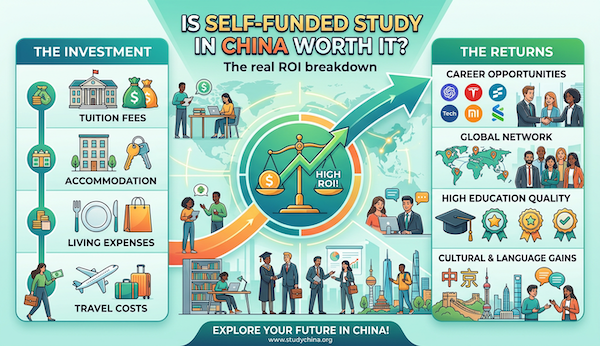
If you are reading this, you probably have the financial ability to study in China without a scholarship. Your family can pay the tuition. The question is not “Can I afford it?” It is “Should I spend this money?”
That is a very different question.
This article does not try to talk you into coming to China. It gives you a framework to decide whether the return on investment (ROI) makes sense for your specific situation.
The ¥200,000 question
Let us be honest about what you are considering.
A three-year master’s degree in China, even at a reasonably priced university, will cost you somewhere between ¥85,000 and ¥180,000 (approximately 12,000to25,500). A four-year bachelor’s degree can cost ¥120,000 to ¥280,000 (17,000to40,000). A three-year PhD, if you are paying out of pocket, can run ¥150,000 to ¥300,000 (21,000to43,000).
That is not pocket change. That is the down payment on an apartment in many countries. That is the startup capital for a small business. That is three to five years of living expenses in many places.
So the question matters.
But here is what most people get wrong about ROI: they only count the degree. They ask, “Will this degree get me a high-paying job?” That is the wrong question. The degree is only one part of what you are buying.
What you are actually paying for is a three-to-four-year immersion in the world’s second-largest economy while it is still growing and transforming. The degree is the receipt. The real product is the access, the network, and the perspective you cannot get from outside.
Whether that is worth it depends entirely on how you plan to use it.
What self-funding actually costs in 2026
Here are the real numbers, without sugar-coating.
Tuition fees by degree level
| Degree | Budget Range (RMB/year) | Mid-Range (RMB/year) | Top-Tier (RMB/year) |
|---|---|---|---|
| Bachelor’s | ¥18,000 – 25,000 | ¥25,000 – 35,000 | ¥35,000 – 55,000 |
| Master’s | ¥25,000 – 35,000 | ¥35,000 – 50,000 | ¥50,000 – 80,000 |
| PhD | ¥30,000 – 40,000 | ¥40,000 – 60,000 | ¥60,000 – 100,000+ |
Note: Medicine (MBBS) and MBA programs can cost significantly more, up to ¥200,000+ for the entire program.
Tuition fees by major (average)
| Major | Average (RMB/year) | Range |
|---|---|---|
| Engineering (AI, CS, Robotics) | ¥35,000 | ¥25,000 – 60,000 |
| Business & Economics (MBA, Finance) | ¥40,000 | ¥28,000 – 100,000 |
| Medicine (MBBS) | ¥45,000 | ¥30,000 – 80,000 |
| Arts & Design | ¥30,000 | ¥20,000 – 50,000 |
| Chinese Language & Culture | ¥20,000 | ¥15,000 – 28,000 |
Mandatory fees (annual, approximate)
| Fee Item | Cost (RMB) |
|---|---|
| Application Fee (one-time) | ¥400 – 800 |
| Registration Fee (annual) | ¥200 – 500 |
| Comprehensive Medical Insurance (annual) | ¥800 |
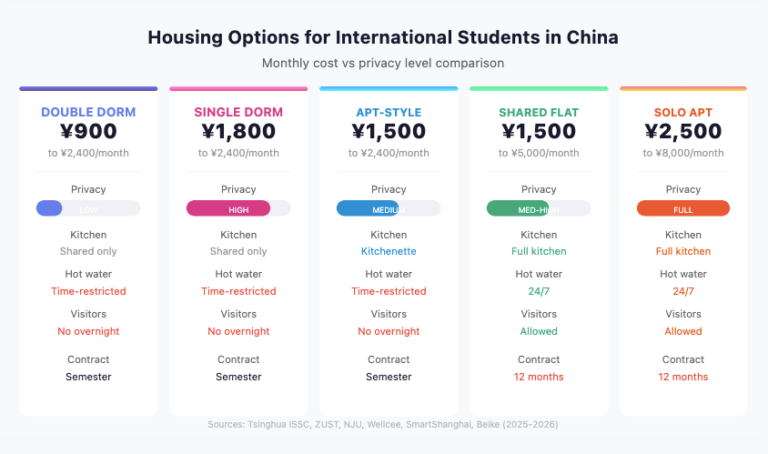
| On-Campus Housing | ¥3,000 – 12,000 |
| Textbook & Materials | ¥500 – 2,000 |
| Residence Permit (annual) | ¥400 – 800 |
Living costs by city tier (monthly, realistic budget)
| City Tier | Rent (Campus Dorm) | Food | Transport | Utilities/Other | Monthly Total |
|---|---|---|---|---|---|
| Tier 1 (Beijing, Shanghai) | ¥1,000 – 2,500 | ¥2,000 – 4,000 | ¥300 – 600 | ¥300 – 500 | ¥5,100 – 9,000 |
| New Tier 1 (Hangzhou, Chengdu, Wuhan) | ¥800 – 2,000 | ¥1,500 – 3,000 | ¥200 – 400 | ¥300 – 500 | ¥3,200 – 5,900 |
| Tier 2/3 (Xi’an, Guizhou, Lanzhou) | ¥500 – 1,500 | ¥1,200 – 2,500 | ¥150 – 300 | ¥200 – 400 | ¥2,900 – 4,900 |
Three-year master’s total cost estimate
| Scenario | Tuition (3 yrs) | Living (3 yrs) | Total (RMB) | Total (USD) |
|---|---|---|---|---|
| Tier 1, Mid-Range | ¥105,000 | ¥180,000 – 270,000 | ¥285,000 – 375,000 | $40,700 – 53,600 |
| New Tier 1, Budget | ¥75,000 | ¥115,000 – 212,000 | ¥190,000 – 287,000 | $27,100 – 41,000 |
| Tier 2/3, Budget | ¥60,000 | ¥104,000 – 176,000 | ¥164,000 – 236,000 | $23,400 – 33,700 |
Wait. The numbers above look scary, do not they?
Here is the context you need: a three-year master’s degree in the United States costs 120,000to180,000. In the UK, £45,000 to £90,000. In Australia, AUD 90,000to150,000.
China is still the most cost-effective destination among top-tier educations, by a wide margin.
But cost-effective does not mean “worth it.” That depends on what you do with it.
The ROI framework: how to think about payback
Before we go further, you need a way to think about return on investment that actually works.
Most people use a simple formula: ROI = (Salary After Graduation – Cost of Study) ÷ Cost of Study
That formula is wrong for education. Here is why: salary is not the only return, and it is often not even the main return.
A better framework has four questions:
Question 1: What do you want to do with China?
If your answer is “I want to work in China after graduation,” your ROI calculation is very different from someone whose answer is “I want to start a business in my home country that trades with China.”
For the first person, the return is measured in: job placement rate, starting salary in China, and ability to get a work visa.
For the second person, the return is measured in: Guanxi (network) with Chinese suppliers/manufacturers, fluency in business Chinese, and understanding of how Chinese businesses operate.
If you cannot answer this question clearly, your ROI is probably negative. You are buying a tool without knowing what you want to build.
Question 2: What is your alternative use of this money?
If you take ¥200,000 and invest it in a low-risk index fund, it grows to roughly ¥260,000 in five years (assuming 5% annual return). If you use it as startup capital for a business, it might return ¥500,000 or it might return zero.
The cost of studying in China is not just the tuition. It is the opportunity cost, what that money could have done if you had used it differently.
Question 3: How much of the available value will you actually capture?
Studying in China gives you access to internships at Chinese companies, networking events, language partners, and alumni connections. But you have to show up. You have to apply for those internships. You have to attend those events.
I have seen self-funded students who graduated with zero Chinese company connections because they only hung out with other international students and never left the campus bubble. Their ROI was near zero, not because China was not worth it, but because they did not use what was available.
Question 4: What is your backup plan if things do not work out?
If you graduate and cannot find a job in China, what then? If you return to your home country, does your Chinese degree have value there?
This is where many self-funded students get into trouble. They assume “I will figure it out in China” and then struggle because they did not plan for the alternative.
What you actually get after graduation
Here is the data that actually matters.
Employment outcomes for international students in China
The data here is frustratingly incomplete. Chinese universities do not systematically publish employment outcomes for international graduates the way US or UK universities do. But here is what we know from partial data and surveys:
| Outcome | Estimated Percentage | Notes |
|---|---|---|
| Employed in China within 6 months | 35% – 50% | Varies heavily by university ranking and major |
| Return to home country | 30% – 45% | Often with a salary premium of 10% – 30% |
| Continue to further study (PhD in China or abroad) | 10% – 20% | |
| Still searching after 6 months | 10% – 20% |
Important caveat: These are estimates based on partial university reports and anecdotal evidence. The data is not systematically collected.
Does Having a Scholarship vs. Self-Funded Matter for Outcomes?
Here is something that might surprise you: for employment outcomes, it does not matter whether you had a scholarship or paid your own way.
Employers in China do not ask, “Did you have a CSC scholarship?” They ask, “Which university did you graduate from? What can you do? Can you speak Chinese? Do you understand how things work here?”
A self-funded student from a top-100 Chinese university who did internships and learned Chinese is far more employable than a CSC scholarship recipient from a low-tier university who stayed in the international student bubble.
The scholarship helps you get in. It does not help you get a job afterward.
Salary expectations (realistic, not promotional)
| Employment Location | Starting Salary (Monthly, RMB) | Starting Salary (Annual, USD) | Notes |
|---|---|---|---|
| Working in China (Tier 1, STEM) | ¥8,000 – 15,000 | $13,700 – 25,700 | Need work visa; Chinese fluency critical |
| Working in China (Tier 1, Non-STEM) | ¥6,000 – 10,000 | $10,300 – 17,100 | |
| Returning to home country (Asia) | Highly variable | — | Chinese degree + language often gives 10% – 30% premium |
| Returning to home country (Europe/North America) | Highly variable | — | Chinese degree alone has limited recognition; internships matter more |
Again, the data is limited. But the pattern is clear: the degree alone is rarely enough. The students who get good outcomes are the ones who combined the degree with internships, language skills, and a clear career narrative.
Two real student stories
The following two cases are composite stories built from publicly available admission data, university announcements, and documented student experiences. They reflect real financial and decision-making patterns, but the names and some details have been combined to protect privacy.
Case 1: when it was worth it
A student from Vietnam’s family ran a small textile trading business that already sourced materials from Guangzhou. His undergraduate GPA was 3.1 out of 4.0. He could have waited to apply for a CSC scholarship, but the timing would have meant losing a year.
He chose to self-fund a two-year master’s in International Business at Zhejiang University (budget tier: ¥38,000 per year in tuition, plus about ¥3,500 per month in living costs in Hangzhou).
Total cost for two years: approximately ¥145,000 ($20,700).
During his program, he did three things that changed the ROI equation:
- He interned for six months at a trading company in Yiwu that specialized in connecting Southeast Asian buyers with Chinese suppliers.
- He reached HSK 5 and learned enough business Mandarin to negotiate supplier contracts.
- He used his university’s alumni network to identify three potential suppliers for his family business, visiting them in person during breaks.
After graduation, he returned to Vietnam and expanded the family business’s supplier base from two to seven Chinese factories. He estimates the increased margin from better supplier pricing paid back his education cost in approximately 2.5 years.
His verdict: “If I had waited for the CSC scholarship, I would have lost one year plus the connections I built in Yiwu. The self-funded route was not cheap, but it was faster and more targeted.”
Case 2: when it was probably not worth it
A student from a European country self-funded a three-year bachelor’s degree in Chinese Language and Literature at a university ranked outside the top 150 in China. The tuition was ¥22,000 per year, and living costs in a Tier 2 city were about ¥2,800 per month.
Total cost for three years: approximately ¥160,000 ($22,900).
The student had a genuine interest in Chinese literature and culture. The program was taught in Chinese, and he reached HSK 6 by his second year. Academically, he did well.
But he had no clear plan for what came after graduation. He did not do internships (partly because his visa restricted work, partly because he did not research this in advance). He did not build connections with Chinese companies. He focused entirely on his studies.
After graduation, he returned to Europe. His degree was recognized as a bachelor’s equivalent, but it did not open specific career doors. He ended up working in a job unrelated to China, earning a salary that did not reflect his educational investment.
His verdict (paraphrased from a forum post): “I do not regret studying in China because I loved the experience. But if I am honest about the money, it has not paid back. I would have been better off doing a master’s in China after my bachelor’s, focusing on something more employable, and actually using the degree for work.”
The difference between Case 1 and Case 2 is not the amount of money spent. It is having a plan for using what you pay for.
When self-funding makes sense
Self-funding makes sense in these scenarios:
1. You have a clear China-connected plan. You want to work in China after graduation. Or you want to build a business that involves China. Or you want to work for a company in your home country that does business with China. If you can articulate specifically how the China experience connects to your career, self-funding is a rational investment.
2. You are targeting STEM, Business, or Medicine at a top-100 Chinese university. These degrees have the highest employment rates and salary outcomes for international graduates. A self-funded engineering master’s from Tsinghua or Zhejiang University has a very different ROI from a self-funded literature bachelor’s from an unranked university.
3. You are using China as a stepping stone to further study. Many international students use a Chinese master’s degree as a stepping stone to apply for PhD programs in Europe or North America. Chinese research output in STEM fields is now world-class, and a master’s with research experience can be a strong application builder.
4. Your family business already has China connections. If your family already trades with China, the ROI is not just about your personal salary. It is about the business value of having a family member who understands China, speaks the language, and has the network. In this case, the degree is partly a business investment, not just a personal one.
5. You can afford it without going into debt. This is important. If self-funding means your family has to take on significant debt, the risk-reward calculation changes dramatically. Education debt is harder to restructure than business debt, and there is no guaranteed return.
When self-funding does not make sense
Self-funding does not make sense in these scenarios:
1. You are going to an unranked or low-ranked university, studying a major with limited job market relevance. A degree from a university ranked below 200 in China, in a field like literature or arts, with no clear career plan, is a high-risk investment with limited upside.
2. You cannot answer the question “What will I do with this degree?” If your answer is “I will figure it out while I am there,” that is a recipe for a low ROI. You need at least a hypothesis before you arrive.
3. You are expecting the degree alone to deliver a high salary. A Chinese degree alone, especially from a mid-tier university, does not guarantee a high salary in China or elsewhere. The students who get good outcomes are the ones who combined the degree with internships, language skills, and a clear career narrative.
4. You are going primarily for the “experience” without considering the financial return. The experience of living in China is genuinely valuable. But if you are spending ¥200,000 for a “life experience,” you should at least be honest with yourself that it is a consumption expense, not an investment.
5. You have a high-opportunity-cost alternative use of the money. If the same ¥200,000 could fund a business startup with a clear path to revenue, or a degree in a country with clearer post-graduation work rights, you should compare those options directly.
How to maximize ROI if you do pay
If you decide to self-fund, here is how to make sure you actually get your money’s worth.
1. Choose your university by employment outcomes, not by city prestige. Beijing and Shanghai are glamorous, but the universities there are also the most expensive. A slightly lower-ranked university in Hangzhou or Chengdu might give you a better ROI because the cost is lower and the employment support is similar.
2. Treat internships as part of your curriculum. In China, internships are not just resume builders. They are visa pathways. Many international students who stay in China after graduation do so because they interned at a company that then sponsored their work visa. If you are not planning to do at least one internship during your program, you are leaving money on the table.
3. Learn the language to a functional level. Even if your program is taught in English, learning business Chinese to HSK 4 or 5 level dramatically increases your employability in China and your value to any company that deals with Chinese counterparts.
4. Build relationships with professors who have industry connections. In China, Guanxi matters. A professor who knows you and likes your work can open doors that no job application portal can.
5. Use your university’s career services from day one. Most international students ignore career services until their final semester. By then, the best on-campus recruitment events are over. Start in your first semester.
6. Budget for the hidden costs. Your tuition and living expenses are not the only costs. There are travel costs (exploring China is part of the experience, but it adds up), visa renewal costs, and the cost of attending networking events. Budget for these from the beginning.
The Verdict
So, is self-funded study in China worth it?
The honest answer is: it depends on what you do with it.
If you treat it as a passive experience, show up to classes, stay in the international student bubble, and expect the degree to do the work for you, it is probably not worth it. You will have a great time, but the financial ROI will be low.
If you treat it as a targeted investment, choose your program strategically, build language skills and industry connections, and have a clear plan for after graduation, it can be an extremely high-ROI decision. Not because the degree itself is so valuable, but because of what you can access while you are there.
The students who get the most out of self-funded study in China are the ones who arrive with a question, not just with a checkbook.
Last updated: May 2026. All cost data reflects 2025-2026 academic year rates. Employment data is based on partial university reports and should be verified with specific institutions.