A Chinese degree at top global firms: what employers actually think
You spent four or more years in China. You learned the language, built a network, and earned a degree from a Chinese university. Now you want to know: does this actually help you get hired at a top company?
The answer depends on where you apply, what you studied, and how well you can articulate the value of your China experience. For some roles, a Chinese degree is a decisive advantage. For others, it barely registers. This article breaks down where Chinese degrees carry real weight and where they do not.

The employer perception problem
Let us be honest about the starting point. Outside of Asia, most HR managers cannot name five Chinese universities. A 2023 QS Global Employer Survey found that while employer familiarity with Chinese universities is rising, it still lags behind US, UK, and Australian institutions. A degree from Tsinghua means something in Beijing. In Berlin or Boston, it might draw a blank.
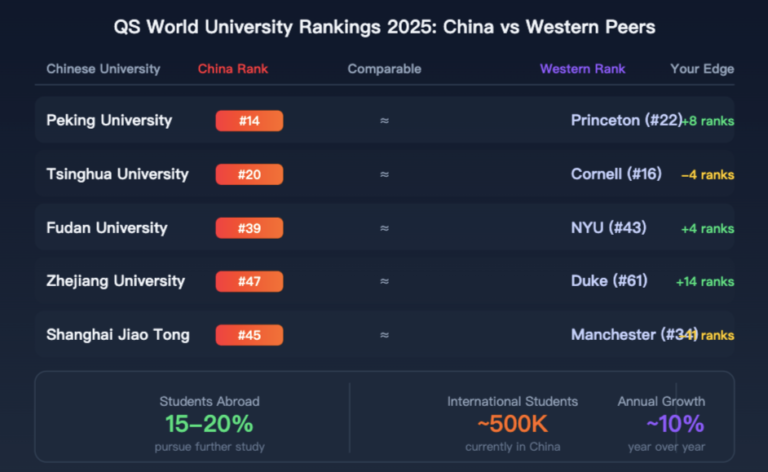
But this perception gap is narrowing. China now has more universities in the ARWU top 100 than any country except the US. Chinese research output in STEM fields has overtaken the US in volume. Employers in industries with China exposure are catching on.
The key insight: A Chinese degree is not a universal credential like a degree from MIT or Oxford. It is a specialized asset. Its value is highest at companies that do business with China, operate in China, or compete with Chinese firms. At companies with no China connection, it carries less weight.
Six industries where Chinese degrees matter most

1. Trade and logistics
China is the world’s largest trading nation. Companies involved in import-export, freight forwarding, customs brokerage, and cross-border e-commerce need staff who can negotiate with Chinese suppliers, navigate Chinese regulations, and build relationships with Chinese partners.
Major employers include BYD (expanding globally and hiring locally in destination markets), COSCO Shipping, and logistics firms like DHL and Maersk that maintain large China operations. A graduate who speaks Mandarin and understands Chinese business etiquette has a measurable edge over a candidate who does not.
2. Technology and internet
Chinese tech companies are expanding overseas aggressively. Tencent, Alibaba, ByteDance (TikTok’s parent), Huawei, and Xiaomi all hire international staff for their global operations. These companies need people who understand both the Chinese product development model and the target market’s culture.
Beyond Chinese firms, Western tech companies with China operations (Apple, Tesla, Microsoft) also value candidates with China experience for roles in product localization, partnerships, and market strategy.
3. Infrastructure and energy
The Belt and Road Initiative has created a massive pipeline of infrastructure projects across Asia, Africa, and Latin America. Chinese construction firms like China Communications Construction (CRCC), China Railway, and Sinopec hire international graduates as project coordinators, site managers, and community liaison officers.
These roles require Chinese language skills, cultural understanding, and often an engineering or project management background. A Chinese degree combined with technical training is a strong combination.
4. Diplomacy and international organizations
Foreign ministries, embassies, and international organizations (UN agencies, World Bank, Asian Infrastructure Investment Bank) routinely hire staff with China expertise. The AIIB, headquartered in Beijing, is an obvious example. But even ministries of trade and foreign affairs in countries from Pakistan to Brazil need China specialists.
These roles typically require a master’s degree and strong language skills. A bachelor’s from a Chinese university plus a master’s from a Western institution is a common and powerful combination.
5. Finance and consulting
Global banks with China operations (HSBC, Standard Chartered, Citi) and Chinese banks expanding overseas (ICBC, Bank of China, China Construction Bank) hire bilingual staff for cross-border roles. Consulting firms like McKinsey, BCG, and Bain maintain large China practices and hire analysts who can work across markets.
The Big Four accounting firms (PwC, Deloitte, EY, KPMG) are among the largest employers of international graduates from Chinese universities, particularly for their China practice teams.
6. Education and media
Universities, Confucius Institutes, and media organizations (CGTN, Xinhua, international media bureaus in Beijing) hire Chinese degree holders. Academic positions typically require a PhD, but media and cultural exchange roles are accessible with a bachelor’s or master’s.
| Industry | Typical starting salary (USD/year) | Chinese degree advantage | Top employers |
|---|---|---|---|
| Trade and logistics | 35,000 – 55,000 | High | COSCO, DHL, BYD overseas |
| Technology | 45,000 – 90,000 | High | Tencent, ByteDance, Huawei |
| Infrastructure and energy | 40,000 – 70,000 | Very high | CRCC, Sinopec, State Grid |
| Diplomacy and NGOs | 50,000 – 80,000 | Very high | AIIB, UN, World Bank |
| Finance and consulting | 60,000 – 120,000 | Moderate | Big 4, HSBC, ICBC |
| Education and media | 30,000 – 60,000 | Moderate | Confucius Inst., CGTN |
What Chinese companies look for when hiring foreigners
Chinese companies expanding overseas face a specific problem: they need local staff who understand the Chinese way of working. A foreigner with a Chinese degree fits this need perfectly. Here is what they prioritize:
- Chinese language ability: HSK 5 or above is often the minimum. HSK 6 is preferred for client-facing roles.
- Cultural fluency: Understanding guanxi (relationship-building), face-saving communication, and Chinese corporate hierarchy matters as much as language.
- China network: Alumni networks from Chinese universities provide warm introductions that cold applicants cannot match.
- Technical skills: A Chinese degree alone is not enough. It must be paired with marketable skills (engineering, finance, marketing, data analysis).
- Flexibility: Chinese companies often have longer working hours and less structured processes than Western firms. They want people who can adapt.
HSK reality check: Many job postings list HSK 5 as a requirement, but the real threshold is whether you can conduct a business meeting in Chinese. HSK 5 is a starting point, not a finish line. If you cannot negotiate, present, or write professional emails in Chinese, the certificate alone will not land you the job.
The Belt and Road advantage
According to the Ministry of Commerce, Chinese outward direct investment reached $177 billion in 2023, with a growing share going to Belt and Road countries. This investment creates jobs. Chinese companies operating abroad need local staff who understand both sides.
A graduate from a Belt and Road country (Pakistan, Indonesia, Thailand, Kazakhstan, Kenya, etc.) with a Chinese degree is in an unusually strong position. They speak the local language, understand the local market, have Chinese language skills, and hold a recognized Chinese credential. This combination is rare and valued.
Real example: A Pakistani graduate with a master’s from Tsinghua was hired as a country manager for a Chinese telecom company’s Pakistan operations at a salary 40% higher than the local market rate. The company needed someone who could bridge Chinese management and Pakistani staff. His Chinese degree was the deciding factor.
Salary expectations: Chinese degree vs Western degree
Here is the honest comparison. In most cases, a degree from a top Western university (Ivy League, Oxbridge, top-50 global) commands a higher starting salary than a degree from even the best Chinese university. But the gap narrows significantly when you factor in China-specific roles.
| Scenario | Western degree only | Chinese degree only | Chinese degree + Chinese fluency |
|---|---|---|---|
| Role at a Western MNC in China | Baseline | -10% to -15% | Comparable to baseline |
| Role at a Chinese company overseas | Baseline | +15% to +25% | +30% to +40% |
| Role at a Belt and Road project | Baseline | +20% to +30% | +35% to +50% |
| Role with no China connection | Baseline | -15% to -25% | Comparable to baseline |
The pattern is clear: a Chinese degree is worth more when the job involves China. For jobs with no China connection, it is worth less than a comparable Western degree. This is not a judgment of educational quality. It is about employer familiarity and perceived relevance.
How to position your Chinese degree in interviews
Do not assume employers will understand the value of your Chinese degree. You need to translate it for them. Here is how:
- Name-drop strategically: If your university is ranked globally (Tsinghua, Peking, Fudan, SJTU, Zhejiang), mention the ranking. If it is not, emphasize what you learned and who you studied under.
- Quantify your language ability: “Fluent in Mandarin, HSK 6, capable of conducting business negotiations in Chinese” is more powerful than “speaks Chinese.”
- Showcase your network: Mention professional connections you built in China, especially if they are relevant to the employer’s business.
- Frame cultural knowledge as a skill: “I understand Chinese negotiation styles, business etiquette, and regulatory environment” is a concrete value proposition.
- Connect it to the role: Explain specifically how your China experience helps the company. If the company has no China connection, focus on transferable skills: adaptability, cross-cultural communication, independence.
Common mistake: Listing your Chinese university on your resume without context. If the recruiter has never heard of it, they will skim past it. Add a one-line descriptor: “Ranked #1 in China for engineering (ARWU 2024)” or “One of China’s top 10 research universities.” Give them a frame of reference.
Regional differences in recognition
The value of a Chinese degree varies dramatically by region:
| Region | Recognition level | Why |
|---|---|---|
| Southeast Asia | High | Heavy Chinese investment, trade ties, large Chinese diaspora |
| Central Asia | High | Belt and Road projects, energy partnerships |
| South Asia (Pakistan, Bangladesh) | High | CSC scholarships, CPEC, defense ties |
| Africa | Moderate to high | Infrastructure projects, growing Chinese corporate presence |
| Middle East | Moderate | Energy trade, construction projects |
| Latin America | Moderate | Trade ties growing, but distance limits exposure |
| Europe | Low to moderate | Strong domestic universities, limited China knowledge |
| North America | Low | Geopolitical tensions, employer unfamiliarity |
The double-degree strategy
If you are still choosing your educational path, consider this: the strongest career outcomes come from combining a Chinese degree with a Western degree. Common patterns include:
- Bachelor’s in China + Master’s in US/UK/Europe: Gives you both China expertise and a globally recognized credential. This is the most marketable combination.
- Bachelor’s at home + Master’s in China: Strong for Belt and Road country nationals aiming for China-related roles.
- Joint degree programs: Many Chinese universities now offer joint programs with Western partners (e.g., Tsinghua-Berkeley, SJTU-UMich). These give you two credentials and two alumni networks.
For current students: If you are studying in China now, start building your career strategy early. Intern during summers (through the legal internship annotation), join professional associations, attend industry conferences, and collect recommendation letters from Chinese professors. These are harder to get after you leave.
FAQ
Is a degree from a top Chinese university equivalent to one from an Ivy League school?
No, not in terms of global employer recognition. Ivy League degrees are recognized everywhere. A degree from Tsinghua or Peking University is highly respected in China and Asia, moderately recognized in Europe, and less recognized in North America. However, for China-related roles, a top Chinese degree can be more useful than an Ivy League degree with no China connection.
Will Chinese companies prefer me over a local candidate in my home country?
It depends on the role. For positions requiring China knowledge (liaison, project coordination, cultural bridge), yes. For positions where local market knowledge matters more (sales, marketing, legal compliance), a local candidate without a Chinese degree may be preferred. Your advantage is strongest when the role explicitly requires understanding both sides.
I have a Chinese degree but my Chinese is still basic. Does the degree still help?
Less than you might hope. The degree alone signals academic capability, but the real value employers seek is Chinese language and cultural fluency. If you studied in an English-taught program and did not invest in learning Chinese, your degree is just a piece of paper to most China-focused employers. HSK 5 or above significantly increases your marketability.
Do multinational companies in China hire graduates from Chinese universities?
Yes, but they often prefer candidates with international experience. MNCs in China typically hire for roles that require both Chinese market knowledge and global business standards. A candidate with a Chinese degree plus an internship or exchange experience abroad is more competitive than a candidate with only a Chinese degree. The Big Four accounting firms and major consulting firms are exceptions that actively recruit from top Chinese universities.
What is the best major to study in China for career prospects?
Engineering (especially electrical, mechanical, and civil), computer science, international business, and Chinese language are the most marketable. These align with the industries that hire most aggressively: tech, infrastructure, trade, and diplomacy. Avoid majors with no clear career path, as the Chinese degree alone will not compensate for a weak field.
Can I use my Chinese degree to get a work visa in China after graduation?
Yes, but the requirements have tightened. You need a job offer from a Chinese employer, a bachelor’s degree or above, and two years of relevant work experience (waived for master’s degree holders from top universities in some cities). The work visa (Z visa) process is separate from your student visa. Shanghai, Beijing, and Shenzhen offer streamlined pathways for graduates from top-ranked universities.
Pros and cons at a glance
| Pros | Cons |
|---|---|
| Engineering, CS, and AI: a Chinese degree signals scale and hands-on experience that infrastructure, semiconductor, and AI employers actively recruit for. | Humanities and social sciences: employer name recognition outside Asia is weakest for China-taught programs, so you must frame the degree yourself. |
| Business and economics: Belt and Road and China-market roles reward graduates who already understand the ecosystem and regulatory reality. | Medicine and clinical fields: licensing and degree recognition vary sharply by country, and you should map the path before you enroll. |
| Double-degree or exchange paths: add a Western credential that closes the name-recognition gap for non-Asia roles. | Cross-field hires: for roles outside China you often have to translate your skills explicitly, because recruiters may not know the school or curriculum. |
Key authorities and official resources
- Campus China (CSC): Official China Scholarship Council portal for scholarships and the study-in-China system.
- Ministry of Education: National education regulations, degree recognition, and foreign-student policy notices.
- CHSI (student record): The official Chinese student information and degree verification service employers use to confirm credentials.
- Degree Committee (CDGDC): China Academic Degrees and Graduate Education Development Center, which accredits degrees.
- CSC Official: China Scholarship Council site for scholarship rules and recipient requirements.