The Visa Window (Day 30 to Day 22)
If you only do one thing this month, it is the visa. Nothing else matters without it.
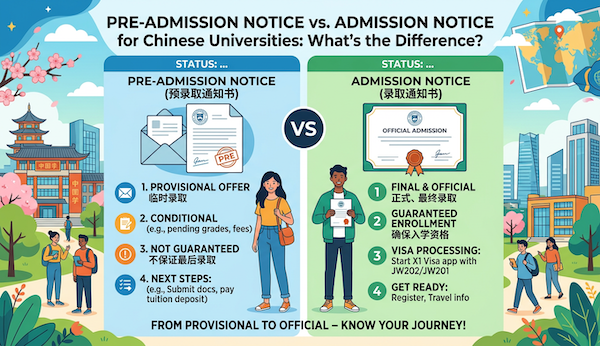
By late July, your university should have sent you three things: the Admission Notice, the JW202 form (or JW201 if you are on a CSC scholarship), and a registration guide with your reporting date. If you have not received these, email the international student office today. Summer is vacation season in Chinese universities and offices can go quiet for a week at a time. Do not wait.
The JW form is now digital in most cases. You will get an email with a download link or a PDF attachment, not a paper form in the mail. Check your spam folder. Students miss this email every year.
Once you have these documents, book your visa appointment immediately. Chinese embassies and visa centers process student applications year-round, but June through August is peak season. In 2025 and 2026, students at busy consulates (London, Islamabad, Lagos, Washington DC) reported wait times of two to four weeks for an available appointment slot, plus another four to seven business days for processing. If your flight is at the end of August, Day 30 is not early. It is almost late.
What the embassy actually checks:
- Your passport must have at least six months of validity beyond your planned entry date and at least two blank visa pages. Check both now. Passport renewal in August is a race you do not want to run.
- The name on your Admission Notice must match your passport exactly. Middle names, spelling, spaces. If your passport says “John Michael Smith” and the admission letter says “John Smith,” the visa center may reject it. Get the university to reissue the letter if there is any mismatch.
- You need a recent passport photo with a white background. The Chinese visa photo size is 33mm by 48mm, which is NOT the same as a standard US or EU passport photo. Walk into a photo shop and say “China visa photo” and they will know the size. Get eight copies. You will use them for the visa, the health form, registration, the residence permit, the library card, the campus ID, and a few other things nobody warned you about.
Some embassies now require the visa application to be submitted through the China Online Visa Application (COVA) system, then you bring the printed form to your appointment. Fill out every field. Leaving blanks is the number one reason student visa applications get returned. If a question does not apply to you, write “N/A” rather than leaving it empty.
What nobody tells you: the X1 visa in your passport is only an entry ticket. It is typically valid for 30 days from the date of issue, and it lets you enter China once. After you arrive, you must convert it into a residence permit within 30 days. Your university’s international student office handles this process, but they cannot start it until you show up. So the X1 is step one of two. Do not frame it.
Health Check, Insurance, and Where You Will Sleep (Day 21 to Day 15)
Three things to square away in this window, roughly in order of urgency.
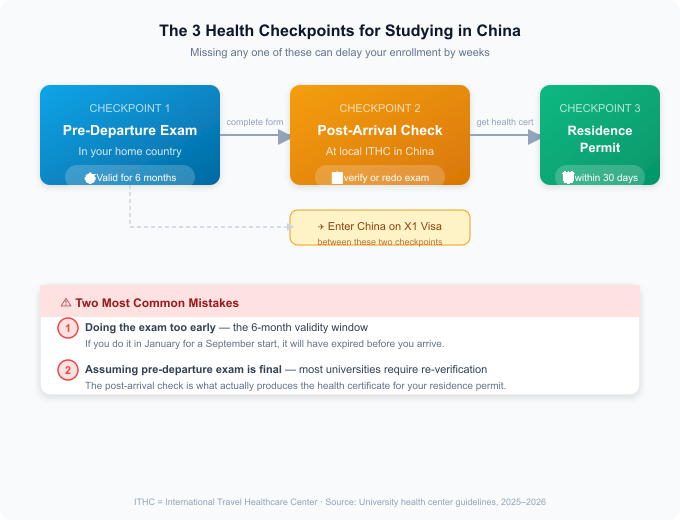
The Foreigner Physical Examination Form. This is the medical form you need for the residence permit application. It must be completed by a licensed physician, stamped by the hospital, and include lab results for the required tests (blood, chest X-ray, ECG). The form is valid for six months from the date of the doctor’s signature. If you did your medical in March for a September intake, check the date. If it expires before you apply for the residence permit, you will have to do it again in China, which costs roughly ¥400 to ¥800 and takes a full morning.
Keep the original form in your carry-on, not your checked luggage. Scan it. Email the scan to yourself. You will need the original for the residence permit application after arrival, and a lost form means a repeat exam.
Health insurance. International students in China are legally required to hold comprehensive medical insurance that meets the Ministry of Education standard. Most universities enroll you in an approved group plan during registration, typically costing ¥400 per semester or ¥800 per year. This is not optional. You cannot register without it. If your university does not offer a plan or you want additional coverage, international providers like Ping An and China Pacific Insurance offer student plans, but confirm with your university’s international office before buying anything independently. Some schools only accept their own designated plan.
If you take prescription medication, bring enough for at least your first two months, in the original packaging, with a copy of the prescription and a doctor’s note (in English is fine). Chinese pharmacies do not honor foreign prescriptions, and you will need to see a Chinese doctor for any refill. Note down the generic name of your medication, not just the brand name, because brand names differ between countries.
Housing confirmation. If you applied for a dorm room, confirm your allocation now. Most universities assign rooms in July and notify students by email. Dorms typically allow check-in two to three days before the official registration date, not earlier. If you book a flight that arrives a week before registration, you will need a hotel for those extra days. University guesthouses on campus are often the cheapest and most convenient option for early arrivals, but they fill up in late August. Book one now if your flight arrives before the dorm opens.
If you plan to rent off-campus, do not sign a lease from abroad without seeing the apartment. Too many students have arrived to find the photos were from three years ago and the landlord has a different idea of “furnished” than you do. Book a hotel or guesthouse for your first week, then apartment-hunt in person. Apps like Ziroom (自如) and Beike (贝壳找房) are the most reliable platforms for foreigner-friendly rentals, but they require a Chinese phone number to verify your account, so you cannot use them until you land.
The Digital Survival Kit (Day 14 to Day 8)
This is the week that separates a smooth arrival from a panic-filled first 48 hours. Everything in this section must be done at home, on your home Wi-Fi, because several of these websites and app stores are blocked inside China.
VPN: install now, test now. Gmail, Google Drive, WhatsApp, Instagram, YouTube, Google Maps, ChatGPT, and most Western news sites do not work in China without a VPN. The websites of VPN providers themselves are blocked inside China, so you cannot download a VPN app after you land. Install it on every device you will bring: phone, laptop, tablet. Test it at home. Connect to a server in Tokyo, Singapore, or Los Angeles and confirm you can reach google.com. If it works at home, it will probably work in China. If you wait until the airport, you have already lost.
Paid VPNs with a track record of working in China include Astrill, ExpressVPN, and LetsVPN. Free VPNs are generally blocked and unreliable. Do not count on a free option. Budget roughly $10 to $15 per month for a reliable service. Subscribe for at least one month before departure so you are not scrambling to renew during your first week of classes.
Alipay and WeChat: set up before you board. China runs on mobile payment. Cash is accepted but increasingly rare, and foreign credit cards are not accepted at most restaurants, shops, and campus facilities. You need Alipay or WeChat Pay working on your phone before you land.
Both apps now let foreigners link an international Visa or Mastercard directly. Here is the order that works:
- Download Alipay from your home App Store or Google Play. Set the app language to English during setup.
- Register with your home phone number. SMS verification works internationally.
- Complete identity verification: scan your passport and take a selfie. As of 2026, this process is automated and takes about 10 minutes. You will get a confirmation within the app.
- Add your card: go to Me, then Bank Cards, then tap the plus icon. Link your Visa or Mastercard.
- Test it. Scan any QR code at home. The payment will not go through because you are not in China, but if you see the payment screen appear, the setup is working.
Key numbers to know: Alipay 2026 limits for verified foreign users. Single transaction: up to ¥35,000. Annual limit: $50,000. Fee structure: 0% on transactions under ¥200, 3% on transactions over ¥200. Small purchases (meals, groceries, bus fare) cost nothing extra. Large purchases (tuition, rent, a new laptop) get a 3% surcharge. For those, consider transferring money to a Chinese bank account once you open one, which eliminates the foreign card fee entirely.
WeChat Pay works similarly but has lower limits: roughly ¥5,000 to ¥6,000 per transaction. New users who link an international card in 2026 get 90 days of zero fees on all transactions, a promotion valid through December 31, 2026. Use WeChat Pay for daily purchases during your first three months and save the fees.
Set up both apps. If one fails or your card gets flagged, you have a backup.
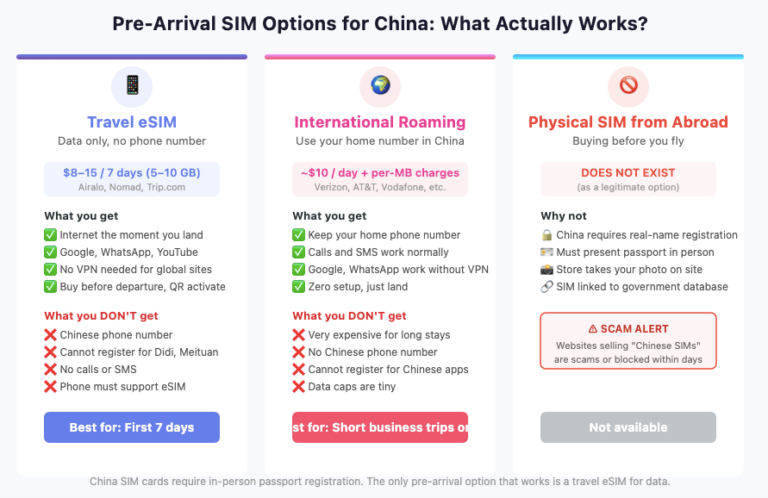
SIM card and phone number. A Chinese phone number is not optional. Many apps require a Chinese number for SMS verification, including food delivery (Meituan), ride-hailing (DiDi), and some university portals. You have three options:
- eSIM before departure: Services like Airalo and Holafly sell China eSIM plans for $15 to $30 (7 to 15 days). Activate on landing. Some eSIMs route data through Hong Kong, which means no Great Firewall, so Google and WhatsApp work without VPN. The catch: eSIMs are data-only in most cases. You do not get a real Chinese phone number, so you cannot verify apps that require SMS. Good for the first week, not a long-term solution.
- Airport SIM on arrival: China Mobile, China Unicom, and China Telecom kiosks at major airports sell SIM cards to foreigners. Bring your passport. A basic plan with 10 to 20GB of data costs roughly ¥100 to ¥200 per month. You walk out with a working Chinese number.
- International roaming: Your home carrier plan may work in China, but it is expensive ($10 to $15 per day) and your data still passes through the Great Firewall on most carriers. Good as an emergency backup, not a daily driver.
The best approach: buy an eSIM for your first week so you have internet the moment you land, then get a local SIM at the airport or a carrier store near campus within your first few days.
Packing: The Inverted List (Day 7 to Day 4)
Most packing guides tell you what to bring. This section starts with what NOT to bring, because the regrets go in both directions and the stuff you should not pack takes up more suitcase space.
Five things students consistently regret packing:
- Toiletries in bulk. Shampoo, body wash, toothpaste, deodorant, razors. Chinese cities have Watsons, Mannings, and Miniso everywhere. You can buy everything you need for a semester for under ¥200. A full-size bottle of shampoo takes up the space of two textbooks. Do not waste the weight allowance.
- Bedding. Most dorms provide a basic bedding set (sheets, pillow, thin quilt) or sell one at check-in for ¥100 to ¥300. Your home bedding will not fit Chinese dorm beds, which are typically 90cm by 190cm for a single. If you absolutely must bring something, bring a pillowcase from home for comfort, not the pillow itself.
- A voltage converter. Nearly all modern electronics (phone chargers, laptop chargers, camera battery packs) handle 110V to 240V automatically. Read the label on your charger. If it says “Input: 100-240V,” you only need a plug adapter, not a converter. A universal travel adapter costs $10 and weighs 50 grams. A voltage converter costs $30 and weighs two kilograms.
- Too many “nice” outfits. You will walk more in your first week on a Chinese campus than you walked in the previous month at home. Campus life is casual. Two or three presentable outfits for formal events are plenty. The rest of your suitcase should be comfortable walking clothes.
- Physical books. A single textbook can weigh over a kilogram. You will find digital versions of most titles, and Chinese university libraries stock international textbooks. If there is one book you genuinely cannot live without, bring it. Otherwise, the weight is not worth it.
Five things students consistently wish they had packed:
- Deodorant and antiperspirant (the kind you use at home). Chinese drugstores sell roll-on deodorant, but stick and spray antiperspirants in Western brands are hard to find outside of expat grocery stores in Shanghai and Beijing. If you have a brand you like, bring a supply for your first semester. This topic comes up on every single international student forum about China. It is not a joke. It is the number one regretted item across Reddit and WeChat groups.
- A power bank (10,000mAh or larger). Your phone is your wallet, map, translator, and camera. It dies faster in China because constant VPN use drains battery. Carry a power bank. Look for the CCC certification mark on the label, which is required for all power banks sold in China. Uncertified ones can be confiscated at airport security.
- A small supply of over-the-counter medicine you trust. Ibuprofen, antihistamines, cold medicine, anti-diarrheal. Chinese pharmacies stock local equivalents, but the brands and dosages are different and the packaging is entirely in Chinese. When you have a fever at 2 AM during your first week, you do not want to be translating drug labels. Bring a small kit for the first two months.
- Comfortable walking shoes that are already broken in. Do not buy new shoes for the trip and pack them unworn. Chinese university campuses are large (a single campus can span 200+ hectares), and your first week will involve multiple trips between the registration office, the dorm, the bank, the police station, and the体检中心 (medical exam center). Students routinely report walking 15,000 to 25,000 steps per day during registration week.
- A small day bag or crossbody bag. You will carry your passport, phone, power bank, tissues, hand sanitizer, and a water bottle everywhere. Pockets are not enough. A lightweight crossbody bag with anti-theft zippers keeps everything organized and accessible. Leave the large backpack for travel days.
Climate reality check. China spans five climate zones. Beijing in September is 15 to 25 degrees Celsius and dry. Guangzhou in September is 25 to 33 degrees with 80 percent humidity. Harbin in September is already dropping to single digits at night. Check your city’s monthly weather averages, not China’s. Pack for the first month, then buy what you need locally.
The document folder. Carry every original document in your hand luggage, never in checked baggage. Make two photocopies of each. Scan everything to PDF and save it to your email, Google Drive, and a USB stick. You need originals plus at least two backup formats. The full document list: passport with visa, Admission Notice, JW202 or JW201 form, Foreigner Physical Examination Form with lab reports, highest diploma and transcripts (original and notarized translations if they are not in English or Chinese), passport photos (six to eight copies), scholarship award letter (if applicable), and a printed copy of your dorm confirmation or hotel booking for the first night.
The Final Countdown (Day 3 to Day 1)
By now, your visa should be in your passport, your bags should be mostly packed, and your digital tools should be tested and working. The last three days are about tying up loose ends on both sides of the flight.
On the China side:
- Confirm your arrival date and time with your university’s international student office. Reply to their registration email. If the university offers an airport pickup service, book it now. Most schools require at least three days’ notice. The pickup is usually free but only operates on specific dates. If you miss the window, you are taking a DiDi or the metro.
- Download the DiDi app (China’s Uber equivalent, with a full English interface). Set it up with your home phone number. You will not be able to use it until you land and have internet, but having the app installed and your account created saves ten minutes of fumbling at the airport.
- Save your dorm address in Chinese characters. Not pinyin. Not English. Show the Chinese text to the taxi driver. If your university’s website does not list the Chinese address, email the international office and ask. Write it down on paper as a backup in case your phone dies.
- Download offline maps for your city. Apple Maps works in China and does not require a VPN. AMap (高德地图) is the local standard but its English interface is limited. Google Maps works with a VPN but is unreliable for public transit routes inside China. Have at least two map options.
On the home country side:
- Call your bank. Tell them you will be in China and using your card there. Do this by phone, not just through the app’s travel notification feature. Banks sometimes miss app-based travel notices, and a frozen card on day one is an avoidable crisis.
- Set up a way to receive SMS from your home number while in China. Many services (banking, government portals, two-factor authentication) send verification codes to your home number. If your home SIM will not work in China, port your number to Google Voice or a similar VoIP service before you leave, or set up call and SMS forwarding through your carrier.
- Pause or cancel subscriptions you will not use: gym, streaming services (most are blocked in China anyway), monthly delivery boxes. Redirect your physical mail to a family member’s address.
- Carry ¥1,000 to ¥2,000 in cash for your first few days. Exchange at your home bank for a better rate than the airport. Keep the cash in two separate places (wallet and bag) in case you lose one.
- Give a family member or trusted friend a copy of: your passport, visa, admission letter, flight itinerary, dorm address, and the contact information for your university’s international student office. If anything goes wrong, they know exactly where you are supposed to be and who to call.
Day 0: Airport to Campus
The flight lands. Now what.
At the airport:
- Fill out the arrival card. Most major airports now use a digital e-arrival card system. You can complete it on your phone before landing if you have in-flight Wi-Fi, or at a kiosk in the arrivals hall. You need your passport number and flight number.
- At immigration, present your passport with the X1 visa, your Admission Notice, and the JW202 or JW201 form. The officer may ask where you will study. Answer with the university name. This is routine. It takes two minutes.
- Collect your bags. If your checked luggage does not arrive, go to the baggage service counter immediately and file a report. Have your dorm address ready. They will deliver your bags to you, usually within 24 to 48 hours.
- Activate your eSIM or buy a local SIM at the airport carrier kiosk. Do this before you leave the arrivals area. You want internet before you step outside.
- Turn on your VPN. Confirm it connects. Confirm you can reach Gmail or WhatsApp.
- Withdraw cash if you need it. ATMs from ICBC, Bank of China, and China Construction Bank accept foreign Visa and Mastercard. The exchange rate is better than the currency exchange counter.
Getting to campus:
- If you booked the university pickup: follow the instructions they sent. Look for a person holding a sign with your university’s name (in Chinese and English) near the arrivals exit. Do not follow anyone who approaches you first and claims to be from the university. Official pickup staff carry university ID and will not ask for money.
- If you are taking a DiDi: open the app, set your destination to the dorm address in Chinese, and confirm. DiDi has an English interface and accepts international cards linked through Alipay. The fare from a major airport to a city-center campus typically runs ¥100 to ¥300.
- If you are taking a taxi: go to the official taxi queue outside the terminal. Do not accept rides from people approaching you inside the terminal. Show the driver your dorm address in Chinese. Taxis accept cash and Alipay. Have small bills ready.
- If you are taking the metro: most major Chinese airports are connected to the city metro system. It is the cheapest option (¥5 to ¥15) but involves navigating stations with luggage. Only recommended if you are traveling light and your university is on a metro line.
First things to do on campus:
- Go to the international student dormitory reception. Show your Admission Notice and passport. They will give you your room key, a campus map, and typically a welcome packet with registration instructions.
- Connect to the campus Wi-Fi. Your university’s IT portal usually requires your student ID number, which should be in the welcome packet or on your Admission Notice.
- Find the nearest supermarket or campus convenience store. Buy water, snacks, and basic toiletries you did not bring. You will be hungry and thirsty after the flight, and the campus canteen may not be open if you arrive outside meal hours.
- Message your family. Tell them you arrived safely. Then sleep. Registration day is tomorrow or the day after, and it is a long one.
Quick Reference: The 30-Day Summary
| Window | What to do | If you skip this |
|---|---|---|
| Day 30-22 | Apply for X1 visa. Book appointment. Check passport validity, photos, name match. | You miss your flight. No way around it. |
| Day 21-15 | Medical form, health insurance, housing confirmation. Bring prescriptions. | Repeat medical in China (¥400-800). No dorm room on arrival. |
| Day 14-8 | Install and test VPN. Set up Alipay and WeChat Pay. Arrange SIM/eSIM. | No internet access to blocked sites. Cannot pay at most places. |
| Day 7-4 | Pack light (skip bulk toiletries, bedding, books). Bring deodorant, medicine, power bank, good shoes. | Overweight luggage fees. Hunting for Western deodorant in a Chinese drugstore. |
| Day 3-1 | Confirm airport pickup. Save dorm address in Chinese. Download DiDi, offline maps. Call bank. Carry ¥1,000-2,000 cash. Give documents to family. | Stranded at the airport. Frozen bank card. Family has no idea where you are. |
| Day 0 | Fill arrival card. Immigration: passport + visa + admission notice + JW form. Activate SIM. Turn on VPN. Get to campus. Drink water. Sleep. | Confusion at immigration. No internet on landing. Walking around campus lost at midnight. |
A Note on Timing
This guide assumes a 30-day window before a late-August or early-September departure. If you are reading this with fewer than 30 days to go, do not panic. Skip to the sections that apply to your remaining time. The order of importance is: visa, documents, digital payments, packing. Everything else can be handled after arrival with a bit more stress and a bit more money.
If you are reading this with more than 30 days, congratulations. Use the extra time to learn a few Mandarin phrases: hello (你好, nǐ hǎo), thank you (谢谢, xiè xie), how much (多少钱, duō shǎo qián), and the name of your university in Chinese. You do not need fluency to arrive. But knowing how to say your university’s name in Chinese is the difference between a taxi driver nodding and a taxi driver taking you to the wrong campus.
The next 30 days will feel chaotic. That is normal. Thousands of international students go through the same process every August. Most of the stress comes from not knowing what comes next. Now you know. Work through the list in order, and by the time you step off the plane, the hard part is already behind you.
Pros and cons at a glance
| Pros | Cons |
|---|---|
| A 30-day reverse countdown removes last-minute panic. | The schedule is tight; a delayed visa or medical exam compresses everything. |
| Ticking off visa, insurance, and the digital kit early avoids day-one blockers. | You must buy insurance and book the medical before leaving, which many forget. |
| Packing the inverted list (documents and electronics first) protects what you cannot replace. | Day-0 logistics depend on setup done weeks earlier. |
Key authorities and official resources
- Campus China (CSC): Official China Scholarship Council portal for scholarships and the study-in-China system.
- CSC Application System: The official platform to submit CSC scholarship applications.
- National Immigration Administration: Rules on visas, residence permits, and temporary residence registration.
- Ministry of Education: National education regulations, degree recognition, and policy notices.
- Chinese Test (HSK): Official HSK Chinese proficiency test registration and score portal.
- China.org.cn: The official English gateway to Chinese government services and policy.
Frequently asked questions
When should I start my pre-departure checklist?
Begin about 30 days before your flight. That window covers the visa, medical exam, insurance, and the digital setup without last-minute panic.
What documents must I carry in my carry-on?
Passport, Admission Notice, JW201 or JW202, scholarship letter if any, degree certificates, and photos. Keep these on you at all times because they cannot be replaced in flight.
Do I need health insurance before I arrive in China?
Yes, you must pay the mandatory plan during registration, and some schools ask for proof earlier. Buy short-term travel insurance to cover the gap before activation.
Should I set up WeChat Pay and Alipay before flying?
Link a foreign card to both before departure so you can pay on arrival. Full features like bank transfers still need a Chinese bank account opened in your first days.
What should I pack versus buy after arrival?
Pack documents, electronics, adapters, essential medicine, and a few comfort items. Buy bedding, toiletries, and bulky winter clothing in China to save luggage weight.
What happens on arrival day (Day 0)?
You go from airport to campus, check into the dorm, get a SIM if not done, and start activating payment apps. Use the rest of day zero to rest before registration opens.