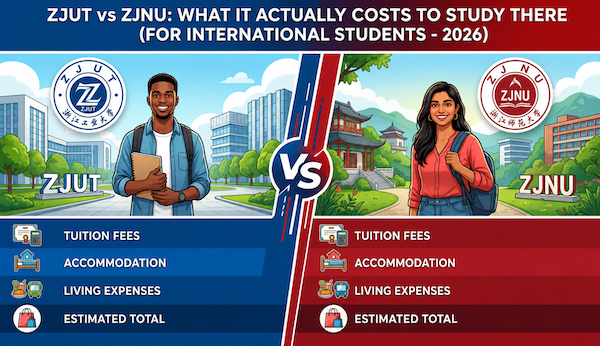
If you’re applying to Chinese universities as an international student, you’ve probably noticed something frustrating: most schools list their fees, but almost nobody tells you what the real total will be. Registration fees, insurance, visa renewals, medical checks. These add up fast, and they’re rarely grouped together in one place.
Hangzhou Dianzi University (HDU) and Zhejiang Sci-Tech University (ZSTU) are both public universities in Hangzhou. They’re roughly the same tier. Neither is a 985/211 school, but both are well-regarded provincial universities. HDU leans hard into engineering and tech (electronics, AI, computer science), while ZSTU has a broader range including arts and design programs.
Since they’re in the same city, living costs are identical. That makes this a pure apples-to-apples comparison of what the schools themselves charge.
I pulled every fee from both schools’ official 2026 international student admission pages. Here’s what you’ll actually pay.
Tuition: The biggest line item
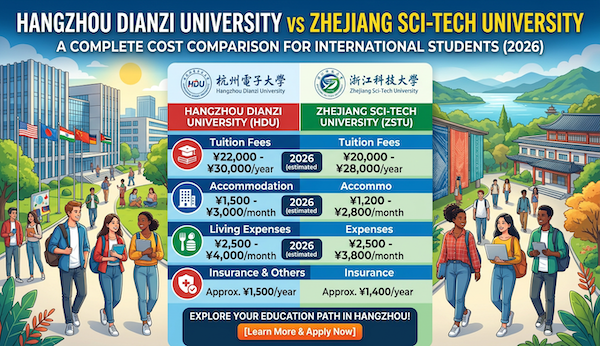
Tuition varies by program type. Here’s the side-by-side breakdown:
| Program Level | Field | HDU (¥/year) | ZSTU (¥/year) | Difference |
|---|---|---|---|---|
| Chinese Language | — | ¥14,000 | ¥14,000 | Same |
| Bachelor | Arts/Humanities | ¥18,000 | ¥15,000 | ZSTU ¥3,000 cheaper |
| Bachelor | Science/Engineering | ¥20,000 | ¥18,000 | ZSTU ¥2,000 cheaper |
| Bachelor | Art/Design | N/A | ¥22,000 | HDU doesn’t offer |
| Master | Arts/Humanities | ¥25,000 | ¥25,000 | Same |
| Master | Science/Engineering | ¥28,000 | ¥25,000 | ZSTU ¥3,000 cheaper |
| PhD | All fields | ¥30,000 | ¥30,000 | Same |
ZSTU is consistently cheaper at the bachelor and master levels for science/engineering programs. If you’re doing a bachelor’s in computer science, you’d save ¥2,000/year at ZSTU. That’s about ¥8,000 over a four-year degree, not life-changing but not nothing either.
One thing ZSTU does that HDU doesn’t: they offer per-semester and even per-week pricing for language students (¥7,000/semester or ¥610/week). That’s useful if you’re just coming for a short-term program. HDU only lists the annual rate.
ZSTU also charges by credit for students who extend past the normal graduation timeline: ¥340/credit for arts, ¥415/credit for science/engineering, ¥450/credit for art/design. HDU doesn’t publish this, which doesn’t mean it doesn’t exist, just that you’d have to ask.
Mandatory fees beyond tuition
This is where things get interesting. HDU publishes a complete list. ZSTU lists some fees but leaves others unspecified.
| Fee Item | HDU | ZSTU |
|---|---|---|
| Registration (one-time) | ¥600 | ¥300 |
| Accommodation (double room/year) | ¥5,400 | ¥5,400 |
| Insurance (per year) | ¥800 | Not specified |
| Residence permit (per time) | ¥400 | Not specified |
| Medical check (per time) | ¥460 | Not specified |
| Textbooks | Not specified | At actual cost |
HDU is more transparent here. You know exactly what you’re signing up for. ZSTU’s page says you need to buy insurance and pay for residence permits, but doesn’t tell you how much.
For ZSTU, you should budget roughly the same as HDU for insurance and visa fees: about ¥800/year for insurance and ¥400/time for residence permit renewals. These are fairly standard across Chinese universities, but it’s worth confirming with ZSTU directly.
Both schools charge ¥5,400/year for a double room. Neither lists a single room option, which means if you want privacy, you’re probably looking at off-campus housing in Hangzhou (budget ¥2,000-4,000/month for a one-bedroom near campus).
ZSTU is the only one that mentions utility costs explicitly: electricity is not included in the accommodation fee. HDU also lists water/electricity as self-paid but buries it in the “living expenses” section rather than the housing section.
First-year total: What you’ll actually pay
Let’s add it all up for a science/engineering bachelor’s student, the most common profile for international students at both schools.
| Cost Item | HDU (Sci/Eng Bachelor) | ZSTU (Sci/Eng Bachelor) |
|---|---|---|
| Registration (one-time) | ¥600 | ¥300 |
| Tuition | ¥20,000 | ¥18,000 |
| Accommodation | ¥5,400 | ¥5,400 |
| Insurance | ¥800 | ~¥800 (estimated) |
| Residence permit | ¥400 | ~¥400 (estimated) |
| Medical check | ¥460 | ~¥460 (estimated) |
| Total First Year | ¥27,660 | ¥25,360 |
The difference is about ¥2,300. That’s roughly $320 USD or €290 EUR at current exchange rates. Not massive, but enough to cover a round-trip flight within Asia.
For a master’s student in engineering:
| Cost Item | HDU (Eng Master) | ZSTU (Master) |
|---|---|---|
| Registration | ¥600 | ¥300 |
| Tuition | ¥28,000 | ¥25,000 |
| Accommodation | ¥5,400 | ¥5,400 |
| Insurance | ¥800 | ~¥800 |
| Residence permit | ¥400 | ~¥400 |
| Medical check | ¥460 | ~¥460 |
| Total First Year | ¥35,660 | ¥32,360 |
Scholarships: The wildcard that changes everything
This is where the comparison gets less straightforward.
HDU’s SONIS scholarship (for new international students) is refreshingly straightforward. There are two prize levels for degree students:
- First Prize: Covers first-year tuition and first-year accommodation. For a science/engineering bachelor’s student, that’s ¥25,400 off your ¥27,660 total. You’d only pay ¥2,260.
- Second Prize: Covers first-year tuition only. That’s ¥20,000 off, leaving ¥7,660 to pay.
The catch: this is for first year only. HDU’s page says nothing about scholarships for years 2, 3, and 4. You’d need to contact them about whether you can apply for continuing student scholarships or other external funding.
ZSTU takes the opposite approach. They list five scholarship categories: Chinese Government Scholarship, Zhejiang Provincial Government Scholarship, ZSTU President Scholarship, ZSTU New Student Scholarship, and ZSTU Current Student Scholarship. That sounds like a lot of options, but none of the amounts are published anywhere on the fee page. You just get names and a link to another page.
This doesn’t mean ZSTU’s scholarships are bad. It means you can’t compare them directly without digging deeper. The Chinese Government Scholarship (CSC) is the same across all universities and is quite competitive. Provincial and university-level scholarships vary.
For someone who can’t read Chinese and is comparing schools from abroad, HDU’s transparency is a real advantage. You know whether you can afford it before you apply.
What neither school tells you
Both fee pages share some notable gaps.
First, living costs beyond housing. Neither page estimates food, transportation, or personal expenses. In Hangzhou, a reasonable monthly budget would be ¥1,500 to ¥2,500 for food (mix of cafeteria and eating out), ¥100 to ¥200 for local transportation, and ¥300 to ¥500 for phone and data. Figure ¥2,000 to ¥3,500 a month total beyond housing, or ¥24,000 to ¥42,000 a year.
Then there’s refund policies. Zero information from either school about whether you can get your money back if your visa is denied, if you decide to transfer, or if there’s a family emergency. This matters. Chinese university refund policies can be strict, and the lack of published information means you should email both schools before committing.
Scholarship renewal is another blind spot. HDU’s SONIS is explicitly first-year only. ZSTU has a “Current Student Scholarship” but no details on amount or eligibility criteria. If you’re relying on scholarships beyond your first year, you need to get this clarified.
Payment deadlines are fuzzy too. HDU gives an application deadline (June 15) but no payment deadline. ZSTU says “before the semester starts” and includes bank account details, but no specific date.
And single room availability: both only publish double room rates. If you need a single room for medical, religious, or personal reasons, you’ll need to ask.
Payment process: ZSTU is more specific
ZSTU publishes its bank details directly on the fee page: account number, bank name, branch, and SWIFT-like code are all there. They also tell you exactly what to put in the transfer notes: your name, passport number, and nationality. You bring the transfer receipt to registration.
HDU’s page says nothing about how to pay. Given that their entire application process is online (no paper documents needed), they probably use an online payment portal after admission, but it’s not stated explicitly.
Which school makes more financial sense?
It depends on who you are.
For STEM bachelor’s students on a budget, ZSTU comes out ¥2,300 to ¥3,300 cheaper per year before scholarships. Over four years that’s roughly ¥10,000 to ¥13,000 saved. But factor in scholarships and the math changes fast. If you can land HDU’s First Prize SONIS, your first year at HDU actually costs less than ZSTU without any scholarship.
Arts and design applicants have an easy decision. HDU doesn’t offer these programs, so ZSTU is your only option between these two. ¥22,000 a year for a bachelor’s in art or design is reasonable for a Chinese university.
If cost certainty matters to you, HDU wins. You know your insurance is ¥800, your medical check is ¥460, your visa is ¥400. At ZSTU these numbers are question marks until you email someone.
Language students get the same annual rate at both schools: ¥14,000. But ZSTU gives you the option to pay by semester (¥7,000) or even by week (¥610), which matters if you’re not committing to a full year.
Scholarship potential is the hardest one to compare. HDU’s SONIS has clear numbers but only covers year one. ZSTU lists more scholarship categories but won’t tell you the amounts. You’d need to email both schools about what happens after the first year before you can make a fair comparison.
The bottom line
These two schools are surprisingly similar in total cost. Both charge ¥5,400 for housing. Tuition differences are ¥2,000-3,000/year in ZSTU’s favor. The real differentiators aren’t the numbers on the fee page. They’re the scholarships and the transparency.
HDU tells you exactly what everything costs and exactly what their scholarship covers. ZSTU costs slightly less at face value but leaves gaping holes in the fee schedule and hides scholarship amounts behind separate pages.
If I were applying, I’d email both schools with a simple request: give me a single number for total first-year cost, including every mandatory fee. The school that responds faster and clearer probably tells you something about what the next four years will be like.
Data sources: HDU International Education College 2026 Admission Guide (intedu.hdu.edu.cn) and ZSTU International Student Fee Schedule (admission.zstu.edu.cn). All figures in Chinese Yuan (RMB). Exchange rates as of May 2026: approximately ¥7.2 = $1 USD, ¥7.8 = €1 EUR.