If you’re thinking about studying in China, there’s a good chance you’ve done this: open QS or THE rankings, scroll down, and pick schools from the top.
I get it. Everyone does this. It’s the obvious starting point.
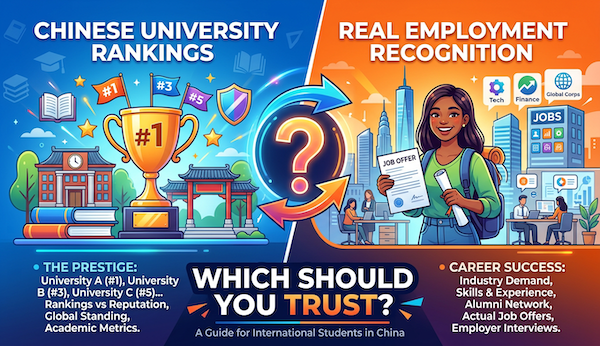
But here’s what nobody tells you: the way Chinese employers evaluate a university has almost nothing to do with QS methodology. A school ranked 30th globally won’t necessarily get you more job interviews than one ranked 150th. Sometimes the opposite is true.
This article breaks down both systems side by side. If you’re coming to China hoping to land a good job after graduation, it matters which list you look at. And which one you should probably stop staring at.
What world rankings actually measure
Let’s start with QS. The six indicators break down like this:
| Indicator | Weight |
|---|---|
| Academic Reputation (global scholar survey) | 40% |
| Citations per Faculty | 20% |
| Employer Reputation (global employer survey) | 10% |
| Faculty/Student Ratio | 10% |
| International Faculty Ratio | 5% |
| International Student Ratio | 5% |
Notice the pattern? Forty percent is just “do academics around the world know your school’s name.” Twenty percent is citations. Ten percent is employer reputation, and it’s a global survey. QS rankings are about academic influence. How many papers your professors publish, how often they’re cited, whether scholars in other countries have heard of your university. That stuff matters if you’re staying in academia. It has almost no bearing on whether a Chinese company wants to hire you.
THE rankings are similar: teaching (29.5%), research environment (29%), and research quality (30%) eat up nearly 90% of the weight. ARWU, the Shanghai Ranking, goes even harder: Nobel Prize and Fields Medal counts for alumni and faculty get 30%, and publications in top journals get 40%. These are academic metrics, start to finish.
Meanwhile, what actually runs through a Chinese HR person’s head when they scan your resume has zero to do with citation counts.
What HR actually looks at
A 2026 study by Liepin Research Institute, covering 576 employers and 187 HR professionals at China’s top 500 companies, broke down the resume screening formula like this:
| Factor | Weight |
|---|---|
| Undergraduate school tier (985/211 or overseas equivalent) | 35% |
| Internship/project experience relevance | 25% |
| Graduate school tier (QS top 50 / top 100) | 20% |
| Direct major relevance | 15% |
| Other (English, certificates, etc.) | 5% |
A few things jump out.
First, QS ranking only accounts for 20% of the screening weight. And even that 20% functions mostly as a coarse filter. The system uses it to weed out obviously unqualified resumes. Once yours passes that bar, the HR person basically stops looking at where you did your master’s. They go straight to comparing your undergrad and your internships.
Second, your undergraduate school is the heaviest knife. Liepin’s data shows that resumes from 985/211 undergrads get through at a rate 47% higher than those from non-elite undergrads. Even if you did your master’s at a QS top 50 school, if your undergrad was non-elite, your interview invitations average 42% fewer than someone with the combo of “985 undergrad plus QS top 200 master’s.”
Third, internships can save you. A non-elite undergrad with three relevant internships can hit 92% of the interview conversion rate of a 985 undergrad with zero internships. Employers aren’t buying your diploma. They’re buying proof you can do the work.
So if you’re an international student coming to China for an undergraduate degree, the last thing you should obsess over is “what’s this school’s QS ranking.” The exception: if you plan to return to your home country after graduation. Your country’s HR probably doesn’t know what 985 means. They’ll look at QS.
Four cases where ranking and recognition pull apart
Shenzhen University
Neither 985 nor 211. QS ranking hovers around 500 to 600. THE puts it beyond 600. By world ranking logic, this is a “fine but forgettable” school.
But Shenzhen University graduates entering Tencent are second only to South China University of Technology, across all Chinese universities. Huawei runs dedicated recruitment fairs at SZU every year. The average starting salary for SZU computer science grads beats many 211 schools.
The reason is simple: Shenzhen University is backed by Shenzhen. The city is home to Tencent, Huawei, DJI, BYD. And SZU is Shenzhen’s only comprehensive university. When these companies hire, they’re not thinking about QS. They’re thinking: “Can this student come to the office down the street? Can they do three days a week starting next week?”
The employment advantage of geographic location carries zero weight in the QS algorithm.
Southern University of Science and Technology (SUSTech)
Founded in 2012. QS ranking also in the 500 to 600 range. But it built a joint Advanced Computing Lab with Huawei, and students can join real Huawei project teams as early as their sophomore year. Algorithm engineer starting salaries match 985 benchmarks.
Over 70% of SUSTech’s 2024 undergraduates went on to graduate studies, nearly half of them at global top-100 universities. This school doesn’t carry the 211 label. Employers voted with their hiring.
University of Sydney vs King’s College London
This is the cleanest example I know of overseas universities being “overrated” and “underrated” in the Chinese job market. QS 2026: Sydney at #18, KCL at #40. Sydney looks way ahead.
But 2026 Liepin data tells a different story. In resume screening for Chinese securities firms and fund companies, KCL’s pass rate is about 15 percentage points higher than Sydney’s.
What explains the gap? KCL is in London. Students can intern in the City between classes. Sydney may look better on the ranking, but in the eyes of Chinese financial HR, its graduates’ “real-world readiness” doesn’t match London’s. The QS academic reputation survey won’t tell you that. The HR system’s historical hiring data will.
Xidian University
Xidian is a 211, not a 985. Its QS ranking consistently sits beyond 700. But Huawei hires more Xidian graduates than from almost any other Chinese university. Top three most years. The 2024 graduates in communications and computer science earned higher average starting salaries than many 985 comprehensive universities.
Why? Because Xidian dominates in specific fields: communications engineering, cryptography, radar signal processing. Huawei looks at the discipline, not the overall ranking.
Two students who actually did it
Numbers are one thing. What this looks like in practice is another.
Ali Yasir, Turkmenistan — hired at Shanghai Electric
Ali studied Civil Engineering at Harbin Institute of Technology, one of China’s 985 universities. When he graduated, he didn’t apply to 50 companies and hope. He focused on one thing: learning Chinese well enough that a Chinese company would take a chance on him.
He made it. He’s now working at Shanghai Electric, one of China’s largest equipment manufacturing groups. In his talk to younger international students at HIT, he put it plainly: the single skill that got him hired wasn’t his GPA. It was Chinese. Not “conversational Chinese” either — the level where you can discuss technical specifications with a client and not miss a detail.
What’s worth noticing here: Ali went to a 985 school, yes. But his resume didn’t get pulled because HIT is 985. It got pulled because he could work in Chinese, in a technical role, on projects that involved other Chinese companies. The degree label helped him get past the first filter. The language got him the job.
Marco, Russia — interning at a Harbin laser company, planning what comes next
Marco is studying Welding Technology at HIT. In the summer of 2024, he did an internship at a laser engineering company in Harbin. His role was specific: he handled technical communication with Russian clients on equipment specifications and process parameters.
He told a reporter that the experience showed him something he hadn’t seen coming. A lot of Russian companies buy equipment from Chinese manufacturers, and there’s a persistent gap in that transaction — technical communication. Someone has to explain what the machine does, in Russian, to a buyer who’s never touched one. Marco realized he could be that person. His plan after graduation: help Chinese companies expand into the Russian market.
He’s not waiting until graduation to figure out if his degree “has good employment recognition.” He’s already using his position — Russian who studied welding in China — to do work that Chinese companies need done.
Both of these students went to a top-tier university, yes. But neither of them got where they are because of a ranking number. Ali is employed because he speaks the language of the company’s clients. Marcos is building a career path that only exists at the intersection of two countries and one skill set.
That’s what “employment recognition” actually means. Not a number on a website.
Double First-Class vs QS: which map is closer to reality?
A distinction that gets missed a lot.
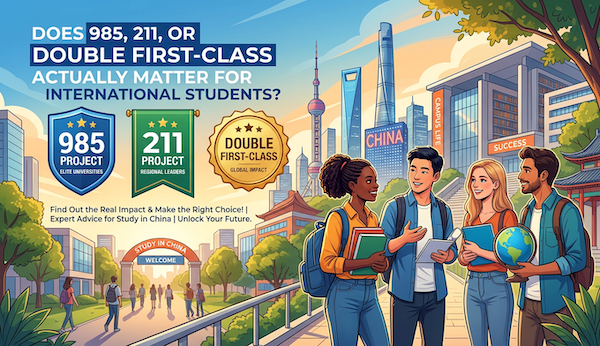
QS evaluates entire universities: overall reputation, research output, internationalization. The Double First-Class initiative evaluates at two levels: the university and the discipline. And it re-evaluates every five years. If your discipline slips, you’re out.
For Chinese employers, Double First-Class is actually more useful than QS:
- A chip company hiring engineers checks whether your school has a Double First-Class “Integrated Circuit Science and Engineering” program. They don’t check your school’s QS ranking.
- A financial firm hiring quantitative analysts looks for grads from CUFE, SUFE, or UIBE. All three are 211, not 985. Their QS rankings aren’t impressive. But in finance recruitment, they’re hard currency.
- If a university has a Double First-Class discipline but a low QS ranking, it doesn’t hurt employer perception in that specific field at all.
QS rankings are signals built for an international audience. Double First-Class and 985/211 are signals built for Chinese employers. Which track you’re on determines which list you read.
A decision guide: pick your goal, read the right list
| Your goal | Look at this | Why |
|---|---|---|
| Work in China after graduation | 985/211 > Double First-Class discipline > city > QS | Chinese HR recognizes this system, not QS |
| Return to your home country | QS / THE > school reputation | Your country’s HR probably doesn’t know what 985 means |
| PhD / academic career | Advisor resources > Double First-Class discipline > QS subject ranking | Academia cares about papers and advisors, not employer surveys |
| Learn Chinese / short-term stay | City > cost of living > international student services | Rankings have nothing to do with your goal |
| Not sure yet | Pick a school with strong Double First-Class disciplines, also check QS | Keeps both paths open |
One practical move: if you already know which industry you want to enter, go look up that industry’s target school list for campus recruiting. Huawei, Tencent, and Alibaba all publish their target school lists on their career sites. That list matters more than any world ranking, because it’s backed by actual recruitment budgets. Real money went into deciding which schools are on it.
Bottom line
World university rankings are a common yardstick. Their biggest value: a student in India and a student in Brazil can compare Tsinghua and the University of Tokyo on the same scale. They let you compare schools when every country uses a different system. That’s actually useful.
But employment recognition inside China runs on a completely different engine. It’s local, experience-driven, and brutally practical. It doesn’t care how many international students your school has. It cares about one thing: “Was the last person we hired from your school any good at their job?”
If you’re coming to China to find a good job, the time you spend scrolling QS would be better spent scrolling through target school lists and course catalogs.
The ranking numbers can be pretty. But an HR person’s mouse wheel won’t scroll an extra second for them.