You just landed at Beijing Capital Airport. You pull out your phone. No signal. You look for the airport Wi-Fi. It asks for a Chinese phone number to send a verification code. You have no Chinese phone number. You try to order a Didi to your university. You have no WeChat Pay. You try to use cash. The taxi driver does not have change.
This is not a worst-case scenario. This happens to thousands of international students every September.
The problem is a chicken-and-egg loop:
- You need a Chinese phone number to open a bank account.
- You need a bank account to use WeChat Pay and Alipay.
- You need WeChat Pay and Alipay to function in daily Chinese life.
- And you cannot get a real Chinese phone number until you are physically standing in China with your passport.
So the real question is not “before or after.” It is what to do before, what to do after, and in what order.
This guide walks you through exactly that.
1. The one-minute decision framework
Here is the short answer. If you remember nothing else, remember this table.
| Item | Get it before flying? | Get it after landing? | Best strategy |
|---|---|---|---|
| eSIM (data only) | ✅ Yes, buy 1 week before | You can, but pointless by then | Buy a 7-day plan before departure |
| Physical Chinese SIM | ❌ Not possible | ✅ Day 1 after landing | Airport counter (fast, expensive) or city store (cheaper) |
| Bank account | ❌ Nearly impossible | ✅ Days 3-5 after landing | After you have SIM + residence registration |
| WeChat / Alipay app | ✅ Yes, download before flying | You can, but need VPN in China | Download before departure |
The core insight: you cannot skip the “after arrival” part. Chinese law requires real-name registration with a passport in person for both SIM cards and bank accounts. There is no workaround. The only thing you control is how smooth or painful the process feels.
2. Option A: Getting a SIM before you fly
There are three things people mean when they say “get a Chinese SIM before I go.” Two of them work. One does not.
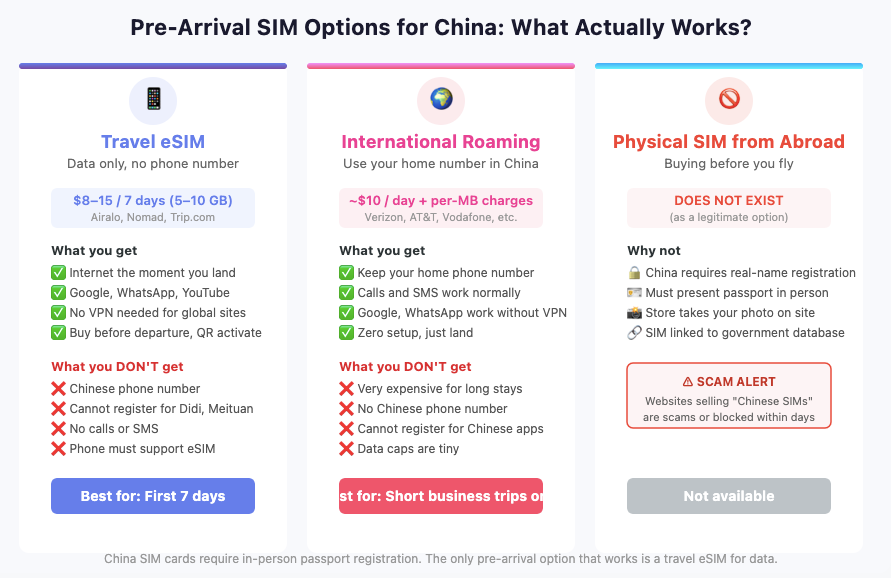
What works: International roaming from your home carrier
If your home carrier offers international roaming in China, you can use your existing number. You land with data and calls.
The catch: it is expensive. American carriers like Verizon and AT&T charge roughly 10perday.ManyEuropeancarriersarenotmuchbetter.Somechargepermegabyte,andasinglevideocallcancostyou40.
It works. It is just not a solution for a student who will be in China for two to four years.
What works: Travel eSIM (data only)
This is the smart move for your first week in China.
Companies like Airalo, Nomad, Holafly, and Trip.com sell China travel eSIMs that you buy online before departure. You scan a QR code, the eSIM activates when you land, and you have internet immediately.
A 7-day plan with 5-10 GB costs about 8−15.Comparethatto70 for a week of international roaming.
What it gives you:
- Internet the moment you land
- Access to Google, Gmail, YouTube, WhatsApp, Instagram without a VPN
- The ability to message your family that you arrived safely
What it does NOT give you:
- A Chinese phone number
- The ability to register for Didi, Meituan, 12306, or any Chinese app that requires SMS verification
- Calls or SMS to Chinese numbers
The travel eSIM is a bridge. It gets you across the first 24-72 hours. It is not a replacement for a real Chinese SIM.
What does NOT work: Getting a physical Chinese SIM from overseas
You cannot do this. Period.
China requires real-name registration for all SIM cards. You must present your passport in person at a carrier store. The store scans your passport, takes your photo, and registers the SIM to your identity in a government database.
Websites that claim to sell you a Chinese SIM card before you travel are either scams, or they are selling you a card registered to someone else’s identity, which will get blocked within days.
Do not waste your money on this.
3. Option B: Getting a Chinese SIM after you land
This is the part you cannot avoid. The question is where and how.
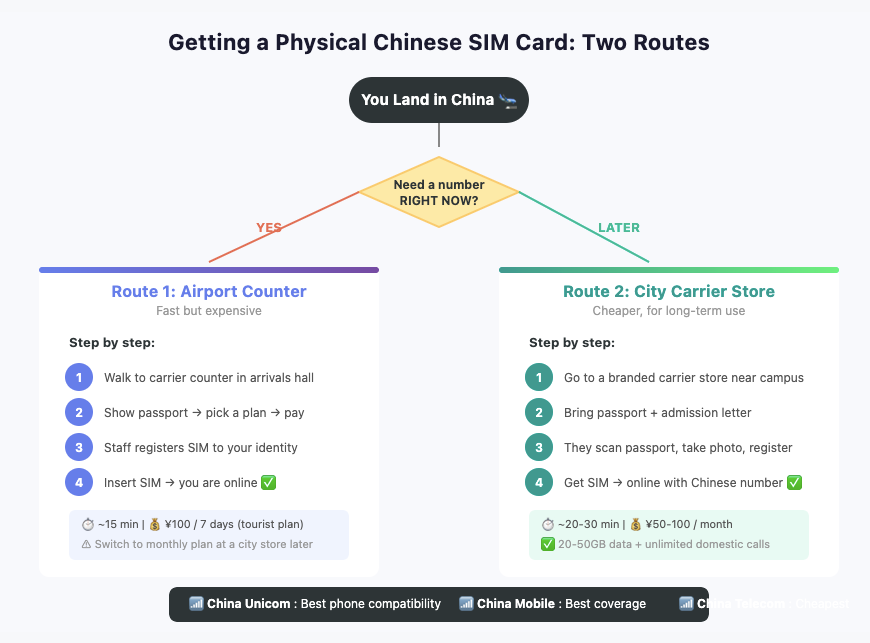
Route 1: Airport carrier counter (fast but costs more)
All major Chinese airports (Beijing Capital, Beijing Daxing, Shanghai Pudong, Guangzhou Baiyun, Chengdu Tianfu) have counters for the three state-owned carriers: China Mobile, China Unicom, and China Telecom.
You walk up, hand over your passport, pick a plan, pay, and walk out with a working Chinese SIM in 15 minutes. Staff at major airport counters usually speak enough English to get through the transaction.
The downside: airport plans are short-term tourist plans. A typical package is around 100 RMB for 7 days with 30 GB data and 100 minutes of domestic calls. After 7 days, you need to go to a city store to switch to a monthly plan anyway.
Airport SIMs are good if:
- Your university is far from the airport and you need immediate connectivity
- You arrive late at night and cannot go to a city store until the next day
- You just want the fastest possible solution
Route 2: City carrier store (cheaper, for long-term use)
This is what you want for your actual student life in China. Go to a major China Mobile, China Unicom, or China Telecom store near your university. Not a tiny roadside phone shop, not a convenience store counter. A proper branded store.
What you need:
- Your passport (valid, with student visa or residence permit)
- Your university admission letter (some stores ask for it)
- About 50-100 RMB for the first month
The process takes about 15-30 minutes. They scan your passport, take a photo, register your identity, and hand you a SIM card. You insert it and you are online.
Monthly student plans typically cost 50-100 RMB ($7-14) and include:
- 20-50 GB of 4G/5G data
- Unlimited domestic calls
- Some international calling minutes (varies by plan)
Which carrier should you pick?
| Carrier | Best for | Why |
|---|---|---|
| China Unicom | Most international students | Best compatibility with imported phones. Strong 5G in cities. |
| China Mobile | Students going to smaller cities or rural areas | Best nationwide coverage. Signal in places Unicom does not reach. |
| China Telecom | Students in southern China | Strongest network in Guangdong, Guangxi, Yunnan. Often cheapest plans. |
One important check before you go: visit frequencycheck.com and confirm your phone supports Chinese network bands. Some phones bought in Africa or Latin America do not support the LTE bands used by Chinese carriers. If your phone does not match, you will have no signal even with a valid SIM, and your only option is to buy a local phone.
Important: install and set up your VPN before you fly. Once you are on a Chinese SIM, Google, WhatsApp, YouTube, and Instagram are blocked. You cannot download a VPN app inside China if you do not already have one. Buy it, download it, and test it before you leave home. ExpressVPN, NordVPN, and Surfshark are the most reliable options in China as of 2026.
4. The winning strategy: why hybrid is best
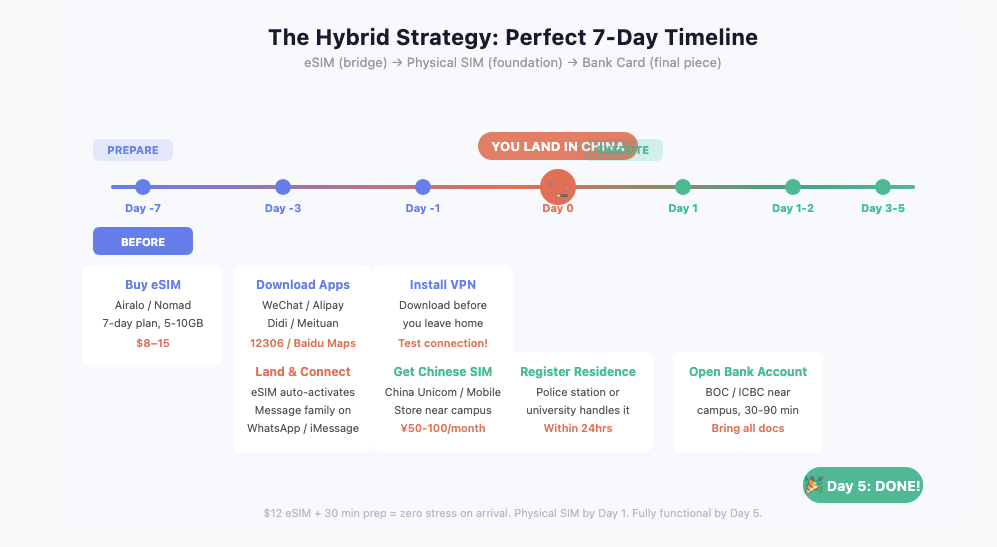
The strongest approach combines eSIM and physical SIM in a specific order. Here is the timeline:
7 days before departure: Buy a 7-day China travel eSIM from Airalo, Nomad, or Trip.com. 5-10 GB is enough for your first week. The eSIM activates automatically when you land in China.
2-3 days before departure: Download these apps while you still have access to Google Play or the App Store without a VPN:
- Alipay
- Didi (ride-hailing)
- Meituan (food delivery, hotel booking)
- 12306 (train tickets, essential if you travel between cities)
- Baidu Maps or Amap (Google Maps does not work well in China)
Also: download and test your VPN. Buy a subscription. Make sure it connects.
Day 0: Landing day Your eSIM kicks in. You have internet. Message your family. Check your university’s pickup instructions. Use Didi or ask the airport info desk to call you a taxi.
Day 1: Get your physical SIM Go to a China Unicom, China Mobile, or China Telecom store near your university. Bring your passport. Walk out with a Chinese phone number.
Day 1-2: Register your residence Chinese law requires you to register your address within 24 hours of arrival. Your university usually handles this, but confirm. You need a residence registration form (临时住宿登记表) to open a bank account. Some universities provide it on day 1. Some take a few days.
Days 3-5: Open your bank account Once you have your Chinese phone number and residence registration, go to a bank branch near campus. Bring all your documents. More on this below.
5. Bank card: why you cannot get it before arrival
I will keep this short. You cannot.
Opening a Chinese bank account requires four things:
- Your passport (original, not a copy)
- A valid Chinese visa or residence permit
- A Chinese phone number (for SMS verification and mobile banking)
- A residence registration form from the local police station
Items 3 and 4 are impossible to get from outside China. Even if a bank in your home country offers a “China account pre-opening service” (ICBC has one in some countries), the account you get is restricted. You cannot link it to WeChat Pay or Alipay until you visit a branch in China anyway. And the process takes 2-4 weeks.
Skip it. Focus on getting your documents in order so you can open a real account in your first week.
6. Step by step: opening a bank account as a student
Which bank?
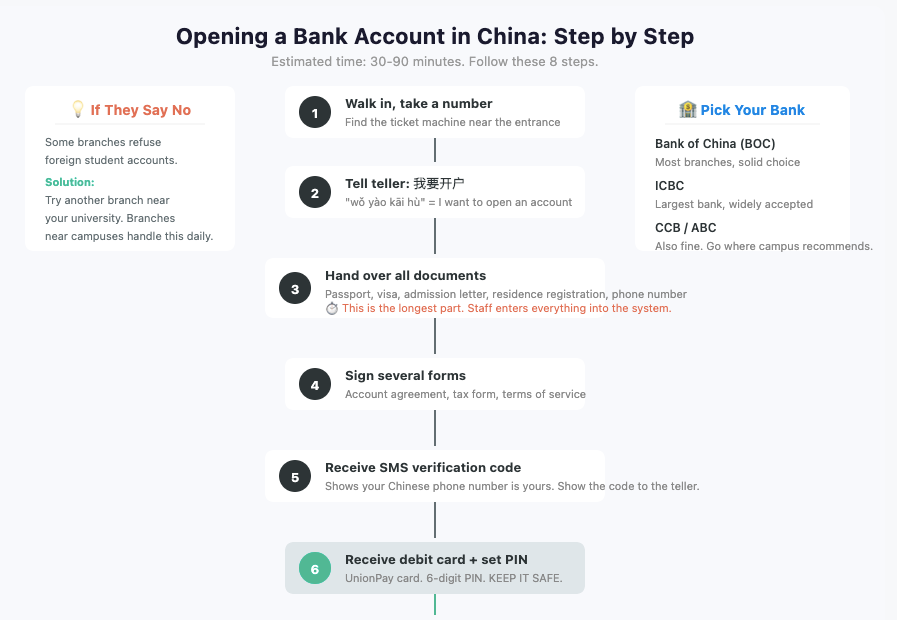
The Big Four dominate China: Bank of China (BOC), Industrial and Commercial Bank of China (ICBC), China Construction Bank (CCB), and Agricultural Bank of China (ABC).
For international students, the real deciding factor is not the bank brand. It is which branch near your university has the most experience with foreign students.
Ask your university’s international student office which branch they recommend. Some universities even have a partnership branch where the staff expect foreign students and the process is streamlined.
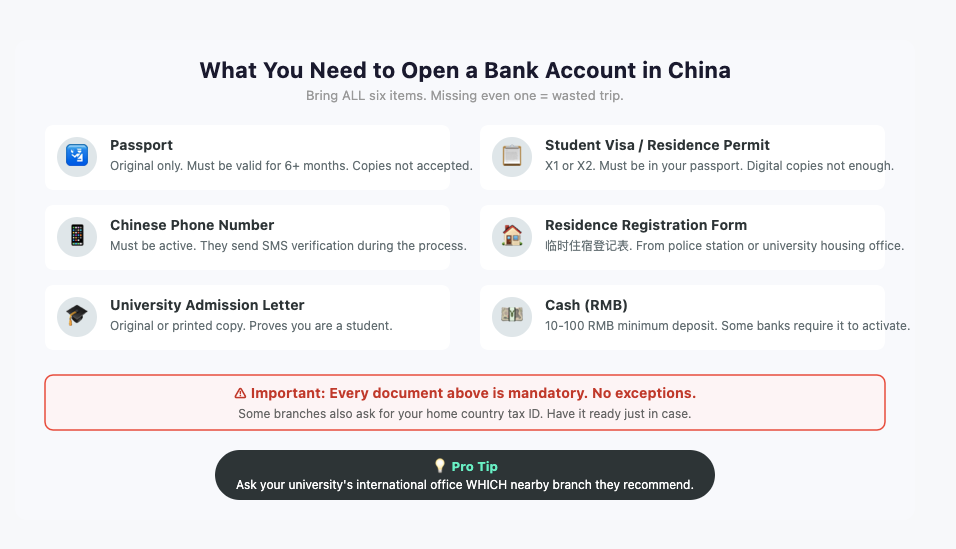
What to bring
- Passport (original, must be valid for at least 6 more months)
- Student visa or residence permit (in your passport)
- University admission letter (original or printed copy)
- Residence registration form (临时住宿登记表) from the police station or your university
- Your Chinese phone number (they will send an SMS verification during the process)
- Cash: some banks require a minimum deposit of 10-100 RMB to activate the account
The process
- Walk into the branch. Take a number from the ticket machine. Wait for your turn.
- When called, tell the teller: “我要开户” (wǒ yào kāi hù) or show them this phrase on your phone.
- They will ask for your passport and documents. Hand everything over.
- They enter your information into the system. This takes a while. They will ask you to sign several forms.
- You receive an SMS verification code on your Chinese phone number. Show it to the teller.
- They hand you a debit card (UnionPay) and help you set a 6-digit PIN.
- They help you download and activate the bank’s mobile app.
- Total time: 30-90 minutes, depending on how busy the branch is.
Common problems
“The teller said they cannot open an account for a student.”
This happens. Some branches are unfamiliar with foreign student procedures and default to “no.” Do not argue. Thank them and try another branch. Branches near universities handle this daily and will not give you trouble.
“They asked for a tax ID number from my home country.”
Chinese banks have started asking for this for compliance reasons. Have your home country’s tax ID ready (for Americans, this is your SSN; for most other countries, it is your national tax number).
“They said my visa type does not qualify.”
X1 and X2 student visas should always work. If a branch refuses, try another. If multiple branches refuse, go back to your university’s international student office and ask them to call the bank on your behalf.
7. Linking everything together: WeChat Pay and Alipay
Once you have your Chinese SIM and your bank card, you have about 5 minutes of setup left.
Open Alipay. Go to “Me” > “Bank Cards” > “Add Card.” Enter your card number. Alipay verifies it via SMS to your Chinese number. Done.
Open WeChat. Go to “Me” > “Services” > “Wallet” > “Cards” > “Add a Card.” Same process. SMS verification. Done.
Now you can:
- Scan QR codes to pay at any store, restaurant, or street vendor
- Order food delivery on Meituan
- Call a Didi
- Buy train tickets on 12306
- Pay your university fees
- Send money to friends
This is the moment where China goes from feeling foreign to feeling functional. The first 3-5 days are chaotic. After this setup, daily life gets dramatically easier.
8. Quick-reference checklists
Before you fly
- Check your phone’s compatibility with Chinese LTE bands at frequencycheck.com
- Buy a 7-day China travel eSIM (Airalo, Nomad, or Trip.com, $8-15)
- Download WeChat, Alipay, Didi, Meituan, 12306, Baidu Maps
- Download and subscribe to a VPN (ExpressVPN, NordVPN, or Surfshark)
- Test your VPN. Make sure it connects.
- Notify your home bank that you will be in China (so they do not freeze your card)
- Save your university’s international student office phone number
- Print or save offline copies of your admission letter and accommodation confirmation
After you land
- Day 0: eSIM activates. Message your family.
- Day 1: Get your physical Chinese SIM at a carrier store near campus.
- Day 1-2: Complete residence registration (your university usually handles this).
- Days 3-5: Open a bank account at a branch near campus. Bring all documents.
- Link your bank card to WeChat Pay and Alipay. Test with a small payment.
- Download 12306 for train tickets and Dianping for restaurant reviews.
- Save emergency numbers: your university, your embassy, police (110), ambulance (120).
9. Two real stories
The student who tried to figure it out on arrival
Fatima, from Nigeria, landed at Shanghai Pudong in September 2025. She had no eSIM. She had no international roaming. Her plan was to find airport Wi-Fi and call her university pickup contact.
The airport Wi-Fi required a Chinese phone number for SMS verification. She had no phone number. She could not get one because she had no data to navigate to a carrier counter. She eventually found a kind stranger who let her use their phone hotspot.
She spent her first two hours in China standing next to a charging station in the arrivals hall, sweating, trying to reach someone, anyone, from her university.
She got through it. But she describes those two hours as the most stressful of her life.
The student who followed the hybrid strategy
Kwesi, from Ghana, arrived at Beijing Capital Airport two weeks later. Before flying, he had bought a 7-day Airalo eSIM for $12 and downloaded every Chinese app he needed. His VPN was installed and tested.
He landed. His phone connected immediately. He messaged his family on WhatsApp: “Landed safe. Everything is fine.” He found his university’s pickup desk using Baidu Maps. He got to his dorm without a single moment of panic.
On day 1, he walked to a China Unicom store near campus. 20 minutes later he had a Chinese SIM. On day 3, his residence registration came through. He opened a Bank of China account that afternoon. By day 4, he was scanning QR codes to pay for bubble tea like he had lived in Beijing for years.
The difference between these two experiences was about $12 and 30 minutes of preparation.
Practice the Chinese you just read
Paste any sentence from this guide into the tool below to see pinyin above each character and an English meaning for every word. Useful when you are facing real forms, notices, or WeChat messages.