12 hidden costs of studying in China that nobody warns you about
You got your admission letter. You paid your tuition. You booked your flight. You think the big spending is over. It is not. Between the day you land and the day you graduate, a steady stream of small and medium expenses will chip away at your budget. Some are mandatory legal requirements. Others are practical necessities that university brochures never mention.
This article breaks down 12 categories of hidden costs that international students in China actually face, based on fee schedules from Tsinghua University, Peking University, Fudan University, and USTC, plus real student reports from 2024 to 2026.

1. Residence permit fee: RMB 400-1,000 per year
Every international student staying in China for more than six months must convert their X1 visa into a residence permit. This is not optional. The fee, set by the National Immigration Administration, varies by permit duration:
| Permit duration | Fee | When you pay |
|---|---|---|
| Under 1 year | RMB 400 | First-year arrival |
| 1-3 years | RMB 800 | Renewal during studies |
| 3-5 years | RMB 1,000 | Long-term programs (PhD) |
You pay this every time you renew. A four-year bachelor student will pay at least RMB 400 four times. Some universities collect the fee on your behalf. Others send you to the Entry-Exit Administration Bureau to pay in person.
Budget for it: Add RMB 800 per year to your annual cost estimate. If you are doing a PhD and get a 3-year permit, you pay RMB 1,000 once, which works out cheaper per year.
2. Medical exam: RMB 400-600
The medical examination for foreigners is a one-time requirement for your first residence permit. The fee ranges from RMB 400 at university-affiliated hospitals to RMB 600 at independent International Travel Healthcare Centers. The exam includes blood tests (HIV, syphilis, hepatitis), chest X-ray, ECG, and general physical check.
If your university does not arrange the exam during orientation week, you will need to go to the local International Travel Healthcare Center yourself. Bring your passport, admission notice, and four passport-size photos. Results typically take 3-5 working days.
If you had a medical exam in your home country: Some universities accept foreign medical exams if they are notarized and authenticated. But the Chinese hospital may still require you to redo certain tests, especially blood work. Budget for the full exam to be safe.
3. Insurance coverage gaps: RMB 300-2,000+ per visit
International students are required to buy Ping An Insurance for International Students in China or an equivalent. The standard plan costs around RMB 600-800 per year and covers inpatient hospitalization and basic outpatient visits. But here is what it does not cover:
| Not covered | Typical out-of-pocket cost |
|---|---|
| Dental work (fillings, root canals, extraction) | RMB 200-2,000+ per visit |
| Vision (glasses, contacts, eye exams) | RMB 150-800 |
| Mental health counseling | RMB 300-600 per session |
| Prescription medication (non-hospital) | RMB 50-300 per prescription |
| Traditional Chinese Medicine (TCM) | RMB 100-500 per visit |
A Reddit user studying at a Shanghai university reported paying RMB 1,800 out of pocket for a root canal because the student insurance only covers dental emergencies, not routine dental work. Another student at PKU paid RMB 450 for glasses at a local optician.
Biggest surprise: Mental health. If you need counseling or therapy, most university clinics offer limited sessions in Chinese only. Private English-speaking therapists in Beijing and Shanghai charge RMB 500-1,000 per session, none covered by student insurance.
4. Utilities and internet: RMB 80-350 per month
University dormitories often include water and electricity up to a quota. Once you exceed the quota, you pay per unit. Off-campus apartments bill you directly.
| Utility | Dorm (included/quota) | Off-campus |
|---|---|---|
| Electricity | Free up to quota, then RMB 0.6/kWh | RMB 100-200/month |
| Water | Usually free | RMB 30-60/month |
| Gas (cooking/heating) | Rarely applicable | RMB 30-80/month |
| Campus WiFi | Free | N/A |
| Home broadband | N/A | RMB 50-100/month |
| Mobile data | RMB 20-50/month (China Mobile/Unicom) | Same |
Students in northern cities like Beijing and Harbin face higher winter heating costs if living off-campus. Central heating is billed annually at RMB 2,000-3,500 for a typical apartment, usually split across the building.
5. Books and materials: RMB 1,450-3,600 per year
Textbook costs vary wildly by major. Language students spend RMB 100-300 per textbook (HSK Standard Course, Boya Chinese, etc.). Engineering and medical students may need multiple specialized textbooks at RMB 200-500 each.
Beyond textbooks, you will encounter:
- Printing and photocopying: RMB 0.1-0.5 per page. A semester’s worth of handouts and assignments adds up to RMB 100-200
- Lab fees and materials: RMB 200-800 per semester for science and engineering students
- Software licenses: Some programs require paid software (SPSS, MATLAB, Adobe) that may not be covered by university licenses
- Graduation thesis binding: RMB 50-100 per copy, typically need 3-5 copies
Money-saving tip: Many universities have secondhand book markets on campus where seniors sell their textbooks at 30-50% of the original price. Check Taobao and Kongfz (孔夫子旧书网) for used books before buying new.
6. Campus card deposit: RMB 20-50
This is a small one, but it catches students off guard. Your university campus card (used for cafeteria, library, gym, and building access) requires a deposit. The amount varies by school. Tsinghua charges RMB 20, PKU charges RMB 30, and some private universities charge up to RMB 50.
The deposit is refundable when you return the card at graduation. But you also need to pre-load the card with spending money. Most students top up RMB 100-200 at a time.
7. Security deposit for off-campus housing: RMB 1,000-3,000
If you move out of the dormitory, you will need to pay a security deposit equal to one or two months’ rent. For a RMB 2,000/month room, that is RMB 2,000-4,000 tied up until you move out.
The deposit is theoretically refundable, but disputes are common. Landlords may deduct for “damages” that were pre-existing. Always take photos of the room on move-in day and document every scratch.
Additional off-campus costs: Property management fee (物业费) RMB 50-200/month, sometimes included in rent. Heating fee RMB 2,000-3,500/year in northern China. Internet installation RMB 100-200 one-time.
8. Graduation fees: RMB 360+ per certificate
When you graduate, you need official documents for your next step. Each university charges for these:
| Document | Typical fee | How many you need |
|---|---|---|
| Transcript (official, sealed) | RMB 20-50/copy | 3-5 copies |
| Diploma copy (notarized) | RMB 100-200/copy | 2-3 copies |
| Degree certificate copy | RMB 100-200/copy | 2-3 copies |
| Translation of diploma | RMB 100-300 | 1-2 copies |
| Notarization and authentication | RMB 300-600 | 1 set |
| Certificate of enrollment (for visa/job) | RMB 20-50/copy | 2-3 copies |
If you need documents authenticated by your embassy or the Chinese Ministry of Foreign Affairs, add another RMB 200-500. Students applying to Western graduate schools often spend RMB 800-1,200 on document preparation alone.
9. Emergency fund: RMB 1,000-15,000+
This is the category nobody plans for, but everybody uses. Common emergencies include:
- Lost or stolen phone: RMB 1,000-4,000 for a replacement
- Medical emergency (uncovered by insurance): RMB 500-5,000
- Urgent travel home (family emergency): RMB 3,000-15,000 for a flight
- Replacement of lost passport: RMB 200-500 plus travel to your embassy
- Bike theft: RMB 200-800 for a new e-bike or bicycle
- Broken laptop or tablet: RMB 2,000-8,000
Recommendation: Keep at least RMB 5,000 in a separate savings account that you never touch. If you have a credit card from your home country, keep it active as a backup payment method. Chinese hospitals require payment before treatment for non-emergency cases.
10. Visa and travel costs: RMB 1,000-5,000+
If you need to renew your visa or apply for a new one during your studies, you may need to travel to Hong Kong or your home country. A round-trip flight to Hong Kong from Beijing costs RMB 1,500-3,000. Hotel and food add another RMB 500-1,000.
Other visa-related expenses:
- Visa application fee: RMB 150-800 depending on type and nationality
- Express processing: RMB 150-300 extra
- Passport photos: RMB 30-60 per set
- Travel to embassy/consulate (if not in your city): RMB 200-1,000
11. Social and gift costs: RMB 100-500 per festival
Chinese social culture involves gift-giving during festivals, birthdays, and special occasions. You are not expected to give expensive gifts, but showing up empty-handed to a Chinese friend’s birthday or a professor’s holiday gathering is awkward.
- Chinese New Year: RMB 100-200 for small gifts or red packets (if invited to a Chinese family)
- Mid-Autumn Festival: RMB 50-150 for mooncake boxes
- Roommate or classmate birthdays: RMB 50-100 per person
- Professor gifts: RMB 50-200 (small items like fruit baskets or tea, never cash)
- Wedding red packet (if invited): RMB 200-1,000 depending on closeness
Cultural note: Never give a clock (钟, sounds like “end”) or green hat (implies infidelity). Avoid giving anything in sets of four (四, sounds like “death”). Red envelopes should contain even amounts, never odd. These small cultural mistakes can cost you social capital.
12. VPN and communication: RMB 300-1,000 per year
China’s internet does not provide direct access to Google, YouTube, Instagram, WhatsApp, and many other services international students rely on. A reliable VPN is essential, and free VPNs are unreliable and often blocked.
- Paid VPN service: RMB 200-600/year (ExpressVPN, Astrill, LetsVPN are popular among students)
- International calling (if not using WeChat): RMB 100-300/year
- Home country SIM card (kept active for OTP verification): RMB 100-200/year
VPN prices spike during politically sensitive periods (March, October, December) when the Great Firewall tightens. Have a backup VPN ready.
Your first week: how much cash to bring

When you arrive in China, your bank account and Alipay will not be ready for 1-2 weeks. During that window, you need cash. The China Daily and university orientation guides recommend arriving with at least RMB 3,500-5,000 in cash.
Bring clean, untorn foreign currency and exchange it at the airport or a Bank of China branch. ATMs accept international cards but may charge RMB 20-50 per withdrawal plus your home bank’s fees.
The total picture
Add it all up, and you are looking at RMB 5,000-12,000 per year in costs that are not included in your tuition quote. Here is a summary for a typical four-year undergraduate student:
| Cost category | Annual estimate | 4-year total |
|---|---|---|
| Residence permit | RMB 400-800 | RMB 1,600-3,200 |
| Medical exam (year 1 only) | RMB 400-600 | RMB 400-600 |
| Insurance gaps | RMB 500-2,000 | RMB 2,000-8,000 |
| Utilities and internet | RMB 960-4,200 | RMB 3,840-16,800 |
| Books and materials | RMB 1,450-3,600 | RMB 5,800-14,400 |
| Campus card deposit | RMB 20-50 | RMB 20-50 (refundable) |
| Security deposit (if off-campus) | RMB 0-3,000 | RMB 0-3,000 (refundable) |
| Graduation fees (year 4) | RMB 0 | RMB 360-1,200 |
| Emergency fund | RMB 1,000-3,000 | RMB 4,000-12,000 |
| Visa trips | RMB 0-2,000 | RMB 0-8,000 |
| Social gifts | RMB 500-2,000 | RMB 2,000-8,000 |
| VPN and communication | RMB 300-1,000 | RMB 1,200-4,000 |
| Total | RMB 5,030-15,650 | RMB 21,220-79,250 |
Bottom line: Budget 15-25% above your quoted tuition and housing costs. If your program costs RMB 30,000 per year, plan for RMB 34,500-37,500 per year in actual spending. If you are on a full CSC scholarship, the stipend (RMB 2,500-3,500/month) should cover most of these costs, but the insurance gaps and emergency fund are still on you.
FAQ
Can I pay these fees with a foreign credit card?
Most government offices, hospitals, and universities in China do not accept foreign credit cards. You will need Chinese cash (WeChat Pay or Alipay) for almost everything. Open a bank account and set up mobile payments within your first week. Bring enough cash to cover the first 7-10 days.
Does the CSC scholarship cover all of these hidden costs?
The CSC scholarship covers tuition, dormitory housing, comprehensive medical insurance, and a monthly stipend (RMB 2,500 for undergraduates, RMB 3,000 for master students, RMB 3,500 for PhD). It does not cover dental work, vision, mental health, VPN, social costs, or emergency expenses. The stipend is enough for daily living if you budget carefully, but unexpected costs can strain it.
How much cash should I physically carry when I arrive?
Carry the equivalent of RMB 3,500-5,000 in clean, untorn foreign currency. Exchange it at the airport or a Bank of China branch on day one. Do not rely on ATMs alone, as international card withdrawals are limited to RMB 2,000-3,000 per transaction and may fail. Also bring a backup credit card for emergencies.
Are there any fees I can skip or negotiate?
Graduation document fees can be minimized by ordering only what you need. Secondhand textbooks save 30-50%. You can skip the campus card deposit if you never leave the dorm, but that is unrealistic. Security deposits are non-negotiable. VPN costs can be shared with roommates if you use a router-based solution. The one fee you should never skip is insurance, even though gaps exist. Having no insurance at all means you pay full price for everything, including hospitalization.
What if I run out of money during the semester?
Most universities have a hardship fund or emergency loan program for international students. Ask your International Student Office. Some universities allow late tuition payment with a small penalty. If the situation is severe, contact your embassy, which may offer emergency repatriation loans. Avoid borrowing from informal lenders, as interest rates can be predatory.
Is it cheaper to live on-campus or off-campus when you factor in all hidden costs?
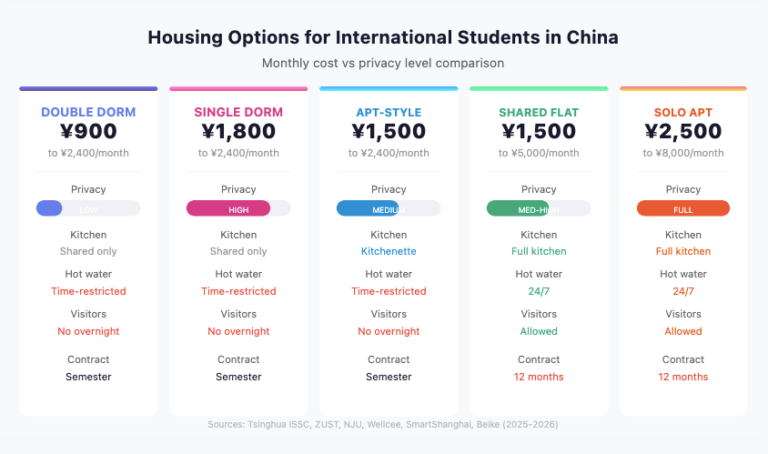
On-campus is almost always cheaper when you factor in all costs. Dormitory rent (RMB 400-1,000/month) includes utilities up to a quota, WiFi, and no security deposit. Off-campus rent (RMB 1,500-4,000/month) plus utilities, internet, security deposit, and commute costs typically totals RMB 2,500-5,000/month. The main reason to go off-campus is space and privacy, not savings.
Pros and cons at a glance
| Pros | Cons |
|---|---|
| Knowing the 12 cost lines lets you budget the real yearly total. | Residence permit, medical exam, and insurance add several thousand RMB on top of tuition. |
| An emergency fund plan prevents the cash crunch most students hit. | Security deposits and graduation fees are easy to forget until charged. |
| You can cut some costs (VPN, gifts, dorm deposit) with advance planning. | Unexpected items (social gifts, visa-run travel) strain a thin budget. |
Key authorities and official resources
- Campus China (CSC): Official China Scholarship Council portal for scholarships and the study-in-China system.
- CSC Application System: The official platform to submit CSC scholarship applications.
- National Immigration Administration: Rules on visas, residence permits, and temporary residence registration.
- Ministry of Education: National education regulations, degree recognition, and policy notices.
- Chinese Test (HSK): Official HSK Chinese proficiency test registration and score portal.
- China.org.cn: The official English gateway to Chinese government services and policy.