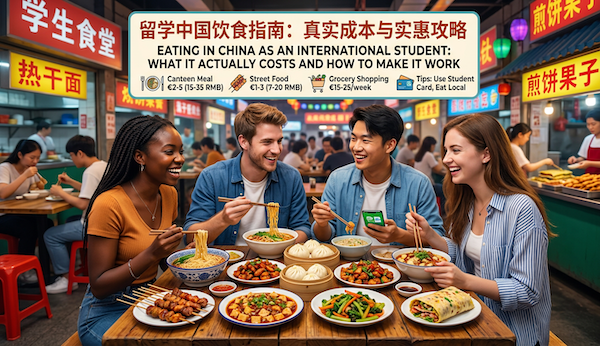
Here are the three numbers that define almost every international student’s relationship with food in China:
- A canteen lunch: ¥8–15
- A Meituan delivery order: ¥20–40
- A week of home-cooked groceries: ¥100–180
The question is not which option is “best.” The question is which combination you will actually stick with, given your dorm setup, how many hours you spend in class, and how much money you realistically have.
This guide gives you the numbers, the trade-offs, and the stuff nobody warns you about. No case studies, no “one weird trick” — just what works and what does not.
The canteen: your cheapest, most reliable option
Every Chinese university has at least one canteen (食堂). Large ones have three to five buildings spread across campus. Peking University’s canteen system reportedly serves over 40,000 meals a day. This is not a dining hall in the Western sense — no set meal, no buffet line, no assigned seating. It is closer to a food court: multiple counters, each run by a different vendor. You walk in, point at what you want, swipe your campus card, and take your tray.
What you will actually eat: The quality gap between counters at the same canteen can be dramatic. The ¥8–12 “rice and two dishes” (米饭加两菜) counter gives you pre-cooked food that has been sitting behind glass for a while — consistent, filling, oily, not exciting. Across the room, the made-to-order noodle station is ¥15–20 and the food is genuinely good. Hand-pulled noodles (拉面), build-your-own rice bowls, claypot rice (煲仔饭) — these counters are worth finding in your first week.
Breakfast at the canteen is its own category. Steamed buns (包子, bāozi) run ¥1–2 each, congee (粥) is ¥3–5 for a bowl, and the egg pancake (鸡蛋饼) at ¥5–8 is one of the best value breakfasts on any campus. Most canteens serve breakfast from 6:30 to 9:00 AM.
Most large canteens have a halal counter (清真窗口). Some universities with larger Muslim student populations — BLCU, Lanzhou University, universities in Xinjiang — have dedicated halal canteen buildings. If this matters to you, ask the international student office specifically: “Do you have a dedicated halal canteen building?” is a better question than “Is there halal food?”
Vegetarian options exist but are not labelled the way international students expect. Many dishes that look vegetarian contain meat broth or small pieces of pork. The safest items: plain tofu dishes, stir-fried leafy greens ordered with an explicit “no meat” instruction (我要素的, wǒ yào sù de), steamed eggs, rice.
Real prices at a glance:
| Meal | Subsidized canteen | Campus commercial street |
|---|---|---|
| Breakfast | ¥3–8 | ¥10–18 |
| Lunch | ¥8–15 | ¥18–35 |
| Dinner | ¥8–15 | ¥15–30 |
| Monthly total (3 meals/day) | ¥600–1,200 | ¥1,290–2,490 |
Campus commercial street (商业街) restaurants sit inside the campus gate but charge market rates instead of subsidized prices. The food quality is generally better, and they accept mobile payment more reliably. Good for days when the canteen rotation has worn you down.
Four things that will catch you off guard in month one:
The hot water thing. Most canteens have boiled water dispensers (热水器), not cold water fountains. Chinese food culture strongly prefers hot or warm water, and there is a practical water-purification history behind it. What it means for you: bring a thermos, or be confused for a week.
The campus card problem. You may not have your card in the first few days. This is also your hungriest week. Use cash where accepted, or get a Chinese friend to pay via WeChat and pay them back. Get Alipay or WeChat Pay set up as your first priority — Alipay’s international version accepts Visa/Mastercard and works for canteen mobile payment on most modern campuses.
The menu loop. Subsidized canteen menus rotate slowly. If you eat every meal at the same building, you will eat the same 15–20 dishes on repeat. For some people this is fine. For others, eating the same 15 dishes on loop starts feeling like a low-grade punishment by month three.
The clock. Canteens close by 21:00, and many close between 14:00 and 17:00 between lunch and dinner service. If you are in the library at 20:45 and hungry, the canteen is not your answer. This is when delivery takes over.
Food delivery: Meituan and Ele.me explained
China’s delivery system is faster and covers more ground than anything in the US or Europe. Meituan’s instant delivery network — covering food, grocery, and retail — has hit daily peaks of over 100 million orders during promotional periods. Average delivery time in urban areas: 25–35 minutes.
For international students, delivery solves three real problems: eating after 21:00, dietary needs the canteen cannot meet, and the craving for food that is not Chinese.
The two apps: As of 2024, Meituan (美团) held about 67% market share and covers almost every city with a university. Ele.me (饿了么), Alibaba’s competitor at roughly 30%, often ran competing subsidies — when Meituan offered a discount, Ele.me responded with a deeper one. JD.com and Douyin have since entered the market and reshuffled the landscape. Both apps have English interfaces if your phone language is set to English, though individual restaurant menus remain in Chinese. After a few weeks of use, you recognize the visual patterns of the dishes you like.
Setup requires a Chinese phone number for SMS verification. Both apps accept WeChat Pay and Alipay for payment. Your delivery address is your dorm building and room number, or your apartment name and unit. Most restaurants have a minimum order of ¥15–30 before delivery is available — if you only want one dish, you may need to add a drink or side to meet the minimum.
If you just arrived and your campus card does not work yet, campus commercial street restaurants are your fallback. They accept WeChat/Alipay and most still take cash. The first 3–5 days are the awkward zone. Get your payment apps set up as fast as possible, and do not be shy about asking a classmate to pay and paying them back.
What this costs in 2026:
| Meal type | Food + fees | Per order |
|---|---|---|
| Chinese meal, nearby restaurant | ¥15–30 + ¥5–10 | ¥20–40 |
| Mid-range restaurant | ¥25–45 + ¥5–10 | ¥30–55 |
| Western / international | ¥35–80 + ¥5–10 | ¥40–90 |
A note on pricing history: during the 2025 delivery price war, Meituan and Ele.me subsidized orders so aggressively that students got full meals for ¥8–12. Goldman Sachs estimated Meituan lost an average of ¥1 per instant delivery order during that period. Those days are over. Budget at these 2026 prices.
Coupons (优惠券) are pushed aggressively by both apps — “spend ¥25, save ¥5” is the most common structure. Using them consistently gets you 15–25% off. Most regular users apply coupons on every order by habit.
The delivery math per month:
- Dinner delivery 3–4 times/week: ¥700–1,200
- Delivery once daily: ¥1,200–1,800
- Delivery as primary food source (2 meals/day): ¥2,000–3,000
What the app does not tell you:
The day-to-day experience is smoother than you might expect. After you place an order, the app shows a live map with the rider’s GPS location. You get a notification when the rider picks up your food and another when they are 200 meters away. Most riders call or send a text (in Chinese) when they arrive — if your Chinese is limited, just walk to the building entrance and look for someone in a yellow (Meituan) or blue (Ele.me) uniform holding a thermal bag. The rider hands you the food, you grab it, that is the entire interaction.
International food costs more and is usually worse. Pizza from a mid-range chain runs ¥40–80 per person. Burgers and sandwiches from Western-style restaurants are ¥30–60, plus delivery. The food is acceptable. It is not cheap. The Chinese food on the same platform at a third of the price is usually objectively better.
The 35-minute estimate is optimistic. Outside peak hours (11:30–13:30 and 17:00–20:00), delivery times regularly stretch to 45–55 minutes. If you are actually hungry and short on time, the canteen is usually faster.
The midnight trap. Delivery platforms operate 24/7 in most cities, though late-night restaurant availability drops sharply after midnight. There is always a reason to order late instead of walking to the canteen. The budget bleed from “just one more order” adds up fast.
Packaging waste. Each order generates 1–3 plastic containers, bags, and utensils. If you order regularly, this accumulates visually in your room within a week.
Cooking: the cheapest option, with strings attached
Cooking costs the least and demands the most. It only makes sense in one situation: you live off-campus and have your own kitchen.
Standard dorm rooms in China almost universally ban cooking appliances. Shared floor kitchens — a small room with 2–4 burners for an entire floor — work for occasional weekend cooking but are not practical for daily meals. If you are in an apartment-style dorm (some newer international buildings include small kitchenettes), cooking becomes viable. If you are in a rented apartment off-campus, you have a full kitchen. This is where cooking becomes a real strategy.
What groceries cost (Tier 2 city, mid-2026; Beijing/Shanghai are 10–20% higher):
| Item | Price |
|---|---|
| Eggs (10 pack) | ¥8–12 |
| Chicken breast (500g) | ¥12–18 |
| Pork belly (500g) | ¥20–30 |
| Leafy vegetables (500g) | ¥3–6 |
| Tofu (400g) | ¥3–5 |
| White rice (5kg bag) | ¥20–35 |
| Cooking oil (1L) | ¥12–18 |
| Bread (small loaf) | ¥8–15 |
Weekly shop for one person eating mostly home-cooked Chinese meals: ¥100–180. Monthly: ¥400–700. This is roughly half the cost of eating every meal at the canteen.
Where to buy: Wet markets (菜市场, càishìchǎng) are the cheapest — 20–40% less than supermarkets for produce — but they close by mid-afternoon and require basic Chinese. Supermarkets near campuses (RT-Mart, Yonghui, Carrefour) are easier but pricier. Hema (盒马) and Dingdong (叮咚买菜) are grocery delivery apps: order through the app, fresh food shows up in about 30 minutes if you are within 3 km of a store. This is the easiest option for students who do not speak Chinese yet.
What you need to buy before you can cook:
- Wok (炒锅): ¥30–80. Flat-bottomed works on any stove.
- Rice cooker (电饭锅): ¥80–150. Check if your apartment already has one.
- Knife, cutting board, spatula, ladle: ¥45–100 combined.
- Total to start: ¥200–350 from a local supermarket or Taobao.
The time you will actually spend:
- Grocery shopping (in person): 30–45 minutes. Via delivery app: 5 minutes of ordering + 30 minutes waiting.
- Cooking a simple meal (stir-fried vegetables + egg dish + rice): 25–40 minutes including setup and cleanup.
- A full home-cooked dinner from start to finish: 60–90 minutes.
For a student with an 8:00 AM lecture and evening study commitments, cooking every meal is genuinely hard to sustain. The students who make it work usually meal-prep on weekends: cook a large batch of rice that lasts 3–4 days, marinate chicken or pork in soy sauce and garlic for quick stir-frying, wash and chop vegetables so all you need to do on a Tuesday night is throw them into a hot wok for 10 minutes. After the first month of trial and error — you will buy the wrong sauce at least once, and you will definitely burn something — cooking settles into a rhythm. The money you save is substantial, but the bigger payoff is control: you eat what you want, when you want, in your own kitchen, without anyone else’s menu deciding for you.
A quick reality check on the transition: moving from canteen-only eating in your first semester to cooking in your second is one of the most common food trajectories for international students who move off-campus. The first month of cooking always costs more than you expect because you are buying equipment and building a pantry from zero. By month two, the costs stabilize at the ¥400–700 grocery range, and the savings over canteen-plus-delivery eating become real. If you can push through the initial frustration — not knowing which supermarket aisle has soy sauce, not recognizing half the vegetables at the wet market, accidentally buying fish sauce instead of cooking oil — cooking becomes the cheapest and most satisfying option available.
The real budget: what the prices do not include
The most expensive food decision you will make in China is not canteen vs delivery vs cooking. It is the meals that fall outside all three.
Social eating is not optional. Hotpot (火锅) is the dominant social food experience in China. A good hotpot dinner runs ¥80–150 per person. Do it twice a month: ¥160–300. Barbecue (烧烤) is ¥50–120 per person. Western restaurant dinners are ¥80–200. These meals are how you build friendships and actually experience being in China. Budget ¥300–600/month for them. The students who do not budget for social eating either spend far more than they planned without understanding why, or avoid these situations and miss a big part of why they came.
The “I cannot deal with anything” meal: At some point you will spend ¥60 on KFC delivery because you have a deadline, the canteen closed three hours ago, and cooking feels impossible. This is fine. It will happen. Budget a small miscellaneous food category for these moments instead of pretending they will not occur.
Dietary constraints, handled practically:
- No pork: Pork is the default protein in almost every Chinese dish, which makes this a genuine headache if you cannot eat it. Your options: find the halal counter (清真窗口) in your canteen — every major canteen has one, cooking in a separate area without pork; on delivery apps, filter by 清真 (halal) restaurants, which both Meituan and Ele.me support; when in doubt, ask 有没有猪肉 (yǒu méiyǒu zhūròu) before ordering. Vendors are used to this question. If you are at a smaller university with limited halal options, you will need to rely more on delivery or cooking. This is worth researching before you arrive, not after.
- Vegetarian: Strict vegetarianism (素食主义) exists in China, primarily tied to Buddhist dietary practice. Buddhist temple restaurants in Chengdu, Hangzhou, and Beijing serve entirely plant-based food that can be genuinely excellent. At regular canteens, stick to plain tofu, stir-fried greens with explicit instructions, steamed eggs, and rice. Vegan is harder — eggs appear in almost everything.
- Home-country food: Widely available in Shanghai, Beijing, and Guangzhou. Korean and Japanese food is common in most Tier 2 cities. In smaller university towns, you may have almost no access to food from your home country. Factor this into your mental health planning, not just your food budget.
What this actually costs: by city and by pattern
| Eating pattern | Monthly food cost |
|---|---|
| Pure canteen (every meal, every day) | ¥600–1,200 |
| Canteen + delivery 3x/week | ¥1,000–1,400 |
| Off-campus cooking (2 meals/day) | ¥600–900 |
| Off-campus mixed (cook + eat out) | ¥1,200–1,800 |
| Delivery as primary source | ¥2,000–3,000 |
Add ¥300–600 for social meals on top of these.
City matters more than most guides admit:
| City | Canteen lunch (rice + 2 dishes) | Monthly canteen |
|---|---|---|
| Beijing / Shanghai | ¥12–18 | ¥900–1,350 |
| Guangzhou | ¥10–16 | ¥750–1,200 |
| Hangzhou / Chengdu / Wuhan | ¥8–15 | ¥600–1,125 |
| Smaller cities | ¥6–12 | ¥450–900 |
The same eating pattern in Beijing costs nearly double what it costs at a county-level university. If food budget is a constraint, the city you choose affects your daily life more than the university’s ranking does.
Who should do what
You are in a dorm and on a budget: Eat at the canteen. Three meals a day, even in Beijing, will cost you ¥1,350/month maximum. This is not a compromise position — it is the option that lets you eat three times a day without tracking every yuan. Use delivery for the 2–3 situations per week where the canteen genuinely fails you: late-night hunger, dietary gaps, and the inevitable “I need this one specific thing” moment.
You are off-campus with a kitchen: Cook breakfast and dinner at home. Eat lunch at the canteen because it is right there and ¥10. If you ran out of money in week three — this genuinely happens — the canteen exists precisely for this. ¥8 gets you a filling meal in every city, every campus, every season. After a month of cooking, you will have your own rhythm, your own pantry, and food you actually chose.
You have more budget than time: Be honest: set aside ¥2,000–2,500/month and use delivery. The apps work. The variety is enormous. The trap is not the cost — it is telling yourself the cost will somehow be lower than it is.
Pros and cons at a glance
| Pros | Cons and things to weigh |
|---|---|
| Canteen meals are subsidized and start at 8 to 15 RMB per lunch | Standard dorms almost universally ban cooking appliances |
| Food delivery is fast (25 to 35 minutes) and reaches nearly every city | International and Western food costs far more and is often lower quality |
| Cooking off-campus can roughly halve your food bill versus the canteen | Delivery used as the main source reaches 2,000 to 3,000 RMB per month |
| Every major canteen has a halal counter for no-pork diets | Vegetarian and no-pork diets need active management, not passive assumption |
Key authorities and official resources
- Study in China: official Chinese government portal for international students
- Campus China: official CSC admissions and university application portal
- China Scholarship Council (CSC): official Chinese government scholarship body
- Numbeo Cost of Living: city-level price data referenced for budget planning
- General Administration of Customs of China: rules on food you may not bring into the country
- Alipay: the payment app international students set up first for campus payments
- Ele.me: one of the two major food delivery platforms in China